

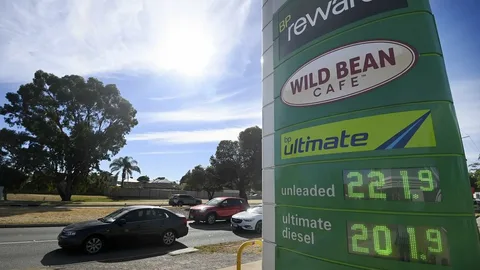

Australia imports around 90% of its petrol, diesel, and jet fuel. When global supply chains break down, Australians feel it fast and that is exactly what has happened in 2026.
The crisis intensified in March when Iran effectively closed the Strait of Hormuz, choking off roughly one-fifth of global seaborne oil trade and exposing Australia’s heavy reliance on imported refined fuels primarily from Asian refineries in Singapore, South Korea, and Malaysia, which depend on Middle Eastern crude.
The result has been a dramatic spike in petrol and diesel prices in Australia, fuel station outages in regional areas, and mounting pressure on the federal government to act.
Australia Diesel Prices: Record-Breaking Numbers
The Australia diesel prices record high is no longer a forecast it is a reality hitting truckers, farmers, and families right now.
According to the ACCC’s weekly fuel price monitoring, daily average retail diesel prices across Australia’s five largest cities reached 303.5 cents per litre on March 25 an increase of 27.8 cents per litre, or 10 per cent, in a single week.
In Sydney, the average diesel price climbed to 309 cents per litre, while regular unleaded petrol sat at 225 cents per litre even after the fuel excise was halved
The surge represents petrol up 31.8 percent and diesel up 40.1 percent since late February ranking among the sharpest fuel price increases in the developed world.
Petrol and Diesel Price in Australia Today: What You Are Paying
The petrol and diesel price in Australia today remains well above historical averages, despite some relief from government measures.
National average regular unleaded petrol prices hit a record $2.38 per litre in late March before easing slightly in early April following a government excise cut.
National average petrol prices for the week ending March 29 reached $2.53 per litre, up from $2.38 the previous week, while diesel prices averaged $3.10 per litre up from $2.82 the week before.
In USD terms, Australia gas prices in USD translate to approximately $1.60 to $1.95 per litre for petrol and up to $1.97 per litre for diesel at peak levels well above US pump prices but still below several European nations.
Data from GlobalPetrolPrices put Australia 61st out of the top 100 countries for gasoline price per litre, with the average price per litre at $2.07 in March 2026 noting that the US had dramatically low fuel costs at around $US1.06 per litre.
Government Response: Excise Cut and Emergency Reserves
The Australia fuel crisis impact has forced the federal government into urgent action on multiple fronts.
The federal government announced it would halve the fuel excise on petrol from 52.6 cents per litre to 26.3 cents per litre for three months from April 1, 2026 lowering the cost of filling a 55-litre tank by around $14.47.
Some states, including Victoria and Tasmania, also offered free public transport for limited periods to encourage people to drive less during the high-price period.
Prime Minister Anthony Albanese’s government also released strategic reserves, underwrote expensive spot-market shipments, and struck bilateral supply deals with Singapore. Energy Minister Chris Bowen confirmed that more than 50 fuel-laden ships are en route to Australian ports, with arrivals expected to improve supplies well into May.
Jet Fuel Shortage: Airlines and Easter Travellers Hit Hard
The jet fuel shortage has added another layer of pain to the Australia fuel crisis impact, hitting the aviation sector at its busiest holiday period.
Along with petrol, jet fuel costs spiked sharply, leading to higher airfares, with Australians planning to fly for Easter facing increased airfare prices especially on domestic flights.
Australia’s strategic fuel reserves held 39 days’ worth of petrol, 29 days of diesel, and 30 days of jet fuel with diesel under the most pressure as it is critical for freight, farming, and logistics.
Though jet fuel stocks at 30 days held steady, airports and airlines continued to monitor developments closely given the sector’s dependence on reliable and affordable fuel supplies.
Easter in Australia 2026: Bilbies, Travel, and Tough Choices
Despite the fuel crisis, Easter in Australia 2026 was marked by its unique customs and a resilient community spirit. Easter Sunday fell on April 5, 2026.
One of Australia’s most beloved Easter traditions is the Easter Bilby a native marsupial promoted as an alternative to the Easter Bunny, to raise awareness of wildlife conservation. In Australia, proceeds from the sale of chocolate Easter Bilbies support efforts to protect this endangered species.
Rabbits are seen as pests in Australia, causing damage to crops and natural habitats. This led to a push for a native Easter Australia animal the bilby which became a symbol of conservation and a uniquely Australian twist on the holiday.
The Sydney Royal Easter Show, running from April 2 to April 13, featured the Wildlife Australia Show offering up-close encounters with native fauna including snakes, crocodiles, possums, lizards, and frogs.
However, the Australia fuel crisis impact cast a shadow over Easter travel. The Australian government issued a formal call for citizens to proceed with their Easter travel plans despite growing logistical pressures on the national fuel supply, with Energy Minister Chris Bowen encouraging the public to visit relatives and take planned breaks.
Expert Quotes
Compare the Market spokesperson Chris Ford warned: “In an extreme event, a 30 per cent increase in fuel prices from where they are currently could push the price of unleaded 91 past $2.50 a litre in some regions.”
According to analysts at The Conversation, if Australia’s fuel supply slows and the government declares an emergency, priority must be given to critical services such as essential works, the defence force, and national security over public distribution.
Energy Minister Chris Bowen confirmed that six oil shipments bound for Australia in April were turned back or deferred due to escalating tensions, and acknowledged fears that key Asian suppliers like Malaysia and South Korea may prioritize domestic needs over exports.
Australia Fuel Crisis Impact: Who Suffers Most?
The Australia fuel crisis impact stretches far beyond the petrol station.
The fuel crunch has hit hardest in regional Australia, where farmers facing harvest and planting seasons reported diesel shortages complicating operations, with some contemplating reduced cropping amid prices that climbed dramatically.
Higher diesel costs also flow directly into grocery prices, freight charges, and everyday goods meaning even Australians who do not own a car are feeling the pinch. The Australia fuel crisis impact is fundamentally an economic crisis touching every household.
Australia’s emergency strategic fuel reserve is classified as “non-compliant” with IEA standards and has been since 2012 meaning the country’s buffer against exactly this kind of shock is smaller than international benchmarks require.
Conclusion: What Comes Next for Australia Petrol Prices?
Hundreds of service stations remain short on diesel or petrol as of April 11, 2026, with experts warning that significant relief could take weeks or longer to reach Australian bowsers even as the fragile US-Iran ceasefire has begun easing some international price pressures.
Officials express cautious confidence that the worst shortages can be avoided. Yet the fragility of global supply chains means any renewed disruption in the Strait of Hormuz could quickly revive pressures on petrol and diesel prices in Australia.The 2026 Australia fuel crisis has exposed deep structural vulnerabilities in refining capacity, strategic reserves, and import dependency. Whether policymakers act decisively to address these long-term issues will determine how resilient Australia is the next time a global shock hits.
FAQs
Does Australia get fuel from Iran?
Australia does not import oil directly from Iran in significant volumes. However, Australia relies heavily on Asian refineries in Singapore, South Korea, and Malaysia which process crude oil from the Middle East, including the Persian Gulf region. When the Strait of Hormuz is disrupted, the entire supply chain that feeds those refineries is affected, which in turn impacts Australia’s petrol and diesel prices.
How much is a litre of diesel in Australia?
As of late March to early April 2026, diesel prices in Australia’s major cities have reached record highs. The ACCC reported average retail diesel prices of 303.5 cents per litre across Australia’s five largest cities on March 25, 2026.In Sydney specifically, diesel has been reported at around 309 cents per litre even after the federal government halved the fuel excise from April.
What will Australia do if we run out of fuel?
If Australia’s fuel supply runs critically low and the government declares an energy emergency, priority must be given to critical services such as essential works, the defence force, and national security over public distribution.The government has also been releasing strategic reserves, securing emergency spot-market shipments, and negotiating bilateral supply deals with nations like Singapore to prevent a worst-case scenario.