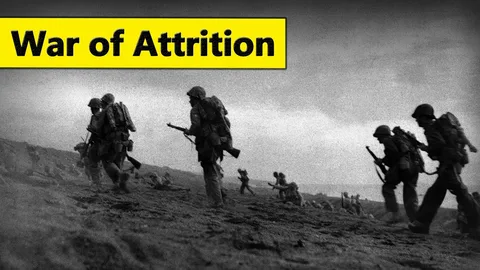
The US-Israel war on Iran has entered what military strategists are calling a war of attrition — a grinding, prolonged conflict in which neither side can deliver a decisive knockout blow and both absorb mounting losses in pursuit of strategic exhaustion of the enemy. The war of attrition dynamic that has emerged in the Iran conflict echoes some of history’s most studied conflicts, from the war of attrition civil war parallels of the American South to the original War of Attrition between Egypt and Israel from 1967 to 1970. Understanding what a war of attrition means — who wins, who loses, and how it ends — is now essential to understanding where the Iran conflict is headed.
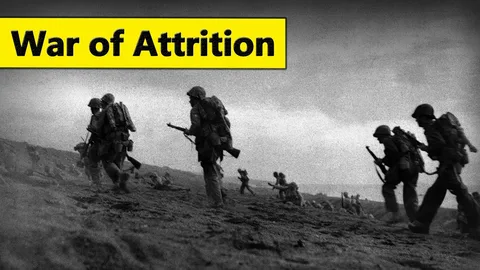
Background: What Is a War of Attrition?
A war of attrition is a military strategy in which one or both sides seek victory not through a single decisive battle but through the gradual wearing down of the enemy’s military capacity, economic resources, civilian morale, and political will to continue fighting.
In a war of attrition, the goal is not to win any individual engagement — it is to make the cost of continuing the war greater than the enemy is willing or able to bear. Victory in a war of attrition goes not necessarily to the strongest or most technologically advanced side, but to the side with the greatest reserves of manpower, economic endurance, domestic political support, and psychological resilience.
The concept of war of attrition has deep roots in military history. The term entered modern strategic vocabulary most prominently through the experiences of World War One — where the Western Front became the defining war of attrition of the industrial age, consuming millions of lives in a conflict where territorial gains were measured in metres and strategic advantage was pursued through the exhaustion of entire nations.
War of Attrition Civil War — The American Precedent
The war of attrition civil war experience of the American South between 1861 and 1865 provides one of history’s most instructive examples of how a war of attrition unfolds and who ultimately prevails.
The Confederate strategy in the American Civil War was fundamentally a war of attrition civil war approach — not to defeat the Union militarily in a single decisive campaign but to make the cost of fighting high enough that Northern political will would collapse and the Union would negotiate Confederate independence. Confederate General Robert E. Lee understood that the South could not match the Union’s industrial output, population base, or economic resources in a prolonged war of attrition civil war scenario.
The war of attrition civil war strategy almost worked. Northern public opinion wavered significantly in 1862 and 1864, and Lincoln himself feared he would lose the 1864 presidential election to a peace candidate. But the Union’s industrial and demographic advantages ultimately proved decisive — General Ulysses S. Grant adopted a counter-war of attrition civil war strategy of relentless pressure across all fronts simultaneously, grinding down Confederate resources faster than they could be replaced.
The war of attrition civil war lesson — that superior industrial and demographic resources ultimately prevail in a prolonged grinding conflict — remains one of the most important principles in modern strategic thinking.
Who Won the War of Attrition — The Egypt-Israel Conflict 1967-1970
The question of who won the War of Attrition refers most specifically to the conflict between Egypt and Israel that ran from March 1967 to August 1970 along the Suez Canal — a conflict that erupted in the aftermath of Israel’s decisive victory in the Six-Day War of June 1967.
Who won the War of Attrition between Egypt and Israel is a question that military historians continue to debate. Egypt under President Gamal Abdel Nasser launched the War of Attrition to erode Israel’s military capacity and force a diplomatic settlement that would recover the Sinai Peninsula lost in 1967. Israel responded with a strategy of deep strikes into Egyptian territory, including bombing raids on targets near Cairo.
Who won the War of Attrition in military terms is genuinely contested. Israel inflicted far heavier casualties on Egypt than it suffered in return. But who won the War of Attrition in strategic terms is a different question — Egypt succeeded in forcing the United States to pressure Israel into a ceasefire, demonstrating that a smaller, weaker power could use a war of attrition to achieve political objectives even without winning militarily.
The War of Attrition ended in August 1970 with a US-brokered ceasefire that largely preserved the pre-war status quo — leaving the question of who won the War of Attrition without a clean answer. Egypt had not recovered the Sinai. Israel had not eliminated the threat. Both sides had been exhausted. The War of Attrition ended not in victory but in mutual depletion — which is, in many ways, the defining characteristic of how wars of attrition conclude.
Details: The Iran Conflict as a War of Attrition
War of Attrition — How the Iran Conflict Fits the Pattern
The US-Israel war on Iran has displayed the hallmarks of a war of attrition from its earliest days.
The United States and Israel began the conflict with overwhelming technological superiority — precision guided munitions, advanced air defence systems, cyber warfare capabilities, and the world’s most sophisticated intelligence apparatus. CENTCOM struck more than 3,000 targets in Iran in the first ten days, destroyed 43 Iranian warships, and killed Supreme Leader Ali Khamenei in the opening hours.
But Iran has not collapsed. The Islamic Revolutionary Guard Corps continues to launch missiles and drones at US bases and Gulf state infrastructure. The Strait of Hormuz remains effectively closed. A new Supreme Leader has been named. Iranian ballistic missiles continue to reach their targets despite US and Israeli air defence efforts.
This is the essential dynamic of a war of attrition — the stronger side cannot translate its tactical superiority into strategic victory because the weaker side has chosen to absorb punishment rather than surrender, betting that time and cost will eventually erode the stronger side’s political will to continue.
War of Attrition — Iran’s Strategy
Iran’s war of attrition strategy has several interconnected elements. First, absorb the initial US-Israeli strikes and preserve as much military capability as possible. Second, impose economic costs on the US and its allies through oil market disruption — with Brent crude surging past $100 a barrel and US gasoline prices jumping 50 cents a week. Third, drag the conflict out long enough for domestic US political opinion to turn against the war — with CNN polls already showing 60 percent of Americans opposing military action in Iran. Fourth, use proxy forces in Lebanon, Iraq, Yemen, and the Gulf to multiply pressure points across a wide geographic area, stretching US and Israeli military resources.
This is a textbook war of attrition approach — not seeking to defeat the enemy in battle but to make the war so costly, so prolonged, and so politically damaging that the stronger side chooses to negotiate rather than continue.
War of Attrition — The US-Israel Counter-Strategy
The US-Israel counter-strategy against Iran’s war of attrition has focused on accelerating the pace of military operations to collapse Iranian military capacity before the war of attrition dynamic can take hold.
Trump’s demand for unconditional surrender, the approval of a $151 million arms sale to Israel, and the reported deployment of a third aircraft carrier to the Middle East all reflect an understanding that allowing the Iran conflict to settle into a prolonged war of attrition would be strategically damaging for Washington.
Energy Secretary Chris Wright’s assurance that Strait of Hormuz traffic would resume once Iran’s ability to threaten tankers was destroyed reflects the same urgency — the economic war of attrition being conducted through oil market disruption is the element of Iran’s strategy most immediately threatening to US domestic political stability.
War of Attrition Dying Fetus — Cultural Reference Explained
The term war of attrition has also entered popular culture through music. War of Attrition Dying Fetus refers to the 2007 studio album released by American death metal band Dying Fetus — one of the most critically acclaimed and commercially successful albums in the extreme metal genre.
War of Attrition Dying Fetus was released on Relapse Records and features the band’s characteristic blend of brutal death metal, grindcore, and politically charged lyrical content. War of Attrition Dying Fetus was widely praised by metal critics for its technical proficiency and the ferocity of its musical attack — earning the band their first significant mainstream metal press coverage.
War of Attrition Dying Fetus as an album title draws directly on the military and political concept of war of attrition, using the language of grinding military conflict as a metaphor for the band’s musical philosophy and lyrical themes of systemic violence, political corruption, and institutional brutality. War of Attrition Dying Fetus remains one of the most referenced album titles in discussions of politically engaged extreme metal and continues to attract new listeners who discover the album through its thematic connection to real-world conflict analysis.
Quotes on War of Attrition
Military historian John Keegan described the war of attrition as the most morally demanding form of warfare — one that tests not the courage of individual soldiers but the endurance of entire societies, adding that history shows that wars of attrition are rarely won by the militarily stronger side if the weaker side is willing to absorb sufficient punishment.
Former NATO commander General David Petraeus warned in analysis of the Iran conflict that the US faces a genuine war of attrition risk if the campaign does not achieve decisive results within weeks, noting that American domestic political tolerance for prolonged military engagement has shortened dramatically since the Iraq and Afghanistan experiences.
Iranian Supreme Leader Mojtaba Khamenei — in one of his first public statements after being named to replace his assassinated father — invoked the war of attrition tradition explicitly, saying Iran had defeated stronger enemies before through patience, sacrifice, and the willingness to absorb punishment that would break lesser nations.
A senior US military analyst told NPR that the Iran conflict has all the structural characteristics of a war of attrition — a stronger power unable to force the rapid collapse of a weaker but deeply committed adversary — and that historical precedent suggests such conflicts either escalate dramatically or end through negotiation rather than outright military victory.
Political scientist Ivan Arreguín-Toft, whose research on asymmetric conflicts and who won the War of Attrition dynamics is widely cited in military strategy literature, noted that weaker sides in asymmetric conflicts win approximately 30 percent of the time when they adopt indirect strategies like war of attrition — a far higher rate than conventional military analysis would predict.
Impact: What a War of Attrition Means for the Iran Conflict and the World
War of Attrition — Economic Impact
The economic impact of the Iran war of attrition is already being felt globally. Oil prices above $100 a barrel, a near-complete Strait of Hormuz shutdown, and the suspension of 140 million barrels of oil supply have delivered the kind of economic shock that a war of attrition is designed to produce — spreading the pain of conflict far beyond the immediate battlefield.
Every week the war of attrition continues is another week of elevated US gasoline prices, disrupted global supply chains, and mounting inflationary pressure that Goldman Sachs has warned could push US inflation back to 3 percent. The economic war of attrition is the dimension of the Iran conflict most likely to determine the ultimate political outcome — not the military exchange of missiles and airstrikes.
War of Attrition — Political Impact
The political war of attrition dynamic is already visible in US domestic polling. A CNN poll showing 60 percent of Americans opposing military action in Iran and a Fox News poll showing 61 percent disapproving of Trump’s economic management represent early indicators of the political erosion that a prolonged war of attrition civil war analysis would predict.
If the Iran conflict settles into a genuine war of attrition lasting months rather than weeks, the political costs for the Trump administration will compound with each passing week of elevated gas prices, military casualties, and inconclusive military results. The war of attrition civil war lesson — that domestic political will is the ultimate battlefield — applies as much to Washington in 2026 as it did to Lincoln’s Washington in 1864.
War of Attrition — Regional Impact
For the Middle East, a prolonged war of attrition between the US-Israel alliance and Iran threatens to destabilise every state in the region regardless of their formal alignment in the conflict. Gulf states absorbing Iranian missiles and drones, Lebanon’s already shattered economy facing further destruction, Iraq caught between US military operations and Iranian-backed militia attacks — all are suffering the regional spillover of a war of attrition whose principal combatants are far larger than any of them.
The who won the War of Attrition question that historians debate about the 1967-1970 Egypt-Israel conflict may be equally difficult to answer about the 2026 Iran conflict — because in a true war of attrition, victory and defeat are rarely clean, rarely final, and rarely proportional to the suffering endured by all sides to achieve them.
Conclusion
The war of attrition dynamic now defining the US-Israel-Iran conflict is one of history’s most studied and most feared strategic scenarios — a grinding contest of endurance in which the ultimate prize goes not to the strongest but to the most patient. The war of attrition civil war experience of the American South, the contested outcome of who won the War of Attrition between Egypt and Israel, and the cultural resonance of War of Attrition Dying Fetus as an artistic response to systemic conflict all point to the same uncomfortable truth — wars of attrition do not end quickly, do not end cleanly, and do not end well for anyone. The Iran conflict is ten days old. If it becomes a true war of attrition, the world may be counting its costs for years.