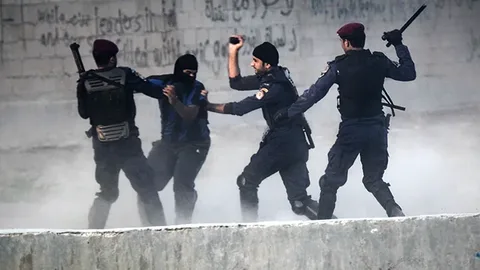
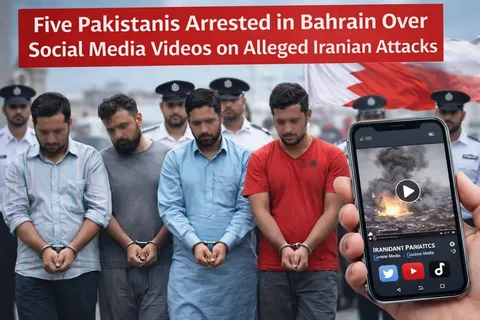
Bahrain authorities have arrested six Asian nationals — including five Pakistanis — for allegedly filming and sharing videos of Iranian missile and drone attacks on the Kingdom of Bahrain. The Bahrain authorities confirmed the arrests as the country remains under active Bahrain attack threat from Iranian strikes targeting military and civilian infrastructure. The arrests reflect the increasingly strict information control measures being enforced across Gulf states during the Iran war, with Bahrain immigration officials also tightening entry and movement procedures under Bahrain force majeure provisions activated since the conflict began.
Background: Why Bahrain Authorities Are Cracking Down on Video Sharing
Bahrain authorities have been operating under emergency security protocols since the first Iranian missiles struck the Kingdom on February 28, 2026 — the opening day of the US-Israel war on Iran.
The Bahrain attack from Iran has been sustained and significant. Bahrain authorities confirmed that since the start of the conflict, Iranian forces have launched 73 missiles and 91 drones at the Kingdom — targeting not only the US Fifth Fleet headquarters at Naval Support Activity Bahrain but also civilian and commercial infrastructure including the country’s main oil refinery at Bapco Energies on the island of Sitra.
Bahrain, as the smallest and most densely populated GCC state, has been placed under comprehensive emergency measures by Bahrain authorities. These measures include Bahrain force majeure declarations that suspend normal commercial and civil obligations, strict Bahrain immigration controls limiting movement in and out of the Kingdom, and now — as the latest arrests demonstrate — active enforcement against the unauthorised filming and distribution of footage related to the Bahrain attack.
Bahrain authorities view the circulation of such footage as a potential national security risk — capable of revealing the locations of military assets, exposing gaps in air defence coverage, spreading panic among the civilian population, and providing intelligence value to hostile actors including Iran’s IRGC.
Details: The Arrests — What Bahrain Authorities Have Said
Bahrain Authorities — Who Was Arrested
Bahrain authorities confirmed the arrest of six Asian nationals in connection with the alleged filming and sharing of videos related to the ongoing Bahrain attack by Iranian forces. Five of the six individuals arrested are Pakistani nationals. The sixth is from another Asian country, which Bahrain authorities have not formally identified in their public statement.
Bahrain authorities have not released the names of the arrested individuals, consistent with the Kingdom’s standard practice in security-related arrests. The nationalities confirm that the detained individuals are expatriate workers — a demographic that makes up the overwhelming majority of Bahrain’s population, with South Asian nationals including Pakistanis, Indians, and Bangladeshis forming the largest expatriate communities in the Kingdom.
Bahrain authorities stated that the individuals allegedly filmed footage of Iranian missiles and drones during active Bahrain attack incidents and subsequently shared that footage through social media platforms and messaging applications.
Bahrain Authorities — The Legal Basis for Arrest
Bahrain authorities are empowered to make such arrests under a combination of Bahrain’s cybercrime laws, emergency security legislation, and the Bahrain force majeure provisions activated at the start of the Iran war.
Bahrain force majeure declarations give Bahrain authorities expanded powers to restrict civilian activity, control information flows, and detain individuals whose actions are deemed to pose a risk to national security during the emergency period. The Bahrain force majeure framework explicitly covers the dissemination of information that could endanger military operations or public order.
Bahrain immigration authorities have also been granted expanded powers under the Bahrain force majeure measures, including the ability to detain foreign nationals pending investigation and to initiate deportation proceedings for expatriates found to have violated emergency security regulations.
Bahrain authorities warned at the time of the arrests that any individual — regardless of nationality or residency status — found filming, photographing, or sharing footage of Bahrain attack incidents without authorisation would face immediate arrest, investigation, and potential deportation under Bahrain immigration enforcement powers.
Bahrain Authorities — The Broader Crackdown Across the Gulf
The arrests by Bahrain authorities are not an isolated incident. Similar enforcement actions have been reported across multiple Gulf Cooperation Council states since the Iran war began.
UAE authorities have issued public warnings against the unauthorised filming of Bahrain attack-style incidents, with social media posts showing missile interceptions or drone strikes subject to removal and potential legal action. Saudi Arabia and Kuwait have issued comparable guidance to their expatriate populations.
Bahrain authorities have been among the most active in publicly confirming arrests — a deliberate signal to the Kingdom’s large expatriate workforce that information control during the Bahrain attack emergency is being treated as a serious national security matter, not a minor administrative concern.
Quotes on Bahrain Authorities Arrests
Bahrain authorities stated in their official announcement that the arrested individuals had violated laws governing the filming and distribution of content related to ongoing security operations, adding that such actions posed a direct threat to national security and public order during the active Bahrain attack emergency.
Bahrain authorities warned all residents of the Kingdom — citizens and expatriates alike — that the Bahrain force majeure provisions currently in force give security services the full authority to act swiftly against anyone found to be compromising operational security through the unauthorised sharing of footage related to the Bahrain attack.
Legal analysts familiar with Bahrain immigration law noted that foreign nationals arrested under Bahrain force majeure emergency provisions face a dual risk — criminal prosecution under Bahraini law and administrative deportation under Bahrain immigration regulations — meaning the five Pakistani nationals and their fellow detainee could face both a criminal process and permanent expulsion from the Kingdom.
Pakistani community representatives in Bahrain urged their fellow nationals to strictly comply with all Bahrain authorities directives during the emergency period, reminding the community that Bahrain immigration status for expatriate workers is tied to their continued compliance with Bahraini law and that any arrest carries the risk of visa cancellation and deportation.
Impact: What the Arrests Mean for Expatriates and the Region
Impact on Pakistani Community in Bahrain
The arrest of five Pakistani nationals by Bahrain authorities has sent a sharp warning through Bahrain’s large Pakistani expatriate community — estimated at over 100,000 people, making Pakistanis one of the largest national groups in the Kingdom’s workforce.
For Pakistani workers in Bahrain, the arrests underscore the legal jeopardy that comes with sharing footage of the Bahrain attack on social media — even casually or without any intent to harm. Many expatriate workers have been filming and sharing footage of missile interceptions and drone strikes out of a mixture of fear, curiosity, and a desire to inform family members back home about conditions on the ground.
Bahrain immigration authorities have made clear through these arrests that such activity — regardless of motivation — constitutes a violation of Bahrain force majeure emergency regulations. Pakistani workers are now being warned through community networks and official Pakistani embassy channels to delete any footage of the Bahrain attack from their devices and to refrain entirely from filming any future incidents.
The Pakistan Embassy in Manama has not yet issued a formal statement on the arrests by Bahrain authorities, though diplomatic sources indicate consular officials are seeking access to the detained Pakistani nationals to verify their welfare and legal status under Bahrain immigration procedures.
Impact on Information Control During the Iran War
The Bahrain authorities arrests reflect a wider regional pattern of aggressive information control that has characterised Gulf state responses to the Iran war from the opening days of the conflict.
Bahrain attack footage has circulated widely on social media platforms including X, TikTok, WhatsApp, and Telegram — giving global audiences real-time visual evidence of missile interceptions, explosions, and infrastructure damage. Bahrain authorities and their counterparts across the GCC view this uncontrolled information environment as a direct security threat during active hostilities.
The Bahrain force majeure framework gives Bahrain authorities the legal tools to act against this footage — but enforcement against social media sharing by millions of residents is practically impossible at scale. The high-profile arrests of the six Asian nationals appear designed to send a deterrent message to the broader expatriate population rather than to comprehensively suppress all Bahrain attack footage.
Bahrain Immigration — Implications for Expatriate Workers Regionwide
The Bahrain immigration dimension of this case has implications that extend well beyond Bahrain’s borders. Across the Gulf, an estimated 35 million expatriate workers from South Asia, Southeast Asia, and Africa depend on their host country residency and employment visas for their livelihoods.
Bahrain immigration authorities — like their counterparts in the UAE, Saudi Arabia, Qatar, and Kuwait — have emergency powers under Bahrain force majeure provisions to cancel visas and initiate deportation without the procedural protections that would apply in normal circumstances. This makes the current period extraordinarily legally precarious for expatriate workers across the Gulf.
The Bahrain authorities arrests serve as a reminder that during the Iran war emergency, the normal assumptions about freedom of expression and social media use that expatriate workers may have developed during peacetime do not apply — and that Bahrain immigration enforcement during Bahrain force majeure periods operates at an accelerated pace with reduced legal recourse for detained foreign nationals.
Conclusion
The Bahrain authorities arrests of six Asian nationals — including five Pakistanis — for allegedly filming and sharing Bahrain attack footage mark a significant escalation in Gulf state information control measures during the Iran war. The combination of Bahrain force majeure emergency powers, active Bahrain immigration enforcement, and public warnings from Bahrain authorities has created a new legal reality for the Kingdom’s large expatriate workforce. Pakistani nationals and other South Asian workers across the Gulf are being urged to exercise extreme caution with social media activity during the ongoing emergency period. As the Bahrain attack threat from Iran continues and Bahrain authorities maintain their heightened security posture, the legal risks for expatriates who film or share conflict-related footage will remain severe — and the consequences swift.