The Generous Heart of a River
By Muhammad Mohsin Iqbal
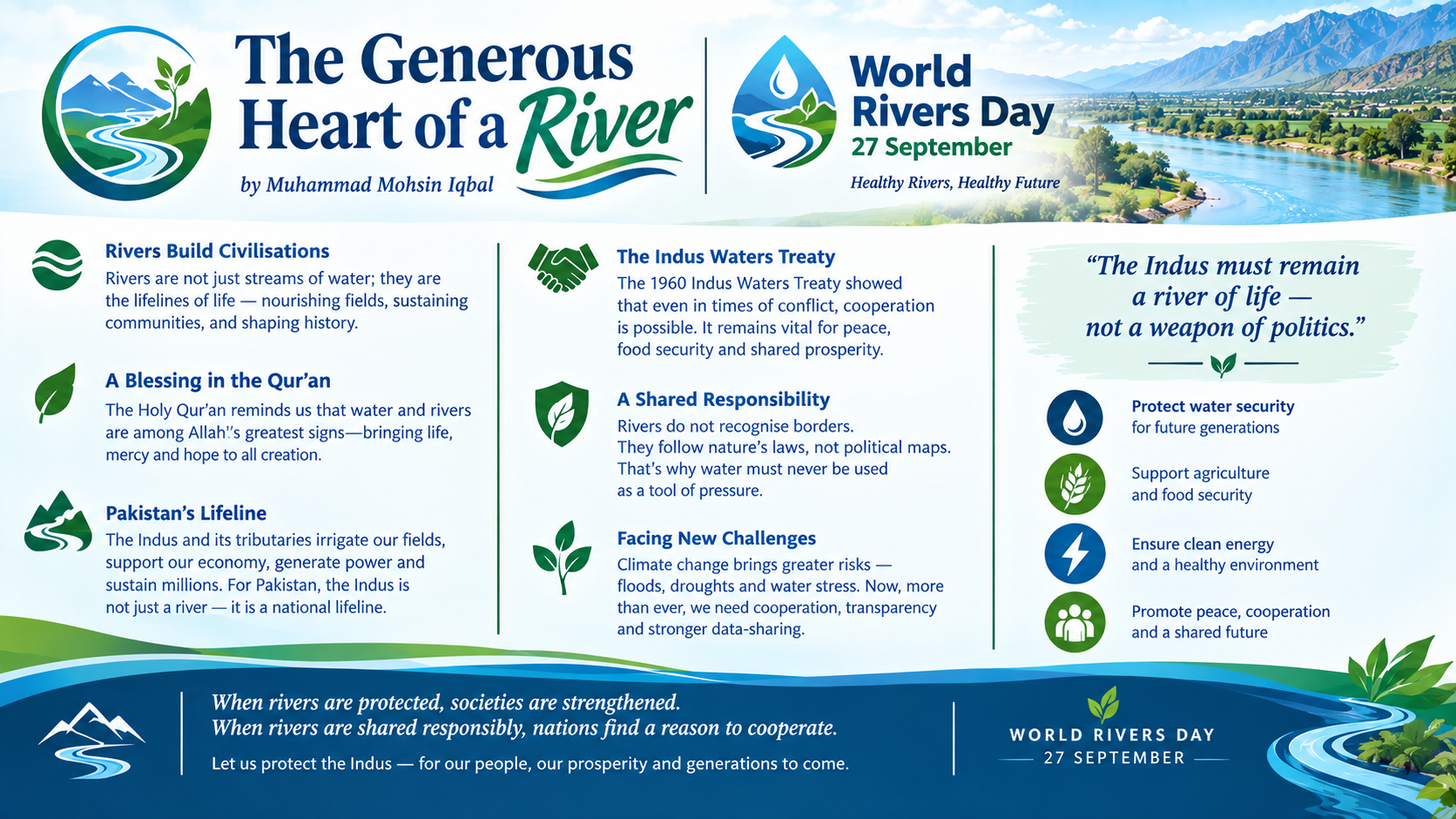
Today, 27 September, the world observes World Rivers Day—a day devoted to reminding humanity of something so familiar that we often forget its true worth: the river. Why was there a need to dedicate a day to rivers? Because rivers are not merely streams of flowing water. They are the arteries of civilisation, the silent witnesses of history, the nourishment of fields, the source of energy, and, in the deepest sense, reflections of life itself.
The Holy Qur’an repeatedly draws our attention to water and to the rivers that flow beneath gardens and through the landscapes of creation. Water is presented not merely as a material necessity but as one of the signs of Allah’s mercy and creative power. The Qur’an asks mankind to contemplate the rain, the earth brought back to life, and the rivers that sustain creation. Indeed, the very story of human civilisation is inseparable from rivers. Great societies arose beside them, cultivated their lands through them, and built their prosperity around their waters.
Pakistan, too, is a blessed land of rivers. The mighty Indus and its tributaries—the Jhelum, Chenab, Ravi, Sutlej and others—have shaped our geography, economy and civilisation. They irrigate our fields, sustain our farmers, support our livestock, feed our cities, generate hydropower and preserve ecosystems upon which millions depend. For Pakistan, the Indus is not simply a river. It is a national lifeline.
That is why World Rivers Day acquires an especially profound meaning for us this year. A river does not recognise political boundaries. It does not carry a passport, stop at a border post or ask whether the land through which it flows belongs to one nation or another. Its waters follow the laws of nature established by the Creator. Human beings may draw boundaries upon maps, but they cannot redraw the natural geography of a river basin without consequences.
The Indus Waters Treaty of 1960 was born from precisely this understanding. After years of difficult negotiations facilitated by the World Bank, India and Pakistan agreed upon a framework for sharing the waters of the Indus system. The Treaty allocated the Eastern Rivers—Ravi, Beas and Sutlej—to India and the Western Rivers—Indus, Jhelum and Chenab—to Pakistan, while also establishing mechanisms for cooperation, information exchange and the settlement of differences and disputes.
For more than six decades, this arrangement endured wars, crises and periods of extraordinary hostility between the two countries. Its survival demonstrated an important truth: even adversaries can recognise that certain necessities of life must remain above political confrontation.
Yet that principle came under grave strain in April 2025, when India announced that it would hold the Indus Waters Treaty in abeyance. Pakistan rejected that position, maintaining that the Treaty contains no provision permitting unilateral suspension. Pakistan has continued to assert that the Treaty remains legally binding and that its established mechanisms should govern water-related differences.
Whatever the competing political arguments between the two states, one principle should remain beyond dispute: water must never become an instrument through which the lives and livelihoods of millions are placed at the mercy of political calculations.
For Pakistan, uncertainty over the Indus waters is not an abstract diplomatic question. It touches the farmer waiting for irrigation water, the family dependent upon affordable food, the worker whose livelihood is linked to agriculture, the industries requiring reliable supplies, and the communities dependent upon hydropower and river ecosystems. The lower riparian cannot simply be expected to live with uncertainty whenever political relations deteriorate.
The danger becomes even more serious in an age of climate change. The Indus Basin is already exposed to floods, droughts, changing precipitation patterns, glacier-related risks and increasingly uncertain hydrological conditions. The World Bank has stressed that South Asia faces severe water-security pressures and that cooperation over transboundary rivers is critical to the region’s future.
In such circumstances, the answer should be more cooperation, not less; more information-sharing, not secrecy; stronger flood-warning systems, not political uncertainty; and greater respect for established mechanisms, not their abandonment.
The Indus Waters Treaty itself contains provisions for the exchange of data and established procedures for resolving questions, differences and disputes. These mechanisms exist for precisely the moments when trust is weakest. International agreements are not tested when relations are cordial; their real value is revealed when relations are strained.
World Rivers Day therefore carries a message far beyond environmental symbolism. It reminds us that rivers belong to a larger human story. They are older than our disputes and will, God willing, outlive our political quarrels. To poison them, exhaust them, obstruct their natural systems or turn them into instruments of coercion is ultimately to endanger ourselves.
The waters of the Indus have witnessed the rise and fall of empires, the birth of cities and the toil of generations. They have carried the prayers, hopes and harvests of millions. They should carry peace as well.
Pakistan has every right to protect its water security and to insist upon respect for its treaty-based rights. At the same time, the enduring answer to a shared river cannot be permanent confrontation. It must be responsible upstream conduct, protection of downstream interests, transparent data-sharing, scientific cooperation and respect for established international commitments.
A river is generous by nature. It gives without asking who is rich or poor, powerful or weak. Perhaps humanity’s duty is to learn from that generosity.
On World Rivers Day, therefore, let us remember: when rivers are protected, societies are strengthened; when rivers are shared responsibly, nations find a reason to cooperate; but when rivers are turned into instruments of pressure, uncertainty spreads from the riverbank into the fields, homes and future of entire peoples.
The Indus must remain a river of life—not a weapon of politics. Its waters should irrigate fields, generate power, sustain ecosystems and nourish generations yet unborn. For Pakistan, the protection of the Indus is not merely an environmental obligation. It is a question of agriculture, economy, food security, national resilience and human survival.
And perhaps that is the deepest message of World Rivers Day: water is life, rivers are civilisation, and responsible stewardship of shared waters is a duty owed not only to nations, but to humanity itself.