
Mojtaba Khamenei, the second son of Ayatollah Ali Khamenei, has been named Iran’s new Supreme Leader after his father was killed on the first day of the US-Israel war on Iran. The Assembly of Experts selected the 56-year-old to lead Iran through the biggest crisis in its 47-year history. A man who spent decades operating in the shadows of the Islamic Republic, Mojtaba Khamenei’s rise represents one of the most dramatic power transfers in modern Middle Eastern history.
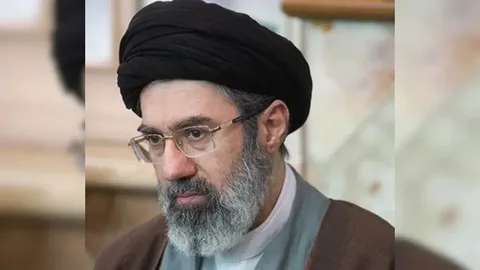
Background: Who Is Mojtaba Khamenei?
Mojtaba Khamenei was born on September 8, 1969 in Mashhad — the second child of Ali Khamenei and Mansoureh Khojasteh Bagherzadeh. His five siblings are Mostafa, his elder brother, Masoud and Meysam, his younger brothers, and Boshra and Hoda, his younger sisters.
When millions of Iranians poured into the streets in 1979 to end the rule of the former Shah, their revolution seemed to have ended the practice of passing power from father to son. Not so.
Mojtaba Khamenei continued his education in Tehran at the prestigious Alavi High School, which produced many of the Islamic Republic’s elite, including former foreign minister Javad Zarif. After graduating, he began religious studies in Tehran before moving to Qom for seminary education.
Prior to his selection, Mojtaba Khamenei occupied a role similar to that of Ahmad Khomeini — a combination of aide-de-camp, confidant, gatekeeper, and power broker. For years he was known simply as the power behind the robes, a man whose influence vastly exceeded his public visibility.
Details: The Making of Mojtaba Khamenei
Mojtaba Khamenei — Early Life: War, Seminary and the IRGC
In the mid-1980s, during the final years of the Iran-Iraq War, Mojtaba Khamenei — then a teenager of around seventeen — was sent to the front lines. He served in one of the most well-known IRGC units, the Habib ibn Mazaher Battalion of the 27th Mohammad Rasulullah Division. Among those associated with the broader formation were commanders such as Qasem Soleimani, Hossein Hamedani, and Ahmad Kazemi.
Although Mojtaba Khamenei’s time at the front was relatively brief, analysts believe the experience and the relationships formed with fellow IRGC fighters played a significant role in shaping his later connections within the security establishment.
In 1989, after the death of Ayatollah Ruhollah Khomeini, Ali Khamenei was appointed Supreme Leader. That same year, Mojtaba Khamenei began his formal clerical studies in Tehran, studying under his father as well as Mahmoud Hashemi Shahroudi, who later served as Iran’s chief justice. He taught dars-e kharej — the highest level of seminary instruction — for more than 15 years and reached the clerical rank of Ayatollah in 2022.
Mojtaba Khamenei Hardline: The Man Behind the Crackdowns
Mojtaba Khamenei hardline credentials are well documented. He is expected to be more hardline than his father, with close ties to some of the most ideologically extremist clerics who led the regime’s most violent crackdowns.
Mojtaba Khamenei hardline influence allegedly engineered the 2005 election that installed Mahmoud Ahmadinejad as president. In the 2009 election, he reportedly personally supervised how the IRGC crushed protesters who flooded the streets to dispute Ahmadinejad’s victory. For nearly two decades, local and foreign-based opponents have linked the Mojtaba Khamenei hardline network to the violent suppression of Iranian protesters.
In 2023, leaked IRGC reports revealed that Mojtaba Khamenei effectively controlled the Basij and exercised significant influence over personnel assignments in their Intelligence and Intelligence Protection Organizations.
Several American analysts have described Mojtaba Khamenei as a supporter of Iran obtaining nuclear weapons, in opposition to his father’s fatwa against them. According to The Washington Institute for Near East Policy, Mojtaba Khamenei may decide Iran must move quickly to obtain nuclear weapons to forestall future US and Israeli attacks.
Mojtaba Khamenei Wife: Zahra Haddad-Adel
Mojtaba Khamenei wife Zahra Haddad-Adel was the daughter of former parliamentary speaker Gholam-Ali Haddad-Adel. The marriage was a deeply strategic union, linking two of Iran’s most influential conservative families.
Despite her prominent family background, Mojtaba Khamenei wife Zahra kept a low public profile. Iranian media rarely reported on her activities and little information about her personal life was ever made public.
Mojtaba Khamenei wife Zahra and one of their children were killed in the February 28 attack on Ali Khamenei’s residence. Her death alongside that of her father-in-law and mother-in-law turned the Khamenei family into martyrs in the eyes of Iran’s hardline establishment — and almost certainly smoothed the path for Mojtaba Khamenei’s appointment despite years of internal resistance to dynastic succession.
Mojtaba Khamenei Children
Mojtaba Khamenei children include three known offspring. The couple married in 1999 and their first child was born in 2007. Mojtaba Khamenei children are Mohamed Amin, daughter Fatemeh Sadaat, and Mohamed Bagher. According to the Iranian government, one of the Mojtaba Khamenei children — a son — was killed alongside his mother in the February 28 US-Israeli strikes.
The Mojtaba Khamenei children have largely stayed away from public attention due to the family’s security and privacy concerns. Very little information about their education or personal lives is publicly available. Mojtaba Khamenei begins his Supreme Leadership as a widower and a grieving father — personal losses that hardliners within Iran have already weaponised to frame his rise as divine will.
Mojtaba Khamenei — The Financial Empire
Mojtaba Khamenei has amassed an economic empire involving assets in multiple countries, according to reports in Western media. His name is not believed to appear directly in any alleged transactions, but he has reportedly moved billions of dollars through a network of insiders and associates linked with the Iranian establishment.
Bloomberg tied Mojtaba Khamenei to Ali Ansari, an Iranian businessman sanctioned by the United Kingdom, as a central alleged facilitator in the network. Reports link his wealth to Swiss bank accounts and a British luxury property valued at over $138 million. The United States sanctioned Mojtaba Khamenei in 2019 during Trump’s first term over working to advance his father’s destabilising regional ambitions and oppressive domestic objectives.
Mojtaba Khamenei — How Was He Chosen?
The IRGC played a decisive role in securing Mojtaba Khamenei’s appointment. According to Iran International, starting early on March 3, IRGC commanders pressured Assembly of Experts members to vote for Mojtaba Khamenei through repeated contacts and psychological and political pressure. Members described the atmosphere of the online meeting as unnatural. Those who presented arguments against Mojtaba Khamenei were given limited time to speak, discussion was cut off, and a vote was held.
The IRGC pledged allegiance to Mojtaba Khamenei and said it was ready to fully obey his commands. Iran’s President Masoud Pezeshkian called the appointment a new era of dignity and strength for the nation.
Quotes on Mojtaba Khamenei
Trump said Mojtaba Khamenei would have to get approval from the US, adding that if he does not get that approval, he is not going to last long.
US Senator Lindsey Graham said Mojtaba Khamenei was not the change the world was looking for, adding that he believed it was just a matter of time before Mojtaba Khamenei meets the same fate as his father.
Russian President Vladimir Putin pledged unwavering support for Mojtaba Khamenei’s appointment. China said it opposed any targeting of the new Supreme Leader.
Iran state TV confirmed that Mojtaba Khamenei was wounded at some point during the conflict — a detail that underscores just how dangerous a position he now occupies.
Impact: What Mojtaba Khamenei’s Rise Means for the World
The Mojtaba Khamenei hardline background signals that the Iranian regime may become more repressive, not less. His selection indicates that hardline factions retain power and that the government has little desire to agree to a deal or enter negotiations in the short term as the war enters its second week.
Most critically, Mojtaba Khamenei has gained control not only of an Iranian military now at war but also a stockpile of highly enriched uranium that could be used to build a nuclear weapon — should he choose to decree it. The Mojtaba Khamenei hardline stance on nuclear weapons, which reportedly differs from his father’s fatwa against them, has alarmed Western governments and Israeli intelligence alike.
On the global stage, oil prices have surged, Gulf states have called emergency meetings, and US allies in the region are watching the Mojtaba Khamenei succession with deep unease.
Conclusion
Mojtaba Khamenei steps into the most consequential role in the Islamic Republic under the most dangerous conditions any Iranian leader has faced since 1979. A Mojtaba Khamenei hardline by ideology, a product of the IRGC by training, and now a martyr’s son by circumstance, Mojtaba Khamenei enters the Supreme Leadership with everything to prove — and, as Trump and Israel have made clear, everything to lose. Whether Mojtaba Khamenei moves toward nuclear escalation, diplomatic survival, or military defiance will define not just Iran’s future but the entire Middle East’s.