

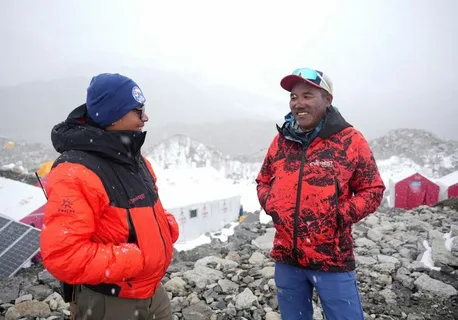

Nepali guide Kami Rita Sherpa has climbed Mount Everest more times than anyone in history, reaching the summit for a record 32nd time in May 2026. His achievement, alongside Lhakpa Sherpa’s own women’s record on the same mountain, has renewed global interest in who holds the biggest Everest summit records today.
Background
Kami Rita Sherpa, known worldwide as the “Everest Man,” first stood on top of the world’s highest peak in 1994 while working for a commercial expedition. Since then, he has returned to the summit almost every climbing season, sometimes twice in a single year, steadily building a record that no other climber has come close to matching.
Born in 1970 in Thame, a village in Nepal’s Solukhumbu region, Kami Rita grew up in the same community as Tenzing Norgay, one of the first two men to summit Everest in 1953. He began working in the mountains as a porter at just twelve years old, long before his name became synonymous with Everest itself.
His record has grown steadily over three decades, moving from 22 summits in 2018 to 30 in 2024, and now 32 as of May 2026. No other climber, Sherpa or foreign, comes close to matching that number in the mountain’s recorded history.
Details
On May 17, 2026, Kami Rita reached the 8,849-metre summit at 10:12 a.m. local time, confirmed by Nepal’s Department of Tourism as his 32nd successful ascent. Just five days later, he returned to Kathmandu, where officials and well-wishers greeted him with flowers and traditional shawls at the airport.
On the same day as his record-breaking climb, fellow Nepali guide Lhakpa Sherpa completed her own 11th ascent of Everest, extending her record as the woman with the most Everest summits in history. Known as the “Mountain Queen,” Lhakpa first summited Everest in 2000, becoming the first Nepali woman to successfully climb and descend the mountain.
Other notable Everest records round out the picture beyond these two headline names. British guide Kenton Cool holds the record for most Everest summits by a non-Sherpa climber, with 19 ascents to his name. Ang Rita Sherpa, meanwhile, still holds the record for most Everest summits without supplemental oxygen, having reached the top 10 times between 1983 and 1996 entirely without bottled air.
Questions about Everest survival rates also come up often alongside these records. Yes, thousands of climbers have reached the summit and returned safely; more than 6,000 individual people have summited Everest successfully since 1953. But the mountain remains dangerous, particularly above 8,000 metres in what climbers call the “death zone,” where the air holds barely a third of the oxygen found at sea level.
Quotes
Himal Gautam, spokesperson for Nepal’s Tourism Department, called Kami Rita and Lhakpa’s twin achievements “another milestone in Nepal’s mountaineering history.” He added that healthy competition between record-holding climbers helps make the sport “safer, more dignified and better managed.”
Kami Rita himself has repeatedly downplayed the record-chasing aspect of his career. After an earlier ascent, he told reporters he was “just working” and did not set out to break records, adding that he takes more pride in the recognition his climbs bring to Nepal on the world stage.
Following his 32nd summit, Kami Rita also used his platform to raise concerns about overcrowding on the mountain, urging Nepali authorities to consider limits on the number of climbers allowed on Everest each season as demand for permits continues to grow.
Impact
The record-breaking climbs arrive at a moment when Everest is seeing unusually high traffic. With China closing the northern route through Tibet this season, nearly all climbers have shifted to the southern route through Nepal, pushing daily summit numbers to new highs, including 274 climbers reaching the top in a single day this May.
That surge has renewed debate over permit limits and safety on the mountain, a conversation Kami Rita’s own comments have helped push into the spotlight. Nepal’s tourism authorities depend heavily on Everest permit fees, which creates tension between growing revenue and managing overcrowding on a mountain where traffic jams near the summit have previously contributed to climber deaths.
For the broader mountaineering community, Kami Rita and Lhakpa’s records also serve as a reminder of how central Sherpa guides are to Everest’s success stories. Nearly every major summit record on the mountain, from Kami Rita’s overall record to Ang Rita’s oxygen-free milestone, belongs to Nepali climbers whose expertise makes commercial expeditions possible in the first place.
Conclusion
With permit numbers rising and climbing seasons showing no sign of slowing down, further records on Everest look likely in the coming years. Kami Rita has not confirmed whether he plans to attempt a 33rd summit, though his past pattern suggests he may return to the mountain again before long.
For climbers and readers following mountain summit success stories, this season’s climbs show clearly where the records currently stand, and how much of Everest’s history still belongs to the Sherpa guides who make the mountain accessible to everyone else.
Frequently Asked Questions
Who became the first Pakistani to climb 7 summits in 7 continents?
Samina Baig holds the distinction of being the first Pakistani, and the first Pakistani woman, to complete the Seven Summits challenge, finishing all seven peaks by 2014 after first climbing Mount Everest in 2013 at the age of 21. Her brother, Mirza Ali, followed a similar path and became the first Pakistani man to complete the same challenge in 2019, after summiting Everest as his final peak. Together, the siblings are recognized as the first pair of siblings in the world to both complete the Seven Summits, a feat that brought significant attention to Pakistan’s small but growing mountaineering community.
Who is the youngest person to summit Everest?
American climber Jordan Romero holds the record as the youngest person to summit Mount Everest, reaching the top on May 22, 2010, at 13 years and 10 months old, accompanied by his father, stepmother, and three Sherpa guides. His climb broke the previous record held by Nepal’s Ming Kipa, who had summited at age 15 in 2003. Because Nepal now restricts climbing permits to those aged 16 and older, Romero’s record is expected to stand for the foreseeable future, since no younger climber can legally attempt the mountain from the Nepalese side.
How many summits are there in the world?
This depends on which mountaineering challenge is being referenced. The famous “Seven Summits” challenge refers to the highest peak on each of the world’s seven continents, including Everest in Asia, Aconcagua in South America, Denali in North America, Kilimanjaro in Africa, Elbrus in Europe, Vinson in Antarctica, and either Kosciuszko or Carstensz Pyramid in Oceania, depending on which list is used. Separately, serious high-altitude mountaineers often pursue the 14 “eight-thousanders,” mountains that rise above 8,000 metres, all of which are located in the Himalaya and Karakoram ranges across Nepal, Pakistan, China, and India.