


From Oil Shock to Checkout Lines:
US–Iran War Drives Global Spike in Consumer Costs
Apr 17th
by Kainat Rajput
The US–Iran war has triggered a major economic shock, with oil prices surging and consumer goods disruptions rippling through global markets and supply chains — particularly for oil and goods that flow through the Strait of Hormuz. Consumers across the United States and worldwide are facing sharply higher costs for fuel, transportation, food, and everyday goods, placing increasing pressure on households and businesses.
This national news briefing, organized by American Community Media, brought together leading economic and policy experts to unpack how the US–Iran war is driving warflation and what the resulting economic uncertainty means for consumers both in the US and around the world.
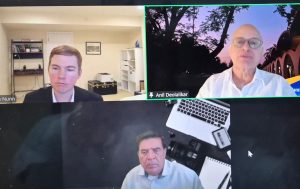
FEATURED SPEAKERS
 |
Dr. William O. Beeman
Professor Emeritus of Anthropology, University of Minnesota wbeeman@umn.edu Dr. Beeman is an internationally recognized expert on the Middle East and Islamic World, with particular depth in Iran, the Gulf Region, and Central Asia. His scholarly work spans sociolinguistics, cross-cultural performance, philosophic anthropology, and the semantics of interaction. He has conducted extensive fieldwork in Iran, Japan, India, Nepal, China, and Europe. His research in recent years has explored the intersection of neuroscience and cognition with music and theatrical performance. From 1996 to 1999, he sang professionally in Europe as an operatic bass and continues his musical career alongside his academic work. Dr. Beeman’s deep understanding of Iranian culture and history informs his view that lasting resolution of US–Iran tensions requires genuine cross-cultural comprehension — an area where he believes US policymakers remain critically deficient. He argues that the 1953 CIA-backed coup that reinstated the Shah remains the defining event shaping Iranian perceptions of the United States, serving as a symbol of American neocolonialism that frames every development in the bilateral relationship to the present day. |
 |
Dr. Anil Deolalikar
Founding Dean, School of Public Policy & Professor of Economics, UC Riverside anild@ucr.edu Dr. Deolalikar has served as Founding Dean of the School of Public Policy since 2013 and as Professor of Economics at UC Riverside since 2003. He also chairs the Board of Directors of the University of California Global Health Institute (UCGHI). Prior to his deanship, he held multiple leadership roles at UCR including Interim Dean of the Anderson Graduate School of Management and Associate Dean of Social Sciences. A development economist, Dr. Deolalikar has published four books and 75 peer-reviewed articles on child nutrition, health, education, poverty, and social protection in developing countries. His work has appeared in the Journal of Political Economy, Review of Economics and Statistics, Health Affairs, and other leading journals. He co-edits The Journal of Asian and African Studies and The Journal of Developing Societies, and is a Fellow of the American Association for the Advancement of Science. He has advised the World Bank, Asian Development Bank, UNDP, and USAID on development projects and programs across Asia and Africa, and served as Lead Human Development Economist for the World Bank in New Delhi (2002–03). He holds a BA summa cum laude from Harvard, a Diploma from Cambridge, and a Ph.D. from Stanford University (1981). |
 |
Dr. Ryan Nunn
Director of Research, Budget Lab at Yale ryan.nunn@yale.edu Dr. Nunn directs research at the Budget Lab at Yale University. His career spans economic research and policy roles at the Federal Reserve Bank of Minneapolis, the US Treasury Department, and the Hamilton Project at the Brookings Institution. He has also served as a senior economist at the White House Council of Economic Advisers. His research covers a broad range of economic policy issues with a particular focus on labor markets and public finance. He has been widely cited on the consumer cost implications of the US–Iran conflict, with commentary appearing in the Wall Street Journal, NPR, CNN, and other major news outlets. Dr. Nunn holds a Ph.D. in public policy and economics from the University of Michigan, Ann Arbor. During the briefing, he highlighted that the United States’ deep integration into global energy markets means domestic oil prices are directly affected by the conflict regardless of domestic production levels — a key reason prices have risen since late February. |
KEY Q&A HIGHLIGHTS
On the economic cost of war to US consumers
Dr. Beeman stated that US military operations in Iran are costing approximately one billion dollars per day, imposing a heavy burden on American consumers while pursuing action against a nuclear program that, in his assessment, Iran was not actively advancing. He noted the war is broadly unpopular with the American public, though it retains the support of the President’s base.
On US energy market integration
Dr. Nunn emphasized that the fact the US now produces significantly more domestic oil than in past decades does not insulate it from global price shocks. Because the US is fully integrated into global energy markets, the conflict has directly driven up domestic oil prices since late February. He also noted that the US purchases more globally than many nations, increasing its vulnerability to oil shocks originating abroad.
On consumer resilience and practical steps
Dr. Beeman observed there is limited ability for individual consumers to shield themselves from rising petroleum prices given the fungible, global nature of energy markets. He pointed to adoption of renewable energy and electric vehicles as the most practical mitigation strategies, noting a meaningful spike in EV sales in the United States and elsewhere since the conflict escalated.
On the geopolitical framing of the conflict
Several journalists raised concerns about the use of religious and civilizational language by US defense officials, including biblical references used to frame military action against Iran. Dr. Beeman noted that Pope Leo’s public pushback against this rhetoric has resonated broadly among American Catholics, who have strongly objected to what they view as a misappropriation of Christian theology in the service of war.
On regional security and Gulf state stability
Questions were raised about the unprecedented nature of Iranian military engagement toward Gulf states — countries that had not previously experienced direct threats of this kind. Reporters asked what the conflict means for the long-term security, economies, and diplomatic relationships of Arab nations now facing Iranian missile threats for the first time. Dr. Beeman also addressed potential strikes on civilian infrastructure such as desalination plants, stating that any such attacks on civil facilities would constitute war crimes prosecutable in international courts.
On prospects for electoral consequences
With seven months remaining before national elections and most Americans opposing the war, reporters asked whether the administration could reverse inflationary trends and other economic consequences in time to limit electoral damage. Experts noted the deeply entrenched nature of oil price dynamics and supply chain disruptions, suggesting a rapid turnaround before the midterms would be difficult to achieve.
On renewable energy and long-term energy policy
Reporters asked whether the conflict could reopen discussion on expanding renewable energy investment despite the current administration’s opposing stance. Panelists noted that market forces — driven by surging fuel costs — are already pushing consumers toward renewables and EVs independent of policy direction, creating economic pressure that may prove difficult for any administration to ignore over the medium term.