U.S. Africa Command (AFRICOM) is the Pentagon’s dedicated military command for the African continent, yet its headquarters sits thousands of miles away in Stuttgart, Germany. As debate grows over its future and its role expands across 53 nations, understanding AFRICOM’s structure, U.S. Africa Command location, and ongoing operations has never been more important.
Background: What Is U.S. Africa Command?
U.S. Africa Command, with partners, counters transnational threats and malign actors, strengthens security forces, and responds to crises in order to advance U.S. national interests and promote regional security, stability, and prosperity.
United States Africa Command (U.S. AFRICOM) is one of six of the U.S. Defense Department’s geographic combatant commands and is responsible to the Secretary of Defense for military relations with African nations, the African Union, and African regional security organizations. A full-spectrum combatant command, U.S. AFRICOM is responsible for all U.S. Department of Defense operations, exercises, and security cooperation on the African continent, its island nations, and surrounding waters.
AFRICOM began initial operations on October 1, 2007, under President George W. Bush, and officially became an independent command on October 1, 2008. Since then, U.S. Africa Command has grown into a central pillar of American strategic engagement across the continent.
U.S. Africa Command Location: Why Stuttgart, Germany?
One of the most frequently asked questions about U.S. Africa Command is why its headquarters is based in Europe rather than on the African continent itself.
U.S. Africa Command was in the political crosshairs even before it stood up 18 years ago in Germany’s automotive capital. From the outset, putting a four-star military headquarters focused on Africa in the hometown of Mercedes Benz and Porsche perplexed Stuttgart residents and outsiders alike.
The primary reason the U.S. Africa Command location was set in Germany rather than on the continent is political. African nations were largely reluctant to host a major U.S. military headquarters on their soil, fearing it would signal foreign military dominance. Headquartered in Stuttgart, Germany, AFRICOM is one of seven U.S. geographic combatant commands, responsible for military engagement across 53 African nations.
About 1,500 work at the command’s headquarters in Stuttgart, Germany. Others are assigned to AFRICOM units at MacDill Air Force Base, Florida, and RAF Molesworth, England. The command’s programs in Africa are coordinated through Offices of Security Cooperation and Defense Attache Offices in approximately 38 nations.
The AFRICOM headquarters in Africa debate has never gone away. Critics have long argued that having the U.S. Africa Command headquarters in Germany creates a disconnect between the command and the continent it serves. However, U.S. officials and African partners have consistently cited diplomatic sensitivities as the reason for keeping the U.S. Africa Command location in Europe.
AFRICOM Countries: Scope and Responsibility
U.S. Africa Command covers a vast and strategically vital region. AFRICOM countries span the entire African continent all 54 recognized nations plus island nations and surrounding waters. This makes it one of the largest geographic areas of responsibility of any U.S. military command.
Africa is a fast-growing continent that is expected to house 25% of the world’s population by 2050. It boasts massive stocks of natural resources, including rare earth elements critical to electronics, and last year it accounted for 11 of the world’s 20 fastest-growing economies.The diversity of AFRICOM countries ranges from stable democracies to fragile states battling terrorism. The command maintains Offices of Security Cooperation and Defense Attaché offices in approximately 38 of these nations, coordinating training, intelligence sharing, and joint military exercises.
U.S. Military Operations in Africa: Somalia Focus
Among all U.S. military operations in Africa, none have been more intense or sustained than those in Somalia. U.S. Africa Command Somalia operations have been ongoing for years, targeting both al-Shabaab and ISIS-Somalia.
The U.S. has already carried out 33 airstrikes in Somalia in 2025, according to AFRICOM public affairs. At this pace, AFRICOM is poised to equal or exceed the highest number of strikes there in the command’s history, 63 in 2019.
In coordination with the Federal Government of Somalia, U.S. Africa Command conducted airstrikes against ISIS-Somalia on Feb. 1, 2025.
U.S. Africa Command Somalia operations reflect a broader concern about the growing threat environment. AFRICOM called ISIS-Somalia “a growing threat in East Africa” and said its numbers had tripled from 500 to an estimated 1,500 in the last 18 months.Al-Shabaab has also been identified as a top-tier global threat. AFRICOM told The Intercept that the country’s main militant group, al-Shabab, is now “the largest al Qaida network in the world.”
These U.S. military operations in Africa underscore why the Pentagon has resisted pressure to downsize or dissolve AFRICOM. The command’s presence is seen as critical to preventing Somalia and the wider East African region from becoming a launchpad for global terrorist attacks.
The Debate Over AFRICOM’s Future
In recent years, the question of why U.S. Africa Command is in Germany has taken on new urgency, as policymakers debate whether to move or even dissolve the command.
In response to the President’s direction, efforts are now underway to develop plans and options to relocate U.S. Africa Command headquarters and forces from Germany. The command will look first at options elsewhere in Europe, but also will consider options in the United States.
Republican lawmakers this week raised alarms about a reported Pentagon proposal to merge AFRICOM into the crosstown headquarters of U.S. European Command.
Rep. Mike Rogers, R-Ala., chairman of the House Armed Services Committee, asked the AFRICOM commander whether AFRICOM should remain separate from EUCOM, eventually drawing a “yes.” “I fully agree with you,” Rogers said. “I made it very clear publicly that I will vigorously oppose any effort to consolidate AFRICOM into EUCOM.”
The strategic argument for keeping U.S. Africa Command independent is strong. A growing Chinese presence on the continent should show U.S. leaders why maintaining AFRICOM is important. Access to those resources and economies has driven the Chinese to increase their spending in Africa significantly. Russia also seeks to increase its influence in Africa, especially as it seeks access to warm water ports.
U.S. Army Africa Command and Ground Presence
The U.S. Army Africa command is a subordinate element of AFRICOM, specifically managing land-force engagement across the continent. U.S. Army Africa command is headquartered at Vicenza, Italy, and focuses on building partner capacity, conducting exercises, and supporting crisis response operations.
Beyond the U.S. Army Africa command, AFRICOM coordinates with Special Operations forces, Air Force units, and Navy assets to maintain a flexible, multi-domain presence across the continent without establishing large permanent bases. This “light footprint” approach has been a deliberate policy to respect African sovereignty while still advancing U.S. security goals.
Quotes: What Officials Are Saying
“Everything we do has one overarching goal in mind: achieving peace through strength,” said Gen. Michael E. Langley during his 2025 posture statement to the Senate Armed Services Committee.Addressing terrorist threats, Langley warned: “Left unchecked, they will have a direct effect on the homeland.”
Secretary of Defense Pete Hegseth, after visiting AFRICOM headquarters in Stuttgart on February 11, 2025, said: “Two Combatant Commands that are right in front lines of advancing American interests. Proud to be here today, it’s an impressive display of what Americans are doing in far-flung places for the American people.”
New AFRICOM Commander Takes Over
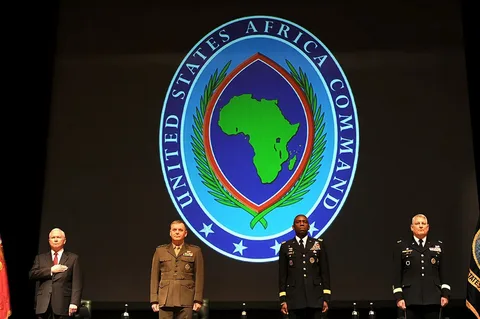
Gen. Dagvin Anderson relieved Marine Corps Gen. Michael Langley of command during a ceremony at Kelley Barracks in Stuttgart on August 15, 2025. Anderson has more than 3,400 flight hours, including 738 in combat. His previous assignments include director of Joint Force Development on the Joint Staff and leadership of Special Operations Command-Africa.
“I am not new to the challenges of Africa,” Anderson said at the ceremony, adding that he is very familiar with rising threats vying for influence on the continent and “seeking to destabilize and undo the world order that we enjoy.”
Global and Regional Impact
U.S. military operations in Africa have broad implications beyond the continent itself. Terrorism emanating from AFRICOM countries has threatened European cities, disrupted global shipping lanes, and fueled refugee crises. The AFRICOM headquarters in Africa debate also intersects with great-power competition, as China and Russia actively fill vacuums left by reduced Western engagement.
During the House Armed Services Committee hearing, Langley said the U.S. military should not cede its influence across Africa even as it pushes African partner nations to shoulder more of the financial burden for their own security under President Trump’s America-first policies.The question of why U.S. Africa Command is in Germany will likely continue to generate debate, but the operational reality on the ground particularly U.S. Africa Command Somalia missions makes a case for the command’s enduring relevance.
Conclusion: What Comes Next for U.S. Africa Command?
The future of U.S. Africa Command (AFRICOM) remains uncertain. Proposals to merge it with EUCOM, relocate its headquarters, or reduce its budget have all been floated in Washington. Yet the growing threat environment across AFRICOM countries from al-Shabaab in Somalia to ISIS in the Sahel and Chinese influence across the continent makes the argument for a robust, independent AFRICOM compelling.
As Gen. Anderson assumes command and navigates both battlefield challenges and political headwinds in Washington, the world will be watching whether U.S. Africa Command can adapt to an increasingly complex Africa. One thing is clear: the continent’s strategic importance is only rising, and the U.S. military’s role there will remain a defining question of American foreign policy for years to come.
FAQs
Who is the commander of the U.S. Africa Command?
As of August 15, 2025, Gen. Dagvin Anderson is the commander of U.S. Africa Command, having taken over from Marine Corps Gen. Michael Langley during a change of command ceremony at Kelley Barracks in Stuttgart, Germany.
How many U.S. troops are in AFRICOM?
AFRICOM has about 1,200 military and civilian personnel assigned to its headquarters in Stuttgart alone. AfriCom is eventually composed of some 1,300 personnel, with about half being members of the U.S. military and the other half from civilian agencies such as the departments of State, Commerce, Homeland Security, and Treasury. Additional troops are deployed across various African nations in support of training missions, counterterrorism operations, and exercises.
Where is the U.S. Army Africa command?
The U.S. Army Africa command (USARAF) is headquartered at Caserma Ederle in Vicenza, Italy. It serves as the Army’s component command under U.S. Africa Command (AFRICOM), managing land force engagement and security cooperation across all AFRICOM countries.