

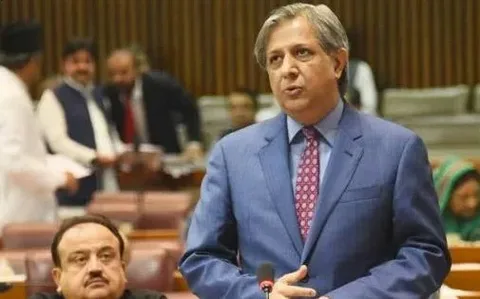

The rumours have been swirling for months. The political messaging has been contradictory. And now Law Minister Azam Nazeer Tarar has stepped in to provide the clearest official position yet there is currently no indication that a 28th Constitutional Amendment is imminent.
The Tarar on 28th amendment statement comes as speculation reaches a peak ahead of Eid ul Adha and Pakistan’s federal budget season with different members of the ruling coalition sending completely different signals about whether the amendment is coming, when, and what it would contain.
What Tarar Said And What His Office Confirmed
Speaking on behalf of Law Minister Azam Nazeer Tarar, Parliamentary Affairs Minister Dr Tariq Fazal Chaudhry told reporters: “There is no 28th Amendment under consideration.” A key official in the Prime Minister’s Office backed this position, stating that nothing related to a new constitutional amendment was being examined at the PMO. “There is no such proposal under review,” the source confirmed. Dr Tariq clarified that no formal meeting had been held on the matter and described the current national debate as “a media-amplified issue.” The Azam Nazeer Tarar statement effectively contradicts what several other government figures had been saying in public for weeks leaving observers to determine which version of events represents the government’s actual position.
Rana Sanaullah’s Claim The Source of the Confusion
The contradiction at the heart of the Tarar on 28th amendment debate traces directly to PM’s Adviser Rana Sanaullah, who told journalists in Chiniot that the government would “soon introduce the 28th Constitutional Amendment.” He said the proposed amendment would focus on local governments, the National Finance Commission, and health-related matters and that consultations were already underway. State Minister for Law Barrister Aqeel Malik then appeared on television to say the 28th naturally comes after the 27th but also clarified that no formal work was currently being carried out. The back-and-forth has created precisely the kind of political uncertainty that makes coalition management difficult with coalition partners, opposition parties, and civil society all trying to decode what the government actually intends.
PPP Has Not Been Consulted Bilawal’s Warning
The Pakistan constitutional reform debate has been further complicated by PPP Chairman Bilawal Bhutto-Zardari’s flat statement that the government has not approached his party on any proposed new amendment. Bilawal chaired a parliamentary committee meeting after which he told reporters that neither Prime Minister Shehbaz Sharif nor anyone in the government had formally or informally raised a new constitutional amendment with the PPP in any meeting. He added clearly: “Any constitutional amendment will not be possible without our support.” Given that PPP holds 74 National Assembly seats making it the coalition’s second-largest partner and essential for any two-thirds majority this is not a throwaway comment. The government legal amendments process cannot proceed without PPP’s active cooperation, and Bilawal has made it clear that cooperation has not been sought.
What the 28th Amendment Was Supposed to Address
Despite the official denial, the policy discussion behind the Tarar on 28th amendment controversy is real. The proposed amendment has been described across multiple government communications as a governance-focused reform package. Its key pillars include strengthening Article 140-A to give greater constitutional protection to local government structures; mandatory Provincial Finance Commissions to ensure consistent fund flows to local bodies; a revised NFC Award framework to address federal-provincial fiscal relations; and possible federal re-entry into education and health policy to ensure uniform national standards. The Pakistan Business Forum has formally written to Nawaz Sharif, Bilawal Bhutto-Zardari, Maulana Fazlur Rehman, and Khalid Maqbool Siddiqui urging that economic safeguards be included in any Pakistan constitutional reform package.
The 18th Amendment The Real Political Fault Line
The single most politically sensitive dimension of the Azam Nazeer Tarar statement controversy is the 18th Amendment. Passed in 2010 under a PPP-led government, the 18th Amendment devolved powers from the federal government to the provinces on health, women’s development, social welfare, and local government. Any constitutional amendment that touched these provincial powers would require PPP to vote against its own most significant legislative achievement something Bilawal has repeatedly described as unacceptable. State Minister Barrister Aqeel Malik tried to defuse this concern, calling suggestions that the 28th would roll back the 18th “extremely false.” Former Senate Chairman Raza Rabbani disagreed sharply, warning that a 28th Amendment could permanently alter the fundamental framework of the 1973 Constitution.
PM Meets Zardari Amendment Still on the Agenda?
Despite the official denials, political signals suggest the Tarar on 28th amendment situation is more fluid than the government’s public position implies. PM Shehbaz Sharif met President Asif Ali Zardari at the Presidency specifically amid swirling rumours about the amendment accompanied by Law Minister Tarar himself, Foreign Minister Ishaq Dar, NA Speaker Ayaz Sadiq, and Interior Minister Mohsin Naqvi. The high-level composition of that delegation suggests the amendment discussion has not ended it has simply moved from public statements to private consultation. Earlier, PM Shehbaz had also met MQM-P leadership in Karachi, where the government legal amendments discussions were a central agenda item and the PM assured the delegation that further consultations would be held.
What Analysts Say Three Amendments in a Year Is Unprecedented
The broader Pakistan constitutional reform pattern under the Shehbaz Sharif government is striking. The 26th Amendment was passed in 2024. The 27th Amendment creating the Federal Constitutional Court and restructuring judicial appointments was passed in November 2025. A 28th Amendment within the same term would mean three constitutional amendments in under two years a pace that has few precedents in Pakistan’s constitutional history. Critics have described the pattern as a deliberate strategy to consolidate power incrementally, with each amendment building on the previous one. Former senior RSS analysis from Observer Research Foundation described the parliament as a “rubber stamp” rubber-stamping amendments that consolidate military and civilian executive power at the expense of judicial independence and provincial autonomy.
Frequently Asked Questions
What is the proposed 28th Constitutional Amendment of Pakistan about?
The proposed Pakistan constitutional reform package described as the 28th Amendment centres on three main areas. First, local government empowerment strengthening Article 140-A to ensure provinces genuinely transfer power and resources to local bodies. Second, fiscal reform revising the NFC Award framework and creating mandatory Provincial Finance Commissions. Third, governance coordination giving the federal government a stronger coordinating role in education and health to ensure uniform national standards. Critics warn it could reduce provincial autonomy expanded under the 18th Amendment. The Tarar on 28th amendment statement of “no indication” suggests a formal bill is not yet imminent, despite ongoing behind-the-scenes discussions.
What did the 27th Constitutional Amendment do?
The 27th Amendment was passed on November 13, 2025 by the PML-N-led coalition with a two-thirds majority in both houses. It created a new Federal Constitutional Court of Pakistan, changed the process for transferring judges between courts, amended Article 243 relating to control of the armed forces, and revised fiscal and administrative arrangements between the federal government and provinces. The bill was presented in the Senate by Azam Nazeer Tarar as Law Minister. The Supreme Court Bar Association and Amnesty International both criticised it as undermining judicial independence. The FCC its central feature began operations in early 2026.
How many constitutional amendments has Pakistan had?
Pakistan has amended its 1973 Constitution 27 times as of May 2026. Major amendments include the 8th Amendment in 1985 under General Zia ul-Haq, which gave the president power to dismiss parliament; the 13th Amendment in 1997 under Nawaz Sharif, which removed that power; the 17th Amendment in 2003 under General Musharraf, which restored it again; the 18th Amendment in 2010 under President Zardari, which devolved powers to provinces; the 21st Amendment in 2015, which established military courts for terrorism cases; the 26th Amendment in 2024 restructuring the Supreme Court; and the 27th Amendment in 2025 creating the Federal Constitutional Court. Whether a 28th Amendment follows depends entirely on whether the coalition can build the consensus that the Tarar on 28th amendment statement suggests does not yet exist.