
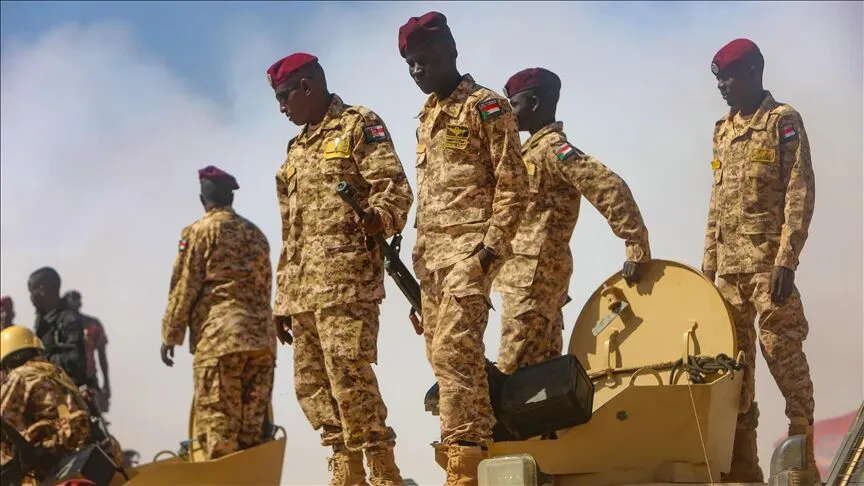

The Sudan war news out of Khartoum this week covers three interconnected developments: the Sudanese Armed Forces retook the city of Bara and surrounding strategic areas in North Kordofan after heavy fighting on July 25; drone strikes continued to kill civilians across multiple cities; and a major Saudi Sudan gold deal is quietly reshaping the country’s wartime economy as Khartoum ditches Dubai in favor of Riyadh as its primary bullion buyer.
Three years into one of the world’s most devastating civil wars, Sudan remains split between a military government holding the east and north and a Rapid Support Forces paramilitary controlling most of the west and Darfur.
Background
Khartoum Sudan news today cannot be understood without the context of what started in April 2023. A power struggle between General Abdel Fattah al-Burhan’s Sudanese Armed Forces (SAF) and General Mohamed Hamdan Dagalo’s Rapid Support Forces (RSF) turned into open urban warfare inside the capital and quickly spread across the country.
As Sudan Tribune and international organizations have documented, the conflict has killed more than 40,000 people according to UN estimates, displaced over 12 million, and created what the UN describes as the world’s worst displacement crisis. Khartoum itself was a battlefield for more than a year before the SAF retook the capital in early 2025.
The RSF simultaneously created a parallel government based in Darfur, dividing Sudan into two zones of control that now function as separate political entities, even as neither side has achieved a decisive military breakthrough.
Army Retakes Bara and Strategic Kordofan Corridor
The latest Sudan news now from the front lines comes from North Kordofan, where the SAF and allied forces recaptured the city of Bara along with the strategic areas of Al-Baraka and Um Sayala on July 25, following heavy clashes with RSF units.
The military significance goes beyond the city itself. <cite index=”38-1″>Um Sayala sits near the vital export road connecting North Kordofan to Omdurman, giving the military a new supply corridor to El Obeid while reducing operational threats to Khartoum and the White Nile states.</cite>
<cite index=”38-1″>Joint Force Spokesperson Mutawakil Ali Wakeel confirmed that the army, the Joint Force, Qashan forces, and supporting troops successfully secured Al-Baraka, Um Sayala, Um Qurfa, Jabrat Al-Sheikh, and Bara. Military officials reported that 73 heavily armed RSF vehicles were destroyed during the fighting, several other vehicles were seized, and numerous RSF combatants and officers were killed.</cite>
The North Kordofan corridor matters because it connects the RSF’s western strongholds with potential lines of advance toward the capital. Cutting that connection reduces RSF pressure on Khartoum from the west, a strategic priority for the army since it retook the city.
Drone War Killing Civilians Across Sudan
Even as the army makes advances on the ground, the Sudan Tribune news on the current situation is dominated by an escalating drone war that is killing civilians at an alarming rate.
<cite index=”42-1″>UN High Commissioner for Human Rights Volker Türk said drone strikes killed over one thousand Sudanese civilians in the first five months of 2026, reflecting the increased human costs of heightened drone usage by both the SAF and the RSF. Data from 2024 to 2025 shows a 600 percent increase in drone-related deaths and an 81 percent increase in drone attacks.</cite>
Recent strikes have hit funerals, residential neighborhoods, and civilian airports. <cite index=”42-1″>The RSF killed twenty-two civilians and wounded nineteen others in a series of drone strikes targeting a funeral procession, a residential neighborhood, and the airport district in El-Obeid.</cite>
SAF drones have also hit civilian targets. The UN Human Rights Council’s deputy commissioner warned that the conflict continues to deepen and expand. Both sides have blocked humanitarian aid, detained aid workers, and used civilian infrastructure as military targets, according to Human Rights Watch and OHCHR reporting covering the full three years of the war.
Explosions near Khartoum’s Wadi Sayidna military base and drone attacks on Atbara — a city 186 miles north of Khartoum — have also been reported in recent days, suggesting the RSF is maintaining pressure on the capital’s outskirts even after losing urban control of Khartoum itself.
Saudi Sudan Gold Deal Reshapes Wartime Economy
Away from the battlefield, the Saudi Sudan gold arrangement announced at the start of 2026 is changing how Sudan finances its military operations.
<cite index=”45-1″>Saudi Arabia’s state-run gold refinery said it was ready to start buying Sudanese bullion immediately as Sudan tries to shift gold exports away from Dubai after years of sanctions and smuggling.</cite> The announcement came after high-level talks between both countries’ minerals ministers at the Future Minerals Forum in Riyadh.
The numbers behind this deal explain why it matters. <cite index=”47-1″>In 2025, Sudan produced 70 tonnes of gold, yet only 20 tonnes were exported officially, Finance Minister Gibril Ibrahim revealed.</cite> The gap between what Sudan produces and what leaves through official channels reflects decades of smuggling networks that have benefited both RSF commanders and informal traders.
<cite index=”48-1″>Sudan’s Ministry of Minerals signed a strategic agreement with the Saudi Gold Refinery company to carry out research, exploration, geological evaluation and mine development work for gold and associated minerals in the Red Sea State.</cite>
Sudan’s rupture with Dubai is partly political. <cite index=”49-1″>After a public rupture with Abu Dhabi last year over its alleged involvement in the fighting, the generals are seeking alternatives.</cite> Sudan’s army-backed government has accused the UAE of backing the RSF to maintain its access to Sudanese gold. The Riyadh deal gives Khartoum a major Gulf partner that is aligned with the SAF rather than the RSF — a meaningful shift in the regional politics of the conflict.
<cite index=”46-1″>Gulf analyst Anna Jacobs told The National: “Saudi Arabia has been trying to make a bigger political and economic push into Africa for years, and Sudan is at the centre of this strategy. Over the last year, in particular, Saudi Arabia has stepped up its support for the Port Sudan-based government as the war with the RSF intensified. The kingdom is more concerned than ever about stability around the Red Sea.”</cite>
Humanitarian Situation Continues to Deteriorate
Sudanese online news and international reporting consistently tell the same story about the civilian situation: it is getting worse, not better.
The ICC’s October 2025 conviction of Ali Muhammad Ali Abd-Al-Rahman formerly a Janjaweed militia commander for 27 counts of crimes against humanity and war crimes in Darfur brought some accountability for historical atrocities, but ongoing violations continue to be documented. <cite index=”39-1″>Dr. Nahid Jibrallah, founder and director of the SEEMA Centre for the Protection of Women and Children, told OHCHR: “The violations are severe torture, rape, and other forms of sexual violence affecting women, men, and children.”</cite>
Both the SAF and RSF have been documented blocking aid deliveries, detaining humanitarian workers, and targeting civilians. The RSF’s parallel government in Darfur has given it an administrative structure to manage territory, but that territory has seen some of the worst atrocities of the war, particularly around El Fasher, which fell to the RSF in late 2025.
Global and Regional Impact
Sudan’s conflict has regional dimensions that keep neighboring governments, Gulf states, and international organizations deeply engaged.
Saudi Arabia’s alignment with the SAF contrasts with the UAE’s perceived support for the RSF — a Saudi-UAE proxy dimension that overlaps with broader Red Sea security concerns. Saudi Arabia’s interest in stability around Port Sudan reflects its Red Sea coastline and trade route concerns directly.
Egypt, which shares a border with Sudan and has close ties to the SAF, has also supported the army-backed government throughout the conflict. The RSF’s parallel government has sought international recognition but has found limited support beyond those already backing it covertly.
For the international community, Sudan represents a test of whether civilian protection can be meaningfully enforced when both sides have strong external backers and access to weapons. The answer so far has not been encouraging.
Conclusion
Sudan war news from this week captures a conflict that is shifting on multiple fronts simultaneously: military advances in Kordofan, escalating drone warfare across civilian areas, and a strategic economic realignment as Khartoum moves its gold exports from Dubai to Riyadh.
Three years in, neither the SAF nor the RSF has achieved the decisive breakthrough that would end the war. The civilian population continues to pay the highest price. The Bara recapture gives the army momentum in a strategically important corridor, but momentum has shifted before without resolving the underlying conflict.
Follow Sudan Tribune, Sudanese Online news sources, and CFR’s Global Conflict Tracker for continuous updates on a war that remains one of the least covered and most destructive on earth.
FAQs
Can you drink alcohol in Khartoum?
No. Sudan introduced a nationwide ban on alcohol in 1983 under President Nimeiry, who implemented Islamic Sharia law across the country. The ban has remained in place through successive governments, including the current military administration. Non-Muslims in Sudan were historically allowed limited access to alcohol in designated areas, but the restrictions have been broadly enforced. The ongoing war has made daily life far more constrained than legal frameworks alone suggest, with security conditions in Khartoum still fragile more than a year after the SAF retook the city.
Why is Khartoum famous?
Khartoum is famous primarily as the capital of Sudan and as the city that sits at the confluence of the Blue Nile and White Nile rivers one of the most historically significant geographic meeting points in Africa. The city has been an administrative, commercial, and cultural center for over a century, and was the site of the famous 1885 siege in which British General Charles Gordon was killed by Mahdist forces. More recently, Khartoum became infamous globally as the epicenter of the 2023 civil war, when urban fighting between the SAF and RSF reduced large parts of it to rubble before the army recaptured the city in early 2025. Much of the city’s infrastructure, civilian neighborhoods, and historic areas remain heavily damaged.
Is Sudan still divided into north and south?
Sudan and South Sudan are two separate countries. South Sudan seceded in 2011 following a referendum in which an overwhelming majority voted for independence, ending decades of civil conflict between the north and south. The two countries are legally distinct sovereign states, though they share complex economic ties, including oil pipelines and shared water resources from the Nile system. The “division” that defines Sudan today is not the north-south one it is the internal split between the SAF-controlled east and north and the RSF-controlled west and Darfur that emerged from the April 2023 civil war and has defined the country’s conflict ever since.