

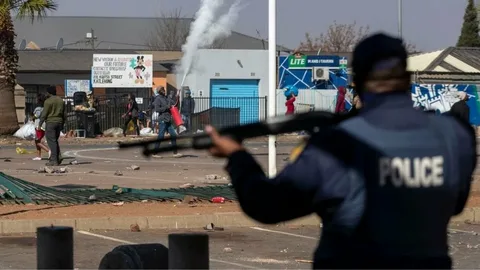

Thousands of people are leaving their homes. Community centers, churches, and emergency shelters are filling up. Aid workers are distributing food, water, and blankets to families who left with almost nothing. And in several affected neighborhoods, police patrols have been reinforced as authorities try to contain violence that has already caused significant displacement.
The South Africa unrest that’s been developing over recent days has crossed a threshold that humanitarian organizations are treating seriously and the international community is paying attention.
The Background: This Isn’t New, But It’s Getting Worse
South Africa has lived through cycles of this kind of unrest for years. The underlying causes are well-documented and deeply entrenched: high unemployment, persistent economic inequality, stretched public services, crime, and recurring tension involving migrant communities who compete for limited work and resources with South African citizens facing their own severe economic pressures.
None of those root causes have been resolved. What changes cycle to cycle is the trigger — a specific incident, a rumor that spreads quickly, a confrontation that escalates and the geography of where the violence erupts.
This latest wave has affected multiple communities, forced emergency responses from humanitarian organizations, and put the situation back in international headlines. Neighboring countries are watching carefully because a significant number of their citizens live and work in South Africa, and what happens here has consequences that cross borders.
Who Is Most Affected?
The people bearing the heaviest weight of this crisis are exactly who you’d expect: families with the fewest options.
Foreign nationals have been particularly vulnerable. Reports indicate that Malawian citizens are among those relocating from affected communities some coordinating with their government, others seeking help from humanitarian agencies, all of them navigating a situation they didn’t create and can’t easily escape.
Children and elderly residents are at particular risk, as they always are during displacement crises. Families have been separated in the chaos of evacuation. People arrived at shelters in the middle of the night with whatever they could carry.
Aid workers on the ground describe increasing demand for emergency support as more people arrive at temporary facilities and warn that prolonged displacement creates its own health risks, particularly for vulnerable populations.
The Humanitarian Response
International and local organizations have scaled up quickly. Emergency teams are on the ground distributing food supplies, drinking water, temporary shelter, medical assistance, hygiene kits, and psychological support for people dealing with trauma on top of displacement.
The logistical challenge is real. Getting supplies to affected areas while security remains uncertain isn’t straightforward. Aid workers have called for guaranteed safe access so relief operations can reach everyone who needs them.
The longer displacement continues, the more complex the humanitarian picture becomes. Short-term shelter is manageable. Weeks of displacement with no clear path back to normal life is a much more serious problem.
Government Response: Containing the Immediate Crisis
South African authorities have acknowledged the severity of the situation. Police deployments have increased in affected areas, investigations into violent incidents are underway, and provincial governments are coordinating with national agencies on the response.
Official statements have emphasized that criminal behavior will be prosecuted and that residents should report suspicious activities. Community leaders have been urged to encourage dialogue rather than confrontation.
The government’s challenge is the one it has faced in previous outbreaks: restoring immediate security while also being honest about the structural conditions that keep producing these crises. Law enforcement can address the immediate symptoms. It cannot address the unemployment, inequality, and social tension that generate them.
Regional and International Concern
South Africa is the largest economy in Southern Africa by a significant margin. It’s a major destination for labor migrants from Malawi, Zimbabwe, Mozambique, Zambia, and elsewhere people who send remittances home that matter enormously to their families and their countries’ economies.
When South Africa experiences instability, the effects don’t stay within South Africa’s borders. Regional trade is affected. Migration patterns shift. Investment decisions get reconsidered. Governments in neighboring capitals are watching this situation not just as a humanitarian concern but as an economic one.
Diplomatic officials from affected countries have urged calm and protection for their citizens. International humanitarian organizations have called for stronger measures to protect displaced families regardless of nationality.
What Experts Are Actually Saying
Humanitarian specialists are consistent in their immediate message: protect civilians first, ask other questions later. Safe access for aid workers, adequate shelter, and basic services for displaced people are the non-negotiables.
Security analysts point to the familiar two-stage problem. Containing the immediate violence is necessary but not sufficient. The conditions that produce recurring unrest unemployment that runs chronically high, economic inequality that is among the most severe anywhere in the world, communities competing for scarce resources — require sustained political and economic responses that go well beyond police deployments.
Migration specialists specifically emphasize that displaced foreign nationals deserve humanitarian assistance without discrimination. Vulnerability doesn’t come with a passport requirement.
What This Means for Visitors
Many parts of South Africa are operating normally, including most tourist destinations. The affected communities and the country’s major tourist areas are geographically distinct in most cases.
That said, international headlines have an effect regardless of specifics, and travel decisions are being made in an environment of uncertainty. Travelers planning South Africa visits should check current government travel advisories from their home countries, monitor reliable news sources, and follow local authority guidance closely. The situation is developing, and conditions can change.
The Deeper Problem
Every outbreak of unrest in South Africa eventually prompts the same conversation about unemployment that has remained stubbornly and devastatingly high for years, about economic inequality that the post-apartheid period has reduced far less than hoped, about communities where young people can see no viable economic future and where frustration periodically finds violent expression.
Foreign nationals become targets during these periods not because they are the cause of South Africa’s economic problems they aren’t but because they’re visible and because blaming outsiders for structural failures is a pattern that appears in societies under economic stress everywhere in the world.
The communities sending migrants to South Africa are themselves economically desperate. The South Africans among whom they settle are economically desperate. The violence that erupts between them is ultimately a symptom of conditions that neither group created and neither group has the power to fix.
Addressing those conditions requires political will, economic policy, sustained investment, and time. None of that is quick. None of it is simple. And in the meantime, families are sleeping in church halls with what they managed to grab on the way out.
FAQs
Is South Africa safe to visit right now?
Most of South Africa, including the major tourist destinations, is continuing to operate normally. The unrest is concentrated in specific communities rather than spread across the country. However, the situation is developing, and travelers should check current official travel advisories from their government, stay informed through reliable sources, and avoid areas where unrest has been reported. The standard advice for South Africa travel — stay aware, avoid certain areas after dark, don’t display valuables applies with additional attention to current events.
What’s the core problem driving unrest in South Africa?
Several deeply entrenched issues simultaneously: unemployment that has remained at crisis levels for years, economic inequality that is among the most extreme anywhere in the world, high rates of violent crime, overstretched public services, and recurring tension involving migrant communities in the context of severe resource scarcity. These aren’t new problems and they don’t have quick solutions. The current unrest is the latest expression of conditions that have been building for a long time.
Is Elon Musk wealthier than South Africa?
No — and the comparison doesn’t quite work the way the question implies. South Africa’s GDP, which measures the total economic output of the entire country, is in the hundreds of billions of dollars annually. Elon Musk’s net worth, while enormous and subject to significant fluctuation with market conditions, represents personal assets rather than economic output. An individual’s wealth and a nation’s economy are measured differently and aren’t directly comparable in a meaningful way.