

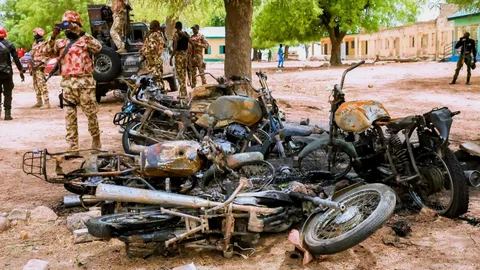

A senior Islamic State commander described as the group’s second-in-command globally has been eliminated in a joint operation by American and Nigerian forces. The IS leader killed on Friday night marks one of the most significant blows to the militant group’s African operations in years.
President Trump announced the news on Truth Social late Friday, calling it a “meticulously planned and very complex mission” that had “greatly diminished” ISIS’s global capacity.
Who Was Abu-Bilal al-Minuki
The man killed in Friday’s operation was Abu-Bilal al-Minuki born in 1982 in Borno State, northeastern Nigeria, according to US Treasury records. Trump described him as the second-in-command of ISIS globally and called him “the most active terrorist in the world.” In 2023, the US State Department designated al-Minuki a Specially Designated Global Terrorist, identifying him as a senior ISIS official based in the Sahel and a member of the organisation’s General Directorate of Provinces the administrative body that provides financial and operational direction to ISIS branches worldwide. His sanctioning came due to his central role in coordinating terror finance and logistics across Africa and beyond.
Trump’s Announcement “He Thought He Could Hide”
Trump did not hold back in announcing the operation. “Tonight, at my direction, brave American forces and the Armed Forces of Nigeria flawlessly executed a meticulously planned and very complex mission to eliminate the most active terrorist in the world from the battlefield,” he wrote on Truth Social. He added that al-Minuki “thought he could hide in Africa, but little did he know we had sources who kept us informed on what he was doing.” Trump thanked the Nigerian government for its cooperation and said the operation had greatly diminished ISIS’s ability to plan attacks in Africa and target Americans abroad. He did not specify the location of the strike or whether it involved airstrikes or ground forces.
Al-Minuki’s Rise Within ISIS in Africa
Al-Minuki’s path to the top of the Islamic State’s African operations ran through the volatile Lake Chad basin. When the Islamic State West Africa Province known as ISWAP split from Boko Haram, al-Minuki played a critical role in establishing the new group’s connections to ISIS central leadership. When Boko Haram’s leader Abubakar Shekau refused an ISIS request to send fighters to Libya between 2015 and 2016, it was al-Minuki who dispatched fighters from ISWAP’s Lake Chad command instead. That decision deepened the rift between ISWAP and Shekau and established al-Minuki as a trusted executor of ISIS directives in West Africa. After Mamman Nur, the leader of ISWAP, was killed in subsequent years, al-Minuki’s influence within the broader organisation grew considerably.
US Military Presence in Nigeria The Buildup
Friday’s operation did not happen in a vacuum. Since late 2025, the United States has steadily increased its military footprint in Nigeria, deploying hundreds of troops to support and train Nigerian forces against the Islamist militant threat. On Christmas Day 2025, the US and Nigeria carried out joint airstrikes in northwestern Sokoto State targeting fighters from the Islamic State in the Sahel a regional affiliate usually active in neighbouring Niger. That operation was the first major joint strike of its kind and set the template for the coordination that made Friday’s mission possible. Trump had also publicly pressured the Nigerian government in late 2025, accusing it of failing to do enough to protect Christians from Islamist violence a charge Abuja rejected.
Why This Matters ISIS in West Africa
The death of a senior figure in the Islamic State’s African command structure is significant precisely because West Africa has become one of the group’s most active theatres. While ISIS lost its territorial caliphate in Syria and Iraq in 2019, it never disappeared it adapted, dispersed, and rebuilt in the Sahel, the Lake Chad basin, and the Horn of Africa. ISWAP in particular has proven more resilient and more strategically sophisticated than Boko Haram, incorporating civilian governance tactics alongside violence and building a degree of local support in areas where government services are absent. Al-Minuki’s role in connecting ISWAP’s operations to ISIS’s global financial and logistical networks made him a high-value target whose removal disrupts those connections in ways that will take the group time to repair.
What Comes Next The Limits of Decapitation
The elimination of a senior militant commander is a genuine tactical success. But the history of counter-terrorism operations in West Africa offers a sobering precedent. The removal of individual leaders including Boko Haram’s Shekau in 2021 has consistently failed to destroy the organisations themselves. Groups adapt, promote replacements from within, and often emerge from leadership vacuums more decentralised and harder to target. The broader conditions that fuel recruitment in the Lake Chad region poverty, government absence, ethnic marginalisation, and climate-driven competition for resources remain entirely unaddressed by military action alone. The operation is a meaningful moment in the counter-terrorism campaign. Whether it is a turning point depends on what follows it.
Frequently Asked Questions
Who helped defeat ISIS and how?
The military defeat of ISIS’s territorial caliphate in Syria and Iraq between 2017 and 2019 was achieved through a coalition of forces. The US-led Global Coalition to Defeat ISIS comprising more than 80 countries provided airstrikes, training, intelligence, and logistics. Kurdish forces, particularly the Syrian Democratic Forces and Iraq’s Kurdish Peshmerga, provided the ground combat that retook Mosul, Raqqa, and other major ISIS-held cities. The Iraqi Security Forces and Iran-backed Popular Mobilisation Units also played a central role inside Iraq. Russia supported the Assad government’s campaign in Syria. No single actor defeated ISIS it was a combination of sustained military pressure from multiple directions.
Who killed the ISIS leader in Iraq and what happened?
ISIS’s founder and leader Abu Bakr al-Baghdadi was killed on October 26, 2019 in a US special forces raid in Idlib province, northwestern Syria not Iraq. Trump announced the operation in a dramatic White House address. Al-Baghdadi detonated a suicide vest as US forces closed in, killing himself and three of his children. His successor, Abu Ibrahim al-Hashimi al-Qurashi, was killed in February 2022 in another US raid in Syria. His successor, Abu al-Husain al-Husaini al-Qurashi, was killed in 2023. The pattern of killing IS leaders has not ended the organisation each leadership elimination has been followed by a rapid succession and continued operations.
Is ISIS still fighting in Syria in 2026?
Yes. Despite losing its territorial caliphate in 2019, ISIS continues to carry out insurgent attacks in Syria and Iraq. The group operates primarily through sleeper cells, ambushes on security forces, and targeted assassinations in areas where government control is weak. The Badia desert region of central Syria remains an area of persistent ISIS activity. In Africa, the group’s affiliates particularly in the Sahel, Lake Chad, and Mozambique have become its most active fronts. The killing of Abu-Bilal al-Minuki on May 16, 2026 reflects how significantly the centre of gravity of ISIS’s global operations has shifted from the Middle East to sub-Saharan Africa over the past five years.