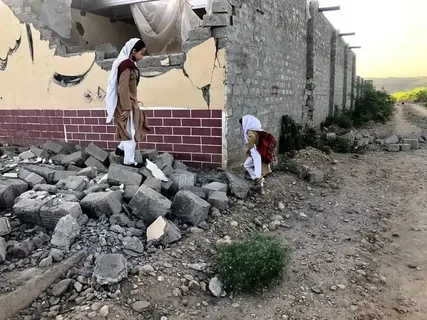
Imagine sending your child to school knowing that the building might not be standing by morning.For families in parts of Pakistan particularly in Khyber Pakhtunkhwa and the tribal districts that isn’t a hypothetical. It’s a reality that thousands of parents have lived with for years. School destruction in these regions isn’t a new crisis. It’s a persistent one, and 2022 brought it back into sharp focus with a fresh wave of documented attacks on educational infrastructure.
The targets are often deliberate. The timing is often calculated. And the damage, in both concrete and human terms, lasts far longer than the rubble suggests.
This Didn’t Start in 2022
Understanding what’s happening now requires going back further.For well over a decade, schools in Pakistan’s conflict-affected regions have been caught in the crossfire of militancy and instability. Buildings have been bombed, burned, and blown up often at night when students and teachers aren’t present, which minimizes casualties but maximizes disruption.
Girls’ schools have been disproportionately targeted. That’s not incidental it’s the point. Attacks on female education aren’t random acts of destruction. They’re calculated attempts to push girls out of classrooms and keep them there.
The pattern documented across research reports and human rights monitoring is consistent: attacks happen, schools close, rebuilding takes months or years, and in the meantime, children especially girls fall further and further behind.
What Happened in 2022
The incidents documented during this period followed the familiar playbook, but the frequency and geographic spread drew renewed attention.
One of the most reported cases involved a girls’ primary school in South Waziristan being destroyed by an explosive device. The attack happened at night. No students or teachers were harmed but the school was gone, and with it, the daily routines, the sense of normalcy, and the academic progress of every child who attended.
Monitoring groups tracking school safety across the region compiled records showing repeated patterns in the same conflict-prone zones. The same areas getting hit. The same communities bearing the cost. The same children losing access to education they were already fighting hard to reach.
Why Attacking Schools Works as a Strategy And Why That’s Devastating
This is uncomfortable to say clearly, but it’s necessary: destroying a school building achieves far more than destroying a building.
When a school is blown up, the immediate effect is obvious students have nowhere to go. But the secondary effects compound over time. Parents become afraid to send their children back, even once a temporary space is found. Dropout rates climb. Girls, whose families are often already uncertain about education, are the first to stop attending and the last to return.
Teachers who are often community members themselves face their own fears about working in targeted environments. Recruitment becomes harder. Turnover increases.
And the rebuilding process, even when resources are available, is slow. Funding constraints, security assessments, construction logistics in remote areas schools can remain closed for a year or more after a single attack. In a child’s education, a year is an enormous amount of time to lose.
The People Most Affected
It’s easy to talk about school destruction in terms of buildings and statistics. The reality is children.Children in South Waziristan, in remote KP districts, in areas where getting an education already requires overcoming significant obstacles poverty, distance, cultural resistance and then adding the threat of violence on top of all of that.
Girls in particular are carrying a disproportionate share of this burden. Educational inequality between boys and girls in Pakistan’s conflict zones was already significant before any attack. Every destroyed girls’ school widens that gap further and makes it harder to close.
Parents in affected areas have spoken consistently about the fear driving their decisions. Many want to send their children to school. They understand education matters. But when the choice feels like a gamble with safety, many families make the only rational decision available to them they keep their children home.
The Official Response
Authorities have consistently condemned these attacks and framed them accurately as assaults not just on buildings, but on children’s futures and community development.
Security agencies increased monitoring in sensitive areas following the 2022 incidents. Surveillance of vulnerable school buildings has been expanded. Local administration representatives have spoken about the importance of protecting educational infrastructure.
These responses matter. But experts reviewing the situation consistently arrive at the same conclusion: rebuilding schools without implementing long-term security measures doesn’t solve the problem. It just resets the clock until the next attack.
The infrastructure can be reconstructed. But if the underlying security conditions that made the school a target in the first place haven’t changed, the cycle continues.
What the International Community Is Watching
Pakistan’s school destruction problem isn’t just a domestic concern it’s one that international organizations focused on education, child protection, and conflict zone humanitarian law monitor closely.
Under international humanitarian frameworks, educational facilities are supposed to be protected. Attacking schools is a violation of those frameworks, and repeated incidents in Pakistan have placed the country in broader global conversations about safe schools declarations and accountability for attacks on education.
Research documents analyzing the affected regions show a consistent pattern: areas experiencing ongoing school destruction have lower literacy rates, higher dropout numbers, and slower overall development compared to national averages. The connection isn’t surprising. But seeing it documented at scale reinforces the long-term cost of what looks, on the surface, like property damage.
What Actually Needs to Happen
Reports, analyses, and expert assessments point in a consistent direction when it comes to solutions. None of them are simple, but all of them are necessary.
Security measures have to precede reconstruction, not follow it. Building a new school in the same location without addressing why the original one was targeted is an expensive way to create the next target.
Community involvement matters enormously. In regions where schools have survived repeated instability, local community protection and buy-in have often been the difference. Schools that communities feel ownership over are schools communities will defend.
Girls’ education needs specific, dedicated protection strategies. Given the disproportionate targeting of female educational institutions, generic school safety measures aren’t sufficient. Specific policies, resources, and monitoring focused on girls’ schools in high-risk areas are essential.
Reconstruction funding and timelines need to improve. Months-long and years-long rebuilding timelines create education gaps that individual children cannot recover from. Faster, better-funded reconstruction programs would reduce the long-term damage of each attack.
Coordination between security agencies and education departments which has historically been fragmented needs to be genuinely improved, not just promised.
The Bottom Line
School destruction in Pakistan’s conflict zones is not a new problem, and 2022 didn’t resolve it. What it did was add to a documented body of evidence that the pattern continues, that girls remain the primary targets, and that the solutions require more than rebuilding walls.
The children in affected regions deserve safe classrooms. They deserve teachers who feel secure enough to show up. They deserve parents who don’t have to choose between education and safety.
Getting there requires sustained political will, real security investment, community partnership, and international pressure where appropriate. None of that is easy. But the alternative accepting that certain children in certain regions simply won’t receive a safe education isn’t acceptable either.
FAQs
What is the broader crisis affecting education in Pakistan?
Pakistan faces overlapping challenges economic pressure, security instability in specific regions, and damaged educational infrastructure all interact with each other. In conflict-affected areas, school destruction compounds already-limited resources and pushes vulnerable children, particularly girls, further out of reach of consistent education.
What country ranks highest in education globally?
Finland, Japan, and South Korea consistently rank among the top performers in global education assessments, recognized for strong infrastructure, well-trained teachers, and high student outcomes. The contrast with conflict-affected regions in developing countries where security threats actively undermine education access highlights how dramatically circumstances shape educational outcomes.
What can be done to protect schools in conflict zones?
International frameworks like the Safe Schools Declaration provide a starting point committing governments to protecting educational facilities during conflict. On the ground, the most effective approaches combine credible security presence, community protection networks, faster reconstruction funding, and specific policies for protecting girls’ schools. Long-term solutions require treating education infrastructure as a security priority, not an afterthought.