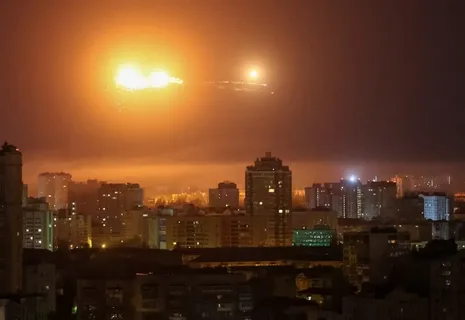
Russia launched a fresh ballistic missile attack on Kyiv in the early hours of July 16, 2026, sending explosions across multiple districts of the Ukrainian capital. The Russian missile attack on Kyiv came just hours after European Commission President Ursula von der Leyen visited Ukraine and signed a landmark drone deal with Kyiv. Ukrainian air defenses engaged the incoming missiles, but several strikes caused fires and structural damage across the city.
Background
The Russian missile attack on Kyiv is the latest in a relentless wave of Ukraine Russian strikes that have intensified through July 2026. Russia has dramatically stepped up its ballistic missile and drone assault on Ukrainian cities over the past several weeks, taking advantage of a well-documented shortage of Patriot interceptor missiles within Ukraine’s air defense inventory.
Earlier this month, on July 2, a massive barrage of more than 70 missiles and nearly 500 drones struck Kyiv in what Ukrainian officials called a “night of horror,” killing at least 25 people and injuring more than 80. A further attack on July 6 killed at least 22 people across Kyiv and surrounding regions, with all 29 ballistic missiles fired that night reaching their targets none were intercepted. Ukraine has been bracing for continued escalation throughout the month.
Details: What Happened on July 16
Explosions Hit Multiple Districts
Ukrainian officials confirmed that Kyiv endured a major Russian assault as ballistic missiles rained down on multiple districts, setting off explosions. Kyiv Mayor Vitali Klitschko reported on Telegram that emergency services were battling blazes across the capital after a warehouse in the Sviatoshynskyi district and a non-residential building in the Darnytskyi district were hit. He added that falling missile debris had also struck a non-residential development area in Darnytsia, triggering additional fires.
This fresh Ukraine rocket attack follows a pattern of Russia targeting the capital’s infrastructure, residential zones, and industrial areas with repeated waves of Kyiv drones and ballistic missiles.
Air Defenses Active But Overstretched
Explosions rocked Kyiv shortly before 1 a.m. local time, according to Kyiv Independent journalists on the ground. Tymur Tkachenko, head of the Kyiv City Military Administration, reported that Russia was attacking the city with ballistic missiles.
Ukraine’s Air Force Command later confirmed that the immediate threat was lifted after approximately one hour. However, the damage on the ground made clear that not all missiles had been intercepted a problem that has defined Ukrainian air defense operations throughout this month’s campaign of drone strikes on Ukraine.
The Timing: Hours After the EU Drone Deal
The attack came hours after European Commission President Ursula von der Leyen visited Kyiv and announced a new “drone deal” between Ukraine and the European Union. The EU also announced a 10-billion-euro ($11 billion) funding plan for additional drones, missiles, and fighter aircraft for Ukraine.
The timing of the Russian missile attack on Kyiv is seen by analysts as a deliberate political signal from Moscow, striking the capital the same night that Kyiv’s Western partnerships were publicly strengthened.
Russia’s Justification and Military Claims
Russia’s Defense Ministry has consistently stated that its Ukraine Russian strikes target military-industrial infrastructure, drone production facilities, weapons depots, fuel networks, and air defense repair sites within the capital. Moscow said the strikes targeted weapons factories in Kyiv, including sites it said produce drones, armored vehicles and missiles, as well as facilities repairing air defense systems and fuel and energy infrastructure in the capital and surrounding region.
However, repeated evidence from the ground has contradicted these claims. Residential apartment towers, ambulance stations, hotels, schools, and civilian warehouses have all suffered damage in previous Kyiv attacks. Damage from the strikes included an “ordinary nine-storey residential building,” with a missile destroying 64 apartments in one strike alone. The Russian tower attack pattern — hitting high-rise residential buildings — has become one of the most widely documented and condemned aspects of the war.
Quotes
Kyiv Mayor Vitali Klitschko confirmed the overnight strikes on Telegram, warning residents to stay in shelters and allowing emergency teams to work across fire-affected districts of the capital.
Ukraine’s Defense Minister Mykhailo Fedorov said Russia is deliberately ramping up ballistic missile attacks on a scale unseen before, exploiting the acute shortage of Patriot interceptors. “Fewer such missiles are produced worldwide each month than the enemy fires at Ukraine in that same period,” he said.
Air force spokesman Yurii Ihnat said on national television: “To intercept ballistics, we need the means for interception. Russians are certainly using the fact that there is a serious deficit of interceptor missiles now, in Ukraine and the world.”
Ukrainian President Volodymyr Zelensky said after an earlier anti-missile coalition meeting: “The more means Ukraine has to shoot down Russian ballistic missiles, the greater the chance that Putin will come to the negotiating table, as his last argument in this war will no longer work.”
Ukraine’s Air Defense Crisis
The pattern of recent Ukraine Russian strikes has exposed a critical vulnerability. Ukraine’s air force said Russia fired 351 drones and 68 missiles overnight in a previous attack, targeting mainly Kyiv, and all 29 ballistic missiles struck their targets. This has become a consistent crisis Ukraine’s air defense systems can handle most drones, but ballistic missiles traveling at hypersonic speeds remain extremely difficult to intercept.
Ukraine’s air defenses remain heavily reliant on the Patriot missile systems to intercept ballistic missiles it can rarely shoot down. The war in the Middle East has strained the global supply of Patriot interceptors a shortage now felt keenly in Ukraine.
Kyiv drones have become a near-nightly feature of life in the capital, but it is the ballistic missiles that are causing the most devastating damage. Ukrainian officials have repeatedly appealed to Washington and European capitals for more Patriot interceptors, arguing that the shortage is costing civilian lives.
The EU Drone Deal: Context and Significance
The drone deal signed by the EU and Ukraine on July 15 represents a major new Western commitment to Kyiv’s defense. The EU released 1 billion euros for unmanned systems and announced a 10-billion-euro funding plan for additional drones, missiles, and fighter aircraft for Ukraine.
Alongside this, French President Emmanuel Macron announced that Ukraine ordered new Franco-Italian air defense systems, including 16 Rafale fighter jets that will operate from 2028 to 2029, and that it has received a licence to produce French missiles, including SCALP cruise missiles.
The Russian missile attack on Kyiv that followed within hours of these announcements is widely understood as Moscow’s direct response to what it views as escalating Western involvement in the conflict. Russia has previously warned that any increase in Western weapons supply would be met with increased strikes on Ukrainian territory.
Russia’s Defense Ministry stated that any increase in the supply of drones, missiles and ammunition produced in the West “will not go unnoticed and will be countered by a corresponding increase in the number and power of retaliatory strikes by the Russian armed forces on Ukrainian territory.”
Impact: Regional and Global Significance
Civilian Toll Mounts
The cumulative impact of Russian missile attacks on Kyiv in July 2026 alone has been staggering. Dozens of missiles hit at least 30 locations in the city in a single July attack. Zelensky said the sites included an ambulance station, a scientific institute, a hotel and businesses. Approximately 800,000 books were destroyed in the inventory warehouse of Ukrainian publishing house BookChef.
More than 16,000 Ukrainian civilians have been killed since the start of Russia’s full-scale invasion. With attacks now intensifying, humanitarian organizations are raising alarm at the scale of ongoing civilian targeting.
NATO and Allied Response
The timing of these Ukraine Russian strikes coinciding with both NATO summits and high-level diplomatic visits has put enormous pressure on Western governments to accelerate weapons deliveries and air defense support. Zelensky is using the attacks on Kyiv to renew his plea for allies to supply Ukraine with missiles for Patriot systems.
“Russia has again chosen escalation over peace with this deplorable onslaught on Kyiv, including dozens of missiles and hundreds of drones killing and injuring civilians, including children,” said one European minister.
Neighboring Poland has taken precautionary steps in response to the spike in Kyiv drone and missile activity. Poland briefly scrambled fighter jets as a preventive measure before calling them back, saying no airspace violation was recorded.
Russia’s Nuclear Posture
Adding to the already volatile atmosphere, Russian Presidential aide Nikolai Patrushev said in an interview with state outlet RIA Novosti that “our naval strategic nuclear forces maintain a state of full combat readiness.” The statement drew sharp concern from European security officials monitoring escalation signals from Moscow.
Conclusion: What Comes Next
The Russian missile attack on Kyiv on July 16, 2026, is unlikely to be the last. Russia has demonstrated both the capability and the willingness to sustain high-tempo ballistic missile and drone strikes on Ukraine regardless of Western diplomatic activity or weapons deliveries. If anything, the pace of attacks appears to correlate with Western escalation in support of Kyiv.
Ukraine’s immediate priority remains securing more Patriot interceptor missiles from its allies. Zelensky is expected to press this demand at upcoming NATO and coalition meetings. In parallel, the EU drone deal and new European missile production licences may provide longer-term air defense capacity but Ukraine’s officials have made clear that help is needed right now, not in 2028.
The world is watching. How quickly allies respond to Kyiv’s latest plea for air defense support may determine whether future Russian missile attacks on Kyiv find a capital better prepared to defend itself or one left further exposed.
Frequently Asked Questions (FAQs)
How many Russian missiles have hit Ukraine?
The number of Russian missiles that have struck Ukraine has escalated dramatically throughout 2026. In the major attack on July 2 alone, Russia fired more than 70 missiles of various types alongside nearly 500 attack drones. In a subsequent attack on July 6, Russia launched 68 missiles along with 351 drones in a single overnight assault, with all 29 ballistic missiles among them reaching their targets without interception. Ukrainian air defense forces say they have intercepted hundreds of missiles over the course of the war, but ballistic missiles in particular have proven extremely difficult to shoot down due to their speed and the global shortage of Patriot interceptor ammunition. Ukraine’s Defense Minister has stated that Russia is firing more ballistic missiles at Ukraine each month than the entire world produces in the same period, underlining just how unsustainable the current defense equation is for Kyiv.
Why did Russia attack Ukraine today?
Russia’s missile attack on Kyiv on July 16, 2026 came hours after the European Union and Ukraine formally signed a landmark drone deal in Kyiv, with European Commission President Ursula von der Leyen announcing a 10-billion-euro weapons funding package. Moscow has previously warned that any increase in Western military support for Ukraine would be met with heavier retaliatory strikes on Ukrainian territory, and the timing of this attack strongly suggests it was a deliberate political response to the EU announcement. More broadly, Russia’s ongoing Ukraine rocket attacks are driven by its stated objective of destroying Ukraine’s military-industrial base, air defense infrastructure, and energy networks, while also applying psychological pressure on Kyiv’s population and leadership. Analysts also link the escalation in July to Russia’s growing use of ballistic missiles to exploit a critical gap in Ukraine’s air defense the shortage of Patriot interceptors that leaves Kyiv unable to shoot down fast-moving ballistic threats.
What missile did Russia hit Ukraine with?
Russia has been using a range of ballistic missiles and drones in its recent Ukraine Russian strikes. The most commonly deployed ballistic missiles include the Iskander-M short-range ballistic missile and the advanced Kinzhal hypersonic aero-ballistic missile, both of which are capable of evading most conventional air defense systems. Russia also uses the Geran-4 drone, an Iranian-designed kamikaze UAV deployed in large swarms to overwhelm Ukrainian air defenses before or alongside ballistic missile strikes. In the July 16 attack on Kyiv specifically, Ukrainian officials confirmed that ballistic missiles struck multiple districts of the city. Ukraine’s air force has described these ballistic weapons as its “Achilles heel” able to be tracked but extremely difficult to intercept without sufficient stocks of Patriot PAC-2 and PAC-3 interceptor missiles, of which Ukraine currently has a critical shortage.