

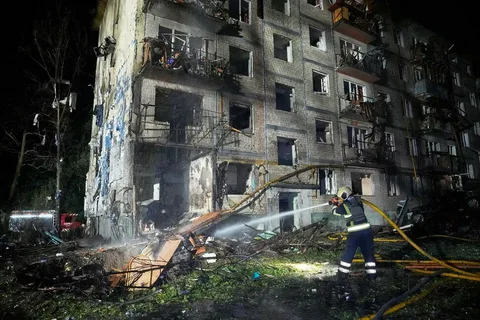

A Russian missile attack on Kyiv early Saturday killed at least three people and injured 15 others, marking the second consecutive night of strikes on Ukraine’s capital. The attack is the latest flashpoint in the Russia-Ukraine war today, as fighting grinds on with no ceasefire in sight more than four years after the full-scale invasion began.
Background
Russia launched its full-scale invasion of Ukraine on February 24, 2022, and the fighting hasn’t stopped since. Anyone tracking the Russia-Ukraine war map over the past year has seen only marginal territorial shifts, even as both sides continue to suffer heavy losses on the battlefield.
Peace talks have surfaced periodically, most recently involving trilateral discussions between the US, Russia, and Ukraine, but no lasting ceasefire has taken hold. Russia has instead stepped up long-range missile and drone strikes on Kyiv in recent months, while Ukraine has continued its own deep strikes on Russian military and industrial targets using drones and long-range systems.
This pattern explains why Russia-Ukraine war news continues to dominate headlines daily. Saturday’s strike on Kyiv was not an isolated event but part of an intensifying campaign against the Ukrainian capital that has grown more frequent through the summer.
Details
Russian forces launched 39 Shahed-type drones alongside four ballistic missiles at Kyiv in the early hours of Saturday, according to Ukraine’s Air Force. Ukrainian air defenses shot down two of the ballistic missiles and 24 of the drones, but the remaining munitions caused significant damage across the city.
More than a dozen explosions shook Kyiv as missiles struck multiple districts, according to witnesses who spoke to Reuters. Kyiv Mayor Vitali Klitschko said residents were trapped in damaged buildings in the Shevchenkivskyi and Solomyanskyi districts, while fires broke out at warehouse buildings in the Darnytskyi district.
Fifteen people were hospitalized, including two boys aged 13 and 17, with one victim reported in serious condition. A water supply pipeline was damaged in the attack, and Kyiv’s Lukyanivska metro station was temporarily closed after its glass entrance was destroyed, though it later reopened.
This was the second straight night of strikes on the Ukrainian capital, following an earlier overnight attack that killed one person and struck a facility Russia’s Defense Ministry said was producing components for Flamingo cruise missiles. The near-nightly pattern of attacks has become a defining feature of the current phase of the war.
Anyone following the broader Russia-Ukraine war who is winning debate will find no clear consensus among analysts. Russia has made small territorial gains in eastern Ukraine in recent months, but at an enormous cost in personnel, while Ukraine’s long-range strike campaign has increasingly targeted Russian military production deep inside Russian territory.
Quotes
Ukrainian President Volodymyr Zelenskyy has continued pressing Western allies for stronger air defense support, and has been negotiating with the United States for a license to manufacture Patriot interceptor missiles domestically.
US President Donald Trump addressed the request on Friday, saying discussions were ongoing but that Washington had not yet agreed to the proposal. He said officials had to be “very careful about letting somebody build” the technology, adding that such transfers could eventually be turned against the country that shared them.
Kyiv Mayor Vitali Klitschko, describing the aftermath of Saturday’s strike, said windows were broken across the Shevchenkivskyi district and that smoke could be seen at the entrance of a residential building, in addition to the damaged water pipeline.
Impact
The continued strikes on Kyiv carry heavy human and economic costs for Ukraine, which remains reliant on Western military and financial support to sustain its air defenses against near-daily Russian bombardment. The debate over a US license for domestic Patriot missile production reflects how central air defense capacity has become to Ukraine’s ability to protect its cities.
The Russia-Ukraine war death toll continues to climb on both sides. Independent analysis from the Center for Strategic and International Studies estimates that combined military casualties, killed, wounded, and missing, have surpassed two million since the war began, with Russia bearing a disproportionately large share of an estimated 450,000 deaths. Ukraine’s own military losses are estimated at between 125,000 and 150,000 fatalities.
On the civilian side, the United Nations Human Rights office has verified more than 16,000 civilian deaths in Ukraine since the invasion began, while cautioning that the true figure is almost certainly higher due to restricted access in occupied and frontline areas. Saturday’s strike adds to that steadily rising toll.
Globally, the war continues to strain diplomatic relationships and energy markets, while reinforcing NATO’s posture in Eastern Europe. The absence of a ceasefire also continues to complicate broader US-Russia relations, particularly around questions of Western weapons transfers to Kyiv.
Conclusion
With Russia-Ukraine war live tracking showing no signs of a slowdown in strikes on Kyiv, the coming weeks are likely to bring continued pressure on Ukraine’s air defense capacity and renewed diplomatic engagement over weapons support. Whether a Patriot production license is eventually granted to Ukraine could shape how effectively Kyiv is able to defend itself against future waves of missile and drone attacks.
For now, the Russia-Ukraine war is still going on with no resolution in sight, and neither side has shown much sign of changing its current strategy.
Frequently Asked Questions
Why was Ukraine attacked by Russia?
Russia launched its full-scale invasion of Ukraine in February 2022, citing a mix of security concerns over NATO expansion, disputed claims about protecting Russian-speaking populations in eastern Ukraine, and denial of Ukraine’s legitimacy as an independent state, a position widely rejected by the international community as a pretext for territorial aggression. The invasion followed years of tension dating back to Russia’s annexation of Crimea in 2014 and the conflict in Ukraine’s eastern Donbas region. Most Western governments and international bodies, including the United Nations, have characterized the invasion as an unprovoked violation of Ukraine’s sovereignty and international law, a position Russia disputes.
How much of Russia’s army is left?
Independent Western analysis, including a widely cited study from the Center for Strategic and International Studies, estimates Russia has suffered around 1.4 million military casualties, including as many as 450,000 deaths, since the invasion began, figures far higher than Russia’s own official disclosures. Despite these staggering losses, Russia has continued to sustain its war effort through ongoing conscription and recruitment, though CSIS reporting suggests monthly casualty rates have recently outpaced monthly recruitment numbers, raising questions about the long-term sustainability of Russia’s current force levels. Neither Russia nor Ukraine publishes fully transparent casualty data, so all figures should be understood as estimates rather than confirmed totals.
What countries support Russia?
Russia has maintained military, economic, or diplomatic support from a small group of countries throughout the war, most notably North Korea, which has supplied troops and munitions, and Iran, which has provided drone technology used extensively in strikes on Ukrainian cities. China has not provided direct military support but has continued significant trade and economic ties with Russia, which Western officials say has helped cushion the impact of international sanctions. Belarus has also served as a staging ground for Russian military operations throughout the conflict. Most other nations, including all NATO members, the European Union, and a broad coalition of countries across Asia and the Pacific, have either sanctioned Russia, supported Ukraine directly, or both.