

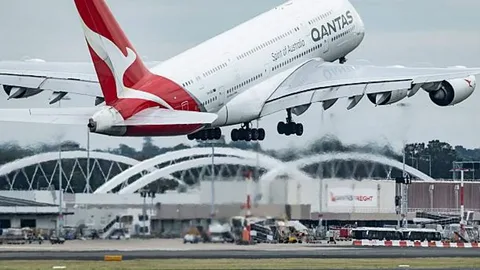

A shocking Qantas passenger incident unfolded mid-flight when a man bit a crew member, forcing the plane to land in French Polynesia. The disruptive traveler now faces a lifetime no-fly ban from the airline.
What Happened: The Qantas Passenger Incident Today
A Qantas flight travelling from Melbourne to Dallas was dramatically diverted on Friday after a passenger turned violent mid-flight. The Qantas passenger incident today has sent shockwaves through the aviation community and gone viral across social media platforms.
The man at the center of the Qantas passenger biting incident attacked a member of the cabin crew during the long-haul journey. Fellow passengers stepped in and physically restrained the individual before the situation could escalate further.
The flight, identified as QF21, was forced to make an unscheduled stop in Papeete, the capital of French Polynesia. This emergency diversion added significant delays to hundreds of passengers who were traveling between Australia and the United States.
Background: Flight QF21 Melbourne to Dallas
Qantas flight QF21 departed Melbourne at 3:27 PM local time and was well into its long transpacific route when the Qantas passenger incident unfolded. The Melbourne-to-Dallas route is one of the airline’s major long-haul international services.
The incident reportedly escalated quickly in the cabin. Eyewitnesses described a chaotic scene as the Qantas passenger biting attack targeted a flight attendant who was carrying out regular duties. Cabin crew are trained to handle in-flight disturbances, but a physical assault of this nature is considered extremely rare.
French Polynesia’s Papeete served as the closest viable diversion point given the flight’s position over the Pacific Ocean at the time of the incident. Local authorities were alerted and waiting upon the aircraft’s arrival.
Details: Qantas Passenger Bites Attendant on Board
The man was physically restrained by fellow passengers during the ordeal, with Australia’s national broadcaster ABC among the outlets reporting that he bit a member of Qantas staff.
The Qantas passenger biting incident has since attracted widespread attention, with searches for “Qantas passenger incident footage” and “Qantas passenger incident video” spiking online. While official video of the event has not been released by the airline, eyewitness accounts paint a disturbing picture of the confrontation.
The Qantas passenger who bit the attendant was described as highly disruptive throughout the flight. Crew members attempted to de-escalate the situation before it turned physical. The biting attack is being treated as a serious criminal assault by authorities.
Upon landing in Papeete, the man was met by local authorities and has been placed on a no-fly ban covering all Qantas aircraft. The severity of this response reflects just how seriously the airline is treating the Qantas passenger biting incident.
Official Response: Qantas Speaks Out
A Qantas spokesperson issued a statement to AFP on Sunday, saying: “The safety of our customers and our crew is our number one priority and we have zero tolerance for disruptive or threatening behaviour on our flights.”
This firm response from Qantas underscores the airline’s strict policy toward passengers who engage in dangerous or violent behavior. The Qantas passenger incident today is being treated with the utmost seriousness at the corporate level.
Aviation safety experts have praised the swift action taken both by fellow passengers who stepped in during the Qantas passenger biting episode and by the airline’s ground team in Papeete. Quick coordination between cabin crew and local law enforcement helped prevent any further harm.
Impact: What This Means for Airline Safety
The Qantas passenger biting incident has reignited global debate around in-flight passenger behavior and the protections available to airline staff. Flight attendants regularly face verbal abuse, but physical assaults like this Qantas passenger incident represent a more alarming trend.
Aviation industry groups have long called for tougher no-fly lists and criminal penalties for passengers who assault crew members. The Qantas passenger biting case may serve as a landmark example used to push for stronger international regulations around disruptive air travelers.
Hundreds of passengers on board QF21 experienced significant disruptions due to the diversion caused by the Qantas passenger incident today. The unscheduled stop in French Polynesia would have resulted in delays of several hours before the flight could continue on to Dallas.
For airline staff worldwide, this Qantas passenger incident video coverage and the resulting media attention bring renewed focus on the very real occupational hazards faced by those who work in the skies. Cabin crew unions in several countries have already reacted with calls for better protective measures.
What Happens Next: Legal and Travel Consequences
The individual involved in the Qantas passenger biting incident now faces both legal proceedings in French Polynesia and a permanent ban from flying with Qantas. Depending on local laws in Papeete, he could also face criminal charges related to assault on a transportation worker.
Qantas is expected to cooperate fully with French Polynesian authorities as the investigation into the Qantas passenger incident continues. The airline has a robust process for reporting and pursuing legal action against passengers who engage in violent in-flight behavior.
The Qantas passenger incident footage, if officially released in the future, could also form a key part of any prosecution. Many modern aircraft have cabin surveillance systems, and it is standard procedure for airlines to preserve this evidence in cases of serious in-flight misconduct.
The global aviation community will be watching closely to see what consequences follow from this Qantas passenger biting case, and whether it leads to strengthened industry-wide policies on crew protection and passenger accountability.
Frequently Asked Questions (FAQs)
Q: Which airline never had a plane crash?
Qantas is widely regarded as one of the safest airlines in the world and is frequently cited as having an exceptional safety record. The airline has not had a fatal crash involving a jet aircraft since the jet age began, making it a benchmark for aviation safety globally. However, no major commercial airline can claim a completely accident-free history across all aircraft types and all eras of operation.
Q: Why was Qantas fined $90 million?
In 2024, Qantas was ordered to pay approximately AUD 100 million (roughly USD 66–90 million depending on exchange rates) in penalties after the Australian Competition and Consumer Commission found the airline had sold tickets for flights that had already been cancelled. The Federal Court of Australia ruled that Qantas misled consumers by continuing to advertise and sell seats on ghost flights. It was one of the largest consumer law penalties in Australian history and caused significant reputational damage to the carrier.
Q: What flight lasts 57 seconds?
The world’s shortest scheduled commercial flight is the Loganair service between the Scottish islands of Westray and Papa Westray, part of the Orkney Islands. The flight covers a distance of roughly 2.7 kilometres and lasts approximately 57 seconds under favorable wind conditions. It holds the Guinness World Record for the shortest scheduled passenger flight on earth.