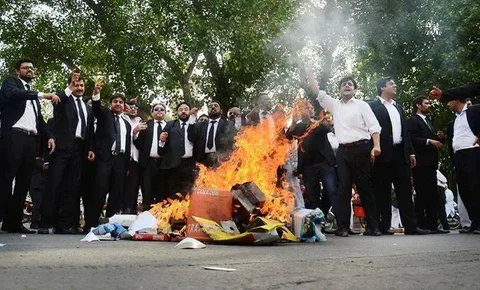

The Punjab lawyers protest 2026 has taken a sharp turn as the Lahore Bar Association (LBA) issued a strong warning against the government. Lawyers gathered in a major convention and threatened to boycott all court proceedings if the newly imposed biometric verification requirement for case filing is not withdrawn. The Punjab lawyers protest 2026 Pakistan situation is drawing serious attention from the legal community across the province.
Background What Triggered the Punjab Lawyers Protest 2026?
The Punjab lawyers protest 2026 did not emerge overnight. Tensions between the legal community and authorities have been building for months. The Lahore Bar Association hosted a lawyers’ convention that opposed the 26th and 27th constitutional amendments and warned of a possible boycott of courts over mandatory biometric verification for case filing.
Bar associations across Punjab have long been vocal about judicial reforms they consider harmful to citizens and lawyers alike. The introduction of biometric verification for litigants was the final trigger that pushed the legal community to organize this major protest convention in May 2026.
The Punjab lawyers protest 2026 date is significant the convention was held on May 8, 2026, at a private hotel in Lahore. It brought together elected representatives of bar associations from various districts of Punjab along with a large number of practicing lawyers.
Convention Details Who Attended and What Was Decided?
The convention was presided over by LBA President Irfan Hayat Bajwa. Elected representatives of bar associations from various districts of Punjab, along with a large number of lawyers, attended the event.
This was not a small gathering. The scale of the Punjab lawyers protest 2026 convention showed just how deeply dissatisfied the legal community has become. Lawyers from multiple districts united under one roof to voice their concerns collectively.
The convention passed strong resolutions against recent government policies. Speakers at the event condemned what they described as increasing complications being introduced into the judicial system in the name of reforms. The mood was firm, and the message was clear lawyers in Punjab are ready to escalate their protest if demands are not met.
Biometric Verification The Core Issue Behind the Protest
The immediate trigger for the Punjab lawyers protest 2026 Pakistan is the newly introduced biometric verification requirement for court filings. LBA President Bajwa disapproved of the newly introduced system of biometric verification of litigants, saying that citizens were facing increasing difficulties at the courts and that more complications were being created in the name of improvement in the judicial system.
This is a critical point. The government has framed biometric verification as a step toward modernizing and securing the judicial process. However, lawyers and litigants on the ground say it is creating barriers for ordinary citizens who already struggle with a slow and complex court system.
Bajwa warned that lawyers would boycott court proceedings from Monday if the condition of biometric verification for filing cases was not withdrawn.
If the boycott moves forward, it would mean thousands of cases could be delayed or stalled across Punjab courts affecting ordinary citizens, businesses, and families waiting for legal resolution.
Constitutional Amendments Also in the Crosshairs
The Punjab lawyers protest 2026 is not limited to the biometric issue alone. LBA President Bajwa addressed the convention, saying the event was not for any political party but against the 26th and 27th constitutional amendments.
This distinction is important. By clearly stating that the protest is not politically motivated, the LBA is positioning itself as a defender of constitutional principles rather than a partisan actor. The legal community has consistently argued that recent amendments have weakened judicial independence and the rule of law.
Bajwa said bar associations remained the only platform where voices were raised for the Constitution and the rule of law. He condemned restrictions imposed by the Punjab Bar Council, the regulatory body of lawyers, on bar associations for giving strike calls.
This is a significant statement. The LBA president is essentially accusing the Punjab Bar Council the regulatory body overseeing lawyers of trying to suppress protest action by restricting bar associations from calling strikes.
Quotes What LBA President Irfan Hayat Bajwa Said
LBA President Irfan Hayat Bajwa was the central voice at the convention. His statements reflect the collective frustration of Punjab’s legal community.
Bajwa maintained that bar associations should retain the authority to call strikes within their respective districts for the protection of lawyers’ rights and condemned restrictions imposed on such calls.
He also raised serious concerns about the direction of judicial reforms, stating that changes introduced under the banner of improvement are actually making the system more difficult for citizens to navigate.
His warning about a Monday court boycott is the clearest deadline set so far in the Punjab lawyers protest 2026 Pakistan situation. It gives the government a short window to respond before formal protest action begins.
Other Issues Raised CCD and IHC Judge Transfers
The convention also addressed several other pressing issues beyond biometric verification. Speakers at the convention condemned alleged extrajudicial killings by the Crime Control Department (CCD), claiming that the department had been established unlawfully.
The CCD has been a controversial institution since its formation. Lawyers and civil society groups have raised alarm over what they describe as a pattern of extrajudicial actions. The convention’s condemnation adds another powerful voice to these concerns.
Speakers also condemned the transfer of judges from the Islamabad High Court to other high courts.
The transfer of IHC judges has been a deeply contentious issue in Pakistan’s legal and political circles. Many in the legal community view these transfers as an attempt to weaken a court that has shown independence in its rulings. The Punjab lawyers protest 2026 is therefore also tied to broader concerns about judicial independence at the national level.
H2: Impact What Does This Mean for Punjab’s Courts?
The Punjab lawyers protest 2026 carries real and immediate consequences for the justice system in Pakistan’s most populous province. Punjab’s court system handles an enormous volume of cases from criminal matters to civil disputes, family law, and property cases.
If the LBA follows through on its threat and lawyers boycott court proceedings, the already overburdened system would face serious disruption. Hearings would be postponed. Litigants many of whom travel long distances and have waited months or years for their cases to be heard would face further delays.
At a broader level, the Punjab lawyers protest 2026 Pakistan situation highlights a growing tension between the government’s push for digitized judicial processes and the legal community’s concerns about accessibility and fairness. Biometric systems, while effective in some contexts, can be a barrier for elderly, rural, or less educated citizens.
The protest also signals that Punjab’s bar associations are willing to use the boycott as a political tool to pressure authorities a tactic that has historically proven effective in Pakistan.
Conclusion What Happens Next?
The Punjab lawyers protest 2026 is at a critical juncture. The LBA has set a clear deadline if biometric verification for court filings is not withdrawn by Monday, a full-scale court boycott will begin. The government and judiciary must now decide how to respond.
There are three possible paths forward. First, authorities could agree to review or withdraw the biometric requirement, de-escalating the Punjab lawyers protest 2026 Pakistan situation. Second, they could engage in dialogue with bar associations to find a middle ground perhaps making biometric verification optional or limited in scope. Third, if they ignore the warning, a prolonged boycott could follow, with significant legal and political consequences.
The broader concerns raised at the convention about constitutional amendments, the CCD, and the transfer of IHC judges will not disappear regardless of how the biometric issue is resolved. Pakistan’s legal community is clearly signaling that it intends to remain an active and assertive voice on matters of constitutional governance and the rule of law.
FAQs About Punjab Lawyers and Pakistan’s Legal System
Who is the highest paid lawyer in Pakistan?
Pakistan does not have a publicly available official ranking of lawyers by income. However, senior advocates of the Supreme Court of Pakistan, particularly those who handle high-profile corporate, constitutional, and criminal cases, are considered the highest earning members of the legal profession. Names like Makhdoom Ali Khan, Fakhruddin G. Ebrahim (late), and Shahid Hamid have been among the most prominent and well-compensated senior legal figures in Pakistan’s history.
Who is the famous female lawyer in Pakistan?
Pakistan has several highly respected female lawyers. Hina Jilani is arguably the most internationally recognized a human rights lawyer and UN Special Rapporteur who has received global awards for her work. Asma Jahangir (late) was a towering figure in Pakistan’s legal and human rights landscape, widely considered one of the most influential lawyers in the country’s history. At the High Court level, several women have also risen to prominence as senior advocates in Punjab and Sindh.
How many lawyers are in Punjab?
Punjab has the largest concentration of lawyers in Pakistan. According to the Punjab Bar Council, the province has over 60,000 registered lawyers, spread across district, sessions, and High Court bars. Lahore alone, being the provincial capital and home to the Lahore High Court, has one of the largest bar associations in South Asia. This large and organized community gives Punjab’s bar associations significant collective power as seen in the Punjab lawyers protest 2026.