
PM Albanese mosque Israel protest erupted during Australian Prime Minister Anthony Albanese’s visit to Lakemba Mosque — Australia’s largest — when hundreds of worshippers heckled and booed him over what they described as his inadequate response to Israel’s military operations in Gaza and Lebanon.
PM Albanese mosque Israel protest is one of the most politically uncomfortable moments of his prime ministership — with the Prime Minister facing direct public anger from Australia’s Muslim community in a setting that was intended to demonstrate interfaith respect but instead became a highly visible demonstration of the political cost of Albanese on Israel positions that many Muslim Australians consider insufficiently critical of Israeli military conduct.
Albo on Israel diplomatic balancing act — attempting to maintain the Australia-US alliance while responding to Muslim community concerns about Israeli military operations — has defined one of the most difficult political fault lines of the Albanese government and the PM Albanese mosque Israel protest has brought that fault line into its sharpest and most public focus yet.
Background: PM Albanese Mosque Israel Protest — Why It Happened
Australia’s Muslim Community and Israel
PM Albanese mosque Israel protest must be understood against the backdrop of Australia’s Muslim community’s deep engagement with the Palestinian cause — with approximately 800,000 Australian Muslims whose connections to the Middle East through family heritage and religious solidarity make Israeli military operations in Gaza and Lebanon an issue of profound personal and political significance.
Australia’s Muslim community has been among the most vocal and politically organised critics of Israeli military operations in the current conflict — participating in some of the largest public demonstrations in Australian history and applying consistent electoral pressure on Labor government MPs in seats with significant Muslim populations.
PM Albanese mosque Israel protest at Lakemba — located in southwest Sydney’s Auburn and Canterbury-Bankstown area which contains Australia’s largest concentration of Muslim Australians — placed the Prime Minister in the direct political geography of his government’s most acute community relations challenge.
Albanese on Israel — The Political Tightrope
Albanese on Israel policy has attempted to navigate between 3 competing pressures that have made the PM Albanese mosque Israel protest an expression of the government’s fundamental political difficulty rather than a manageable communications incident.
Albanese on Israel first pressure is the Australia-US alliance — with AUKUS obligations and the broader US alliance framework requiring Australia to maintain a relationship with Israel that is at minimum not actively hostile given Israel’s status as the primary US military partner in the Middle East during the current Iran war.
Albanese on Israel second pressure is domestic Muslim community political power — with Labor holding multiple marginal seats in southwestern Sydney where Muslim voter dissatisfaction with Albanese on Israel positions threatens to produce electoral consequences that the government’s slim parliamentary majority cannot absorb.
Albanese on Israel third pressure is the broader Australian electorate — where polling has shown growing public opposition to Israeli military operations in civilian-populated areas while also showing continued support for the Australia-US alliance that makes a complete break with Israel’s diplomatic position politically difficult.
What Happened at the Mosque
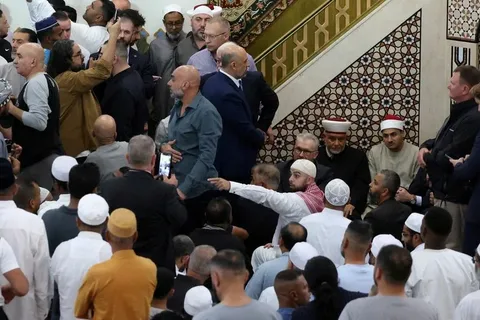
The PM Albanese Mosque Israel Protest — Scene Description
PM Albanese mosque Israel protest began as the Prime Minister arrived at Lakemba Mosque for what was scheduled as a Ramadan iftar visit — with crowds gathered outside the mosque beginning to heckle and boo as his motorcade arrived.
Inside the mosque PM Albanese mosque Israel protest continued — with worshippers calling out demands for stronger Australian government condemnation of Israeli military operations and calling on Albanese on Israel to take a clearer position against what community members described as war crimes.
PM Albanese mosque Israel protest confrontation with the Prime Minister included direct verbal challenges from worshippers who asked why the Australian government had not done more to condemn Israeli strikes on civilian infrastructure in Lebanon and Gaza — with Albanese attempting to respond to questions while the heckling continued around him.
Albo on Israel responses during the PM Albanese mosque Israel protest were measured and diplomatic — with the Prime Minister acknowledging civilian suffering and expressing concern about humanitarian conditions while stopping short of the explicit condemnations that protesters were demanding.
Albanese on Israel — His Position
What Albanese Has Said and Done
Albanese on Israel policy has evolved over the course of the conflict — moving from early statements that emphasised Israel’s right to self-defence toward increasing expressions of concern about civilian casualties and humanitarian conditions while maintaining Australia’s broader diplomatic relationship with Israel.
Albanese on Israel formal government actions have included Australia’s support for UN General Assembly resolutions calling for ceasefire in Gaza alongside other Western nations Australia’s repeated calls for humanitarian access and its expressions of concern about civilian casualties in Lebanon from Israeli operations.
Albanese on Israel position has not included the explicit recognition of Palestinian statehood that multiple European nations have granted the recall of Australia’s ambassador to Israel or the formal designation of Israeli military actions as war crimes — the steps that PM Albanese mosque Israel protest participants have demanded.
Albo on Israel critics within the Muslim community argue that the gap between Albanese’s expressions of concern and concrete policy action represents a failure of political leadership — prioritising alliance management over the humanitarian obligations that international law imposes on all nations regardless of their alliance relationships.
Albo on Israel — Political Consequences
Electoral Implications
Albo on Israel political consequences from the PM Albanese mosque Israel protest extend beyond the immediate embarrassment of being publicly heckled at Australia’s largest mosque to encompass the broader electoral arithmetic of a government holding a slim parliamentary majority.
Albo on Israel electoral threat is concentrated in a specific set of southwestern Sydney seats — including Watson Blaxland and McMahon — where Muslim voter populations are large enough to determine electoral outcomes and where Labor’s 2022 margins are narrow enough to be overturned by the kind of community mobilisation that the PM Albanese mosque Israel protest reflects.
Albo on Israel internal Labor pressure has also increased following the mosque protest — with Labor MPs representing Muslim-majority electorates privately pressing the government to take stronger positions on Israeli military operations in ways that would reduce the community anger the PM Albanese mosque Israel protest has made nationally visible.
Quotes
PM Albanese stated during the mosque visit that his government had consistently called for the protection of civilian lives and humanitarian access — adding that Australia had used its international voice to press for ceasefire and that he understood the deep concern of the Muslim community about the suffering of Palestinian and Lebanese civilians.
Lakemba Mosque community leader Sheik Wesam Charkawi told reporters after the PM Albanese mosque Israel protest that the community’s message to the Prime Minister was simple — words were not enough and that the Australian government needed to take concrete action including recognising Palestinian statehood and conditioning the Australia-Israel relationship on respect for international humanitarian law.
Australian Greens leader Adam Bandt stated that the PM Albanese mosque Israel protest demonstrated the political cost of the government’s failure to take a principled stand on Israeli military operations — adding that the Greens had consistently called for Palestinian statehood recognition and arms embargo on Israel that the Albanese government had refused to implement.
Opposition Leader Peter Dutton described the PM Albanese mosque Israel protest as a consequence of the government’s confused and inconsistent Albanese on Israel foreign policy — adding that Australia needed a clear and principled stance on the conflict that was consistent with its alliance obligations and humanitarian values simultaneously.
Impact: PM Albanese Mosque Israel Protest Consequences
For Labor Government
PM Albanese mosque Israel protest has intensified the political pressure on the Albanese government from both directions of its Israel policy dilemma — with the mosque heckling increasing Muslim community demands for stronger action while simultaneously generating media coverage that nationalist-leaning voters in other electorates may interpret as evidence of inadequate support for Israel.
PM Albanese mosque Israel protest timing — during the broader Iran war that has made Israeli military operations in Lebanon more intense and more internationally controversial — has made the Albanese on Israel political dilemma more acute than at any previous point in the government’s term.
For Australian Muslim Community Relations
PM Albanese mosque Israel protest represents a deterioration in Labor’s relationship with the Muslim community that has historically been among Labor’s most reliable voter blocs — a deterioration with long-term electoral consequences that extend beyond the current conflict to reshape the political alignment of one of Australia’s fastest-growing demographic communities.
Frequently Asked Questions
Why Are There Protests in Israel?
Protests in Israel have occurred throughout the current conflict for multiple reasons including opposition to the government’s management of hostage negotiations, calls for early elections, and demonstrations by families of hostages demanding prioritisation of their return. Israeli anti-war protests have also occurred though they represent a minority position in a society that has experienced unprecedented direct Iranian missile attacks on its cities during the current conflict. The protests most visible internationally are not in Israel but about Israel — with demonstrations in Australia the UK Europe and across Muslim-majority nations expressing opposition to Israeli military operations in Gaza and Lebanon that have produced significant civilian casualties.
Why Is Al-Aqsa Mosque Important to Israel?
Al-Aqsa Mosque is built on the Temple Mount — the holiest site in Judaism — creating an overlapping religious geography that makes it simultaneously the third holiest site in Islam and the location of the First and Second Temples whose destruction is mourned by Jews at the adjacent Western Wall. Israel controls security over the Temple Mount compound following its capture of East Jerusalem in 1967 while Jordan maintains Waqf administrative custodianship of the Al-Aqsa Mosque itself. The Al-Aqsa Mosque significance to Israel is therefore both religious — as the location of Judaism’s holiest site — and political — as one of the most contested sovereignty questions in the Israeli-Palestinian conflict whose management reflects Israel’s claim to sovereignty over a unified Jerusalem.
How Many People Protest in Israel?
Anti-government protests in Israel before the current Iran war regularly attracted crowds of 100,000 or more — with the 2023 judicial reform protests producing some of the largest demonstrations in Israeli history with estimates of up to 500,000 participants in a single Tel Aviv demonstration. During the current Iran war public protest activity in Israel has been significantly reduced by the security environment — with air raid sirens shelter protocols and the national security emergency creating conditions in which mass public gatherings are both practically difficult and politically sensitive. International protests about Israeli military operations — including the PM Albanese mosque Israel protest — reflect global Muslim community mobilisation that has produced demonstrations across dozens of countries simultaneously with total participation estimated in the millions across all locations combined.
Conclusion
PM Albanese mosque Israel protest has exposed with painful clarity the political impossibility of the position that Albanese on Israel policy has attempted to occupy — too critical of Israel for alliance managers and too supportive for Muslim community activists demanding concrete action commensurate with the humanitarian crisis they are witnessing.
Albo on Israel dilemma is not unique to Australia — with centre-left governments across Western democracies facing the same electoral and moral tension between alliance obligations and community demands for humanitarian accountability. But the PM Albanese mosque Israel protest has made Australia’s version of this tension one of the most publicly visible in the world — a spectacle of democratic accountability that reflects both the vitality of Australia’s multicultural democracy and the genuine difficulty of governing a diverse society through a conflict that divides communities along lines of identity solidarity and moral conviction that no diplomatic language can bridge.