
The Numbers That Shocked a Nation
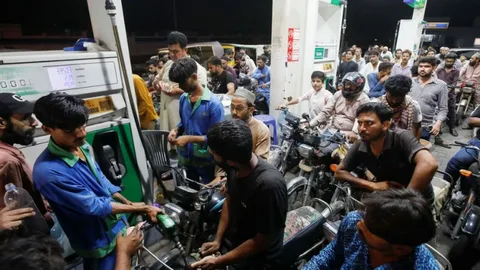
Pakistan woke up on April 3 to petrol prices it had never seen before. The government announced an unprecedented increase of 43 percent in the price of petrol and 55 percent in high-speed diesel, effective immediately. Petrol rose by Rs137 to Rs458.40 per litre. Diesel surged by Rs184 to Rs520.35 per litre. Long queues formed at petrol stations across Karachi, Lahore, and Islamabad as people rushed to fill their tanks before the new rates took hold.
This was the second hike in less than a month. In March, Pakistan had already raised fuel prices by roughly 20 percent, citing rising oil prices driven by the US-Israeli war on Iran. The April increase followed because the government admitted it could no longer afford to absorb the difference between domestic prices and a global crude oil market that had lost control. Diesel prices on global benchmarks had touched a record high of around $250 per barrel on the day of the announcement. Crude oil prices on the Oman and Dubai benchmarks had risen 80 to 90 percent since the conflict began.
For Pakistan’s already-strained population, the timing could not have been worse.
Why Pakistan Is So Exposed
The Pakistan petrol crisis is not just a local reaction to a global event. It is the product of a structural vulnerability that has been building for decades — and that the current shock has simply made impossible to ignore.
Pakistan imports approximately 80 percent of its energy from the Gulf, primarily from Saudi Arabia and the United Arab Emirates, transported through the Strait of Hormuz. That single chokepoint is now the most consequential stretch of water in the global energy system. The US-Israel war on Iran has disrupted shipping through the passage, with more than 12 million barrels of oil lost daily to attacks on Gulf energy infrastructure and restrictions on maritime movement. For Pakistan, which has no meaningful strategic petroleum reserve and almost no domestic crude production, every disruption at the Strait translates directly into a supply shock that hits the consumer within weeks.
The petroleum minister described the situation plainly at the announcement press conference: global markets had spiralled beyond control. Pakistan had managed to secure energy supply lines despite a sharp increase in crude oil prices, but doing so at subsidised domestic prices had become fiscally impossible. The government had already provided subsidies worth Rs129 billion in the three weeks before the announcement. Continuing that level of support was no longer an option the national finances could absorb.
The IMF’s role adds a further constraint. Under Pakistan’s ongoing IMF programme, the government had committed to maintaining petroleum development levies at high levels as a revenue measure. The levy on petrol alone stood at Rs84 per litre — meaning that even before the fuel cost is calculated, over 57 percent of what a consumer pays at the pump goes directly to the government in tax. That levy floor cannot fall meaningfully even if global crude softens, because it is locked in as a programme condition. The Pakistan petrol crisis is therefore not purely imported. It is also partly a consequence of the fiscal architecture Pakistan agreed to in exchange for IMF support.
The Human Cost
Pakistanis now pay more for petrol relative to their income than almost every country on earth — ranked second worldwide behind only Ethiopia in income-adjusted fuel cost, according to data compiled by global fuel price trackers. Pakistan’s nominal petrol price of approximately USD 1.15 per litre sits below the global average of USD 1.40 per litre — but Pakistan’s per capita income of roughly $1,700 per year makes the real burden far heavier than the nominal number suggests.
Commuters across Karachi described the situation in terms that went beyond inconvenience. One resident said that earlier prices had been raised by around Rs55, and now there was another steep hike of Rs137 — making it impossible to manage household expenses. Another called it injustice against the people. Daily wage earners who depend on two-wheelers and public transport face a compounding burden — transport costs rise, food costs follow as freight rates climb, and the disposable income needed to absorb both has already been depleted by two years of elevated inflation.
The government announced targeted relief measures to cushion the impact — a subsidy of Rs100 per litre for two-wheeler users capped at 20 litres per month for three months, Rs1,500 per acre support for small farmers, and early market closures to save electricity. These measures are real but limited, covering a fraction of the population bearing the cost of a crisis generated by global forces the government did not create and cannot fully control.
Iran Petrol Price vs Pakistan — A Striking Contrast
The Iran petrol price comparison throws the Pakistan petrol crisis into sharp relief. Iran, whose subsidised domestic fuel market keeps petrol prices at a tiny fraction of international rates, sits at the opposite end of the global fuel price spectrum from Pakistan. The Iran petrol price — heavily state-subsidised from the country’s own oil production — has historically been among the lowest in the world, with the first 60 litres per month sold at deeply discounted rates. Pakistan, which produces almost no crude domestically and subsidises nothing at the structural level, has moved toward the opposite extreme at the moment of its greatest regional vulnerability.
The irony is stark: Iran, the country whose war with the United States and Israel triggered the Pakistan petrol crisis, is precisely the neighbour whose energy relationship with Pakistan has remained diplomatically and economically constrained for decades. A functioning Iran-Pakistan gas pipeline — stalled since 2014 — could have significantly reduced Pakistan’s exposure to Gulf supply chains and Strait of Hormuz disruptions. The Pakistan petrol crisis is, among other things, the cost of that unfinished infrastructure.
India Petrol Price — The Comparison That Matters
The petrol price in India context is equally instructive. As of April 3, petrol in Delhi was trading at approximately Rs96 per litre — roughly one-fifth of Pakistan’s new price in rupee terms, when currency differentials are accounted for, and significantly more stable. India’s fuel market benefits from a different set of structural advantages: domestic crude production, refined product exports, diversified import sources beyond the Gulf, and a much larger economy with the fiscal depth to absorb supply shocks without immediately passing them through to consumers. The petrol price in India has also not been immune to the Iran war — Brent crude has crossed $100 per barrel and India imports nearly 88 percent of its crude requirement — but India’s state oil companies have been directed to hold prices stable, at least in the short term, absorbing the margin difference.
The petrol price in India comparison is not an argument that Pakistan’s crisis is self-inflicted — global supply disruptions affect both countries. It is an argument that structural preparation determines who absorbs the shock and who passes it through.
The Crisis That Could Change Everything
The Pakistan petrol crisis of 2026 is the most acute energy shock the country has experienced in a generation. But if it produces a genuine policy response, it may also be the most consequential in a different sense — not as a catastrophe, but as a forcing function.
Every analyst who has studied Pakistan’s energy vulnerability has reached the same conclusion: the country cannot continue to build its economy on imported fossil fuels routed through a single maritime chokepoint. Pakistan has vast potential for solar and wind energy, particularly in Sindh and Balochistan. It has domestic natural gas reserves that could be better developed. It borders Iran, whose gas could replace a significant portion of fuel imports if the pipeline were completed. And it is part of a region where regional energy connectivity — with Central Asia, with China through CPEC, with the Gulf — could fundamentally reduce its import dependency over a decade.
The 2026 petrol crisis must be seen as a red flag and not a temporary annoyance. The economy of Pakistan cannot be sustained any longer on fluctuating world oil markets and short-term policy reactions. Regional cooperation, strategic planning, and structural reform are the way out — unless the country wishes to replay the same crisis every few years.
The question is whether this crisis finally delivers the political will to make those changes — or whether, as in previous crises, the pain subsides before the reforms begin.
Frequently Asked Questions
Why are fuel prices going up in Pakistan?
The Pakistan petrol crisis is the result of two intersecting pressures. The first is external — the US-Israel war on Iran has disrupted shipping through the Strait of Hormuz, through which Pakistan receives the overwhelming majority of its imported oil. Crude oil prices on Oman and Dubai benchmarks rose 80 to 90 percent after the conflict began. The second is structural — Pakistan imports approximately 80 percent of its energy, has almost no strategic petroleum reserve, and operates under an IMF programme that requires high petroleum levies as a revenue measure. The government absorbed approximately Rs129 billion in subsidies in the three weeks before the April 3 announcement before concluding that blanket subsidies were no longer financially sustainable.
What is the price of 1 litre of petrol?
As of April 3, the price of 1 litre of petrol in Pakistan is Rs458.40, following the government’s announcement of a 43 percent increase. Diesel has risen to Rs520.35 per litre — an increase of 55 percent. These are the highest fuel prices in Pakistan’s history. For comparison, the petrol price in India as of the same date is approximately Rs94 to Rs103 per litre depending on the city, with Delhi at around Rs96 per litre. The Iran petrol price remains among the lowest in the world due to heavy state subsidies, with the government selling the first 60 litres per month at deeply discounted rates from domestic oil production.
Is Pakistan in crisis?
Pakistan is managing multiple intersecting pressures simultaneously. The Pakistan petrol crisis is the most immediate — a 43 to 55 percent fuel price increase announced on April 3 following a 20 percent increase in March, driven by global supply disruptions from the Iran war. Beyond fuel, Pakistan is managing high inflation, an ongoing IMF programme with fiscal conditionality, foreign exchange reserve pressures, and the economic consequences of the Middle East conflict on its remittance flows and trade routes. The government has characterised its response as a joint decision between civil and military leadership to ensure the country stays within its fiscal limits and avoids slipping back into financial crisis. The crisis is real and severe. Whether it is managed successfully will depend on the duration of the Iran war, the trajectory of global oil prices, and the speed at which Pakistan can accelerate the structural energy reforms that every analysis of its vulnerability recommends.
Conclusion
The petrol crisis that could electrify Pakistan is not a metaphor — it is a literal description of what this moment demands. A country that ranks second in the world for income-adjusted fuel cost, that imports 80 percent of its energy through a chokepoint currently disrupted by war, and that has just delivered the largest single fuel price increase in its history has arrived at a threshold.
The path forward runs through solar farms in Sindh, gas pipelines from Iran, wind corridors in Balochistan, and an energy policy built for the twenty-first century rather than the twentieth. The Pakistan petrol crisis of 2026 did not create that need. It simply made the cost of ignoring it visible — at Rs458 per litre, at petrol stations across the country, on the faces of commuters who can no longer afford the journey to work.