

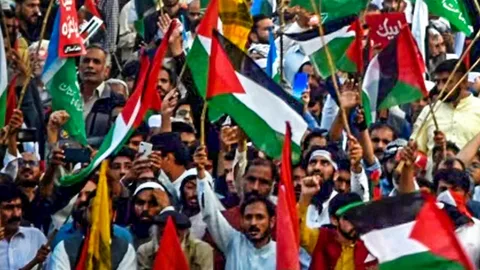

Pakistan has consistently stood beside the Palestinian people throughout the brutal Gaza war, raising its voice at the United Nations, condemning Israeli aggression, and demanding an immediate and permanent ceasefire. As one of the Muslim world’s most vocal advocates for Palestinian rights, Islamabad’s position on the Gaza conflict is clear: it supports Palestine, rejects Israeli military operations, and does not recognize Israel as a state.
Background: Pakistan and Palestine A Long-Standing Bond
Pakistan’s support for Palestine is not a recent development. Since its founding in 1947, Pakistan has never recognized Israel and has always championed the right of the Palestinian people to self-determination. This position is deeply rooted in both religious solidarity and political principle.
Pakistan advocates for an independent Palestinian state based on pre-1967 borders, with Al-Quds Al-Sharif (Jerusalem) as its capital. This stance has remained consistent across every government, military or civilian, for over seven decades.
Pakistan to Gaza: Distance and Geography
For those wondering about the Pakistan to Gaza distance, the two regions are separated by roughly 4,000 to 4,500 kilometers by air, passing over Iran, Iraq, and Jordan. There is no direct flight route between Pakistan and Gaza. Pakistan and Palestine do not share a border; they are geographically apart but diplomatically and emotionally close.
On a Pakistan to Gaza map or a Pakistan and Palestine map, the distance is significant, but Pakistan’s moral and diplomatic proximity to the Palestinian cause has never wavered. The suffering in Gaza is felt deeply across Pakistan’s 250 million people.
Pakistan Stance on Palestine Issue: Official Position
Pakistan’s official stance on the Palestine issue is unambiguous. The government has repeatedly called for a two-state solution, an immediate ceasefire in Gaza, and the lifting of the siege on Palestinian civilians. Pakistan does not recognize Israel and has never established diplomatic ties with Tel Aviv.
Pakistan’s National Assembly passed a unanimous resolution condemning Israel’s military campaign in Gaza, describing it as a “heinous wave of atrocities.” The resolution demanded an immediate ceasefire and expressed full solidarity with the Palestinian people. Pakistan’s parliament, across party lines, stood united on this issue.
At the UN Security Council, where Pakistan served as a non-permanent member for the 2025–2026 term, Islamabad used its platform to advocate strongly for Palestinian rights. Pakistan’s Foreign Minister Ishaq Dar stated that Pakistan would “continue to work with the OIC and Arab partners to mobilize global support for the Palestinian right to self-determination, justice and peace.”
Does Pakistan Support Israel or Palestine?
The answer is unequivocal: Pakistan supports Palestine, not Israel. Pakistan does not recognize Israel as a state and has no diplomatic relations with it. A Gallup poll conducted after the October 7, 2023 Hamas attack found that 91% of Pakistanis expressed sympathy with the Palestinian people, compared to just 2% who sided with Israel. This reflects one of the strongest pro-Palestine public sentiments anywhere in the world.
Pakistan’s Army Corps Commanders, meeting under Chief of Army Staff General Asim Munir, publicly expressed “complete solidarity” with the Palestinian people and condemned Israeli actions in Gaza as “war crimes.” This military-level statement is rare and reflects how deep Pakistan’s institutional commitment to the Palestinian cause runs.
Pakistan on Gaza War: Key Actions and Statements
Pakistan has taken several notable steps during the ongoing Gaza war:
At the United Nations: Pakistan co-signed joint statements condemning Israeli interceptions of Gaza-bound aid flotillas. As a UN Security Council member, Pakistan voted in favor of ceasefire resolutions and called for unhindered humanitarian access to Gaza. Pakistan has also supported the International Court of Justice’s rulings on Israel’s obligations under international law.
At the OIC: Pakistan has been among the most active voices at the Organisation of Islamic Cooperation, urging member states to take decisive diplomatic action against Israeli military operations. Pakistan called on OIC nations to support trade restrictions, sustained diplomatic pressure, and legal accountability for Israel’s actions.
Humanitarian Aid: Pakistan expressed full support for UNRWA, the UN agency for Palestinian refugees, and condemned Israeli attempts to obstruct its operations. Pakistan called the targeting of aid agencies “a moral outrage and a violation of international law.”
Domestic Measures: Pakistan’s All Parties Conference, held on October 7, 2024, passed a resolution condemning Israel’s campaign and calling for global action. Mass solidarity marches were held across Pakistani cities, with tens of thousands participating.
Pakistan’s Role in Gaza Conflict: Diplomacy and Peacekeeping Debate
One of the most discussed topics regarding Pakistan’s role in the Gaza conflict is the debate over joining a proposed International Stabilisation Force (ISF) for Gaza. When the UN Security Council adopted a US-authored resolution paving the way for a transitional administration in Gaza, Pakistan — which was presiding over the Council at the time voted in favor but also noted reservations, saying some of its critical suggestions were not included.
A Gallup Pakistan survey in early 2026 found that nearly three-quarters of Pakistanis supported sending Pakistani troops to Gaza as part of the ISF. Pakistan officials repeatedly stressed that any potential deployment would require “a transparent, politically neutral mandate focused on humanitarian stabilisation rather than disarmament of Palestinian groups.”
Pakistan also joined the US-led Board of Peace, a move that sparked domestic criticism given the absence of Palestinian representation in that body. However, Pakistan defended the decision, stating it would use the platform to advocate for Palestinian rights.
Does Palestine Support Pakistan on Kashmir Issue?
Yes. Palestine and Pakistan share a mutual diplomatic understanding on their respective national causes. Within the Organisation of Islamic Cooperation, resolutions have consistently linked the right to self-determination of both the Palestinian people and the Kashmiri people.
Pakistan’s Foreign Minister Ishaq Dar drew a direct parallel at international forums, stating: “Like Israel in Palestine, India is seeking to brutally suppress the Kashmiris and bring in settlers from all over India to transform occupied Kashmir from a Muslim majority to a Hindu majority territory.”
The OIC, of which Palestine is an observer, has regularly included Kashmir in its declarations alongside Palestine. While Palestine does not have the same institutional leverage as larger states, the political solidarity between Islamabad and Palestinian leadership has been consistent. Both causes are framed under the shared principle of self-determination and an end to military occupation.
Quote: Pakistan’s Commitment to Palestine
“Pakistan reaffirms its unwavering solidarity with the Palestinian people. As a non-permanent member of the UN Security Council for the term 2025–2026, Pakistan has made it a priority to advance peace in the Middle East and justice for our Palestinian brothers and sisters.” Pakistan Ministry of Foreign Affairs
“The question of Palestine is a test case for the credibility of the United Nations and of the international order. Justice delayed is justice denied.” Pakistan Foreign Ministry Statement, September 2025
Impact: Pakistan’s Global Role in Gaza Crisis
Pakistan’s vocal stance on the Gaza war has reinforced its image as a leading Muslim-majority nation in international diplomacy. Its seat on the UN Security Council gave Islamabad rare leverage to push for ceasefire resolutions and humanitarian access directly. Pakistan’s position has also strengthened its ties with Arab nations, Turkey, and other OIC members.
At the same time, Pakistan’s partial alignment with the US-led Board of Peace has sparked debate at home. Critics argue that Pakistan should be more assertive, while the government maintains that diplomatic engagement is more effective than isolation.
Pakistan’s stance has also influenced its bilateral relationship with India, with Islamabad repeatedly drawing comparisons between Gaza and Kashmir to elevate the Kashmiri cause in international discourse.
Conclusion: Pakistan’s Firm Stand on Gaza, Palestine, and the Road Ahead
Pakistan’s position on the Gaza war and the broader Palestine issue remains one of the strongest in the Muslim world. From voting at the UN Security Council to passing unanimous parliamentary resolutions, from army-level solidarity statements to mass public protests, Pakistan has shown deep and consistent support for the Palestinian people.
As the Gaza war continues to reshape Middle East politics, Pakistan will likely remain an active diplomatic player using its OIC membership, UN seat, and bilateral relationships to push for a ceasefire, humanitarian relief, and ultimately a sovereign Palestinian state.
The path from Pakistan to Gaza may be thousands of kilometers long on a map. But Pakistan’s political and moral commitment to the people of Gaza remains as close as ever.
FAQs
Can a Pakistani go to Gaza?
Pakistanis cannot travel directly to Gaza. There are no direct flights, and Gaza is under a prolonged blockade by Israel, severely restricting all movement in and out of the territory. Entry is extremely limited even for international aid workers and journalists. Travel to Gaza is not possible under normal circumstances for any nationality.
Who is the best friend of Pakistan?
Pakistan’s strongest diplomatic allies are generally considered to be China and Saudi Arabia. China has been Pakistan’s most significant economic and strategic partner, especially through the China-Pakistan Economic Corridor (CPEC). Saudi Arabia has historically provided financial support and shares strong religious and cultural ties with Pakistan. Turkey is also considered a close friend. In the context of the Gaza conflict, Pakistan’s ties with Arab Muslim nations have been reinforced by shared support for Palestine.
Which 9 countries voted against Palestine?
In the September 2025 UN General Assembly vote on the New York Declaration which backed a two-state solution, an immediate ceasefire, and Palestinian statehood ten countries voted against the resolution: Israel, the United States, Argentina, Hungary, Micronesia, Nauru, Palau, Papua New Guinea, Paraguay, and Tonga. These countries consistently align with US and Israeli positions on Palestinian statehood resolutions at the UN.