
(Publish from Houston Texas USA)
(By Mian Iftikhar Ahmad)
From wounds to wisdom—how Shafqatullah Mushtaq’s ghazal reflects a complete spiritual journey
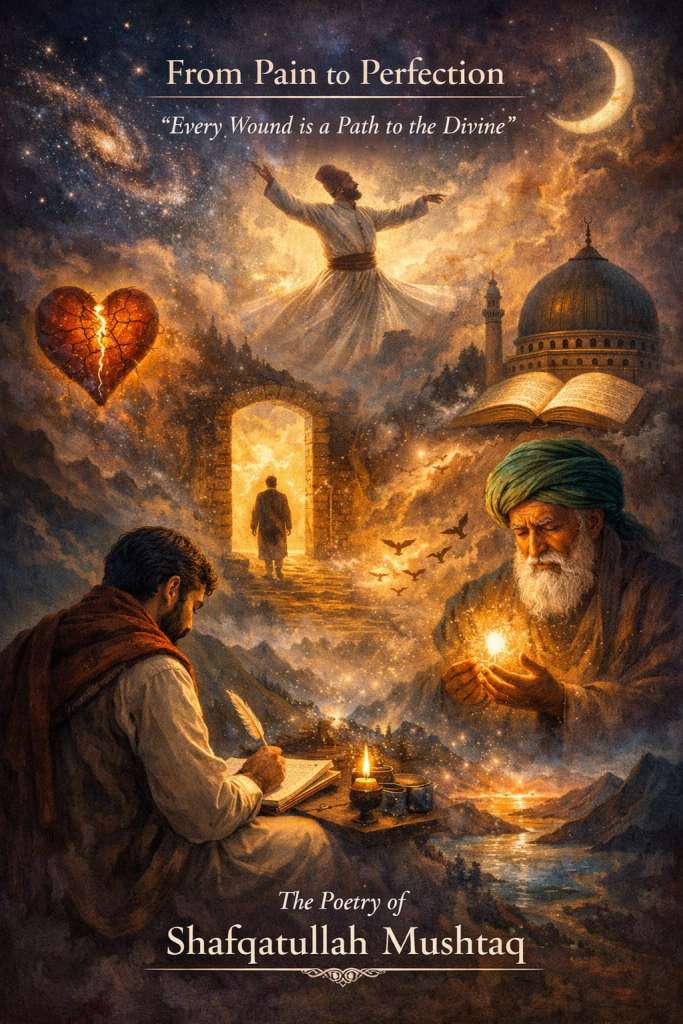
In the name of Allah, the Most Gracious, the Most Merciful. Shafqatullah Mushtaq’s poetry is not merely a ghazal; it is a spiritual travelogue, an autobiography that begins with pain and culminates in perfection. This is a ghazal that contains the wound of love, the fervor of self-awareness, the search for the Beloved’s presence in the universe, the realization of boundless grace, the crafting of a path from sorrows, the certainty of divine assistance, and finally, the declaration of maturity through trials—everything is present within it. This is a complete philosophy of life, molded in classical tradition yet entirely contemporary in spirit.
میرے سینے پہ جب سے تم نے اک گھاؤ لگایا ہے
کبھی خود کو سلایا ہے کبھی خود کو جگایا ہے
This couplet expresses the dual effect of love—on one hand it inflicts a wound, on the other it bestows awakening. “You have inflicted a wound” refers to the mark left by the Beloved. While outwardly this Beloved could be any entity, inwardly it serves as a metaphor for the Divine Being who first wounds the servant and then, through that very wound, draws him toward Himself.
The poet says that ever since this wound was inflicted, his relationship with his own self has transformed. “Sometimes I lull myself to sleep, sometimes I awaken myself”—this is a peculiar state. Sometimes he puts himself to sleep in heedlessness to escape the sting of this wound; sometimes he awakens himself to remain conscious of this reality. This is a continuous process of conflict and reconciliation with oneself. Psychologically, this reflects a state where a person remains trapped between two selves within—one that flees from pain and another that finds its very survival in pain.
This couplet is both the climax and the foundation of the ghazal. The journey begins here.
بنا کر بھیس غالب کا میں غالب آ گیا سب پر
مگر خود کو تمھارے سامنے مغلوب پایا ہے
This couplet is an unparalleled expression of the poet’s intellectual and artistic accomplishments alongside his humility. “Assuming the guise of Ghalib”—meaning the poet acquired such mastery, such understanding and artistry, that he virtually assumed the persona of Ghalib himself. “I overcame everyone”—in debate and discourse, in art and wisdom, in logic and argument, he surpassed all. He reached a station where no one could stand before him.
But then, with the single word “however,” he transforms this victory into defeat. “But found myself overwhelmed before you”—when that True Being appears, for whom all these efforts were made, all accomplishments lose their meaning. Even the guise of Ghalib proves futile. This couplet articulates a fundamental truth of love: love transcends knowledge, love is beyond logic. No matter how much you become like Ghalib, a single glance of love renders you subdued.
This is a Sufistic state where the seeker, after all his spiritual exercises and disciplines, finally realizes that in truth he is nothing, and everything is by Divine grace.
زمین و آسماں کی وسعتوں میں چار سو میں نے
جہاں دیکھا، جدھر دیکھا ترا ہی نقش پایا ہے
This couplet opens a door to the mysteries of Wahdat al-Wujud (Unity of Being). The poet says that in the expanses of the earth, in the heights of the heavens, in all four directions—everywhere, in every direction, he found only Your imprint. “In all directions” means complete encompassment. This is not a claim of metaphorical love; this is the realization of Truth.
When love reaches its culmination, the lover begins to perceive the Beloved’s reflection in every object of existence. This state is also found in the works of Rumi, Ibn Arabi, and Ghalib. The poet has expressed this realization in remarkably simple yet profound words. The word “imprint” (naqsh) is highly significant here—meaning the Beloved’s mark, His sign, His glimpse. This is the state where unity is perceived within multiplicity, and every thing appears to point toward its Creator.
This couplet is not merely part of a ghazal; it is a testament of mystical realization.
سمجھ آیا نہیں اس کا یہ اندازِ کرم مجھ کو
مجھے ہر بار گر جانے سے پہلے ہی بچایا ہے
This couplet is a beautiful expression of humility and wonder. The poet says he cannot comprehend the manner of this grace—what kind of grace is it that whenever he is about to fall, he is saved even before falling?
“To fall” may refer to outward decline as well as inward—the traps of the ego, the dark wells of heedlessness, or the commission of grave errors. “Saved even before falling” means he hasn’t even begun to fall when he is already caught. This reveals the transcendent nature of this grace.
When a person reflects upon their life, they find many instances where they could have fallen, could have been ruined, could have been destroyed—but something, some reason, some moment saved them. This couplet is the name of that feeling. “Cannot comprehend” is actually an admission that this grace is beyond my understanding; I cannot grasp its wisdom; I can only be grateful.
و دل ٹوٹا تو جینے کا قرینہ ہی بدل ڈالا
غموں کو اوڑھ کر میں نے نیا رستہ بنایا ہے
This couplet is a magnificent expression of psychological maturity and existential transformation. The poet says that when the heart broke—which in common understanding is the greatest tragedy—he did not treat it as an end but as a beginning. He completely changed his entire manner of living.
“Wrapping sorrows around myself” means he did not make sorrows into burdens; he made them his identity, his garment, his strength. He did not hide his sorrows; he gathered them and forged a path from them. This is that station where a person builds their identity from their wounds.
This couplet serves as a beacon for all who have passed through great grief. The poet says: heartbreak is not an end; it teaches a new way of living. Grief is not your enemy; if you wrap it around yourself in the right way, it can become your path. This is an extraordinarily positive and empowering verse.
نظر آتا نہیں، دیوار میں ہوتا ہے دروازہ
مرے مولا نے مشکل میں مجھے رستہ دکھایا ہے
This is one of those mystical and Sufistic couplets that leads to the depths of reality. The poet says that outwardly only a wall is visible, no path appears—yet within that wall there is a door, just not visible. And my Lord showed me that door in that difficult moment.
This is the state where a person despairs of their own intellect and insight, and then unseen assistance shows them the way. This couplet recalls the story of Moses and Khidr, where outwardly there was destruction but inwardly there was mercy.
“Showing the way in difficulty”—this is the experience of every person who, at some turning point in life, has felt that when all doors closed, a door opened that they never even imagined. This couplet is a beautiful expression of trust, faith, and surrender.
میں اب پورا اترتا ہوں کسی بھی آزمائش میں
مجھے اس زندگی نے شفقت اتنا آزمایا ہے
This is the concluding verse and the essence of the entire journey. The poet says that now he fully succeeds in any trial—complete, without deficiency, steadfast. And he attained this station because this life tested him so much with “affection” (shafqat).
The word “affection” here is extremely significant. Ordinarily, trials are considered harshness, but the poet calls them affection. That is, all those difficult circumstances, all those tests, all those sorrows—these were actually His affection, His kindness. They did not break me; they built me. They did not weaken me; they strengthened me.
This couplet reveals that state of perfection where a person recalls all their trials with gratitude and realizes that they were all for their survival, for their completion.
Shafqatullah Mushtaq’s ghazal is not merely a collection of emotions; it is a complete spiritual journey. Across its seven couplets, the poet has traversed a path that begins with a wound, passes through self-awareness, searches for the Beloved’s presence in the cosmos, arrives at the realization of grace, crafts a path from sorrows, attains certainty in unseen assistance, and finally reaches the station of maturity through trials.
The greatest beauty of this ghazal is that it is simultaneously personal and universal. The poet has shaped his personal experiences in such a way that every reader can see their own journey within it. The language is simple, but the meanings are profound. The meter flows smoothly, yet every word is carefully considered.
In the classical tradition, after Ghalib, Mir, and Iqbal, ghazal sometimes lacked depth or sometimes diminished in emotional intensity—but in this ghazal, both elements are present in their complete intensity. This is a valuable addition to modern Urdu ghazal that will be read and appreciated for times to come.

Shafqatullah Mushtaq: belongs to Punjab, Pakistan, and serves as a Deputy Commissioner in government service. It is itself highly significant that a high-ranking government officer, whose responsibilities include administrative affairs, public issues, and daily complexities, creates literature of this caliber. This reveals two dimensions of his personality: on one hand, he is a firm administrator; on the other, a sensitive, profound, and spiritually inclined poet.
His literary taste is evident from his poetry. He is well-versed in the tradition of Urdu poetry; his study ranges from Ghalib to contemporary poets. A verse like “Assuming the guise of Ghalib” can only be composed by one who has understood Ghalib, absorbed his style, and then gone beyond to articulate their own expression.
His presence on social media indicates that he utilizes modern platforms to promote literature. A Deputy Commissioner remaining active in literary circles, sharing his poetry with the public, and encouraging new voices—these are all positive aspects of his personality.
Shafqatullah Mushtaq has proven that there is no contradiction between a government position and literary sensibility. Rather, a better administrator is one who understands the depths of human emotion—and poetry is the greatest testament to that understanding.
This ghazal is not merely something to be read; it is something to be contemplated. With each reading, some new layer unfolds. There is pain in it, but no despair; there is love in it, but no waywardness; there is mysticism in it, but no obscurity. Shafqatullah Mushtaq has done justice to his name—his poetry is truly filled with “affection” (shafqat), and the yearning (ishtiyaq) of a “longing one” (mushtaq) manifests in every line.
This poetry is an invaluable addition to that treasury of Urdu ghazal which takes one on a journey from pain to perfection. May Allah preserve him and always grant him the ability to write poetry of this standard. Amen!
For more reading please visit our Articles.