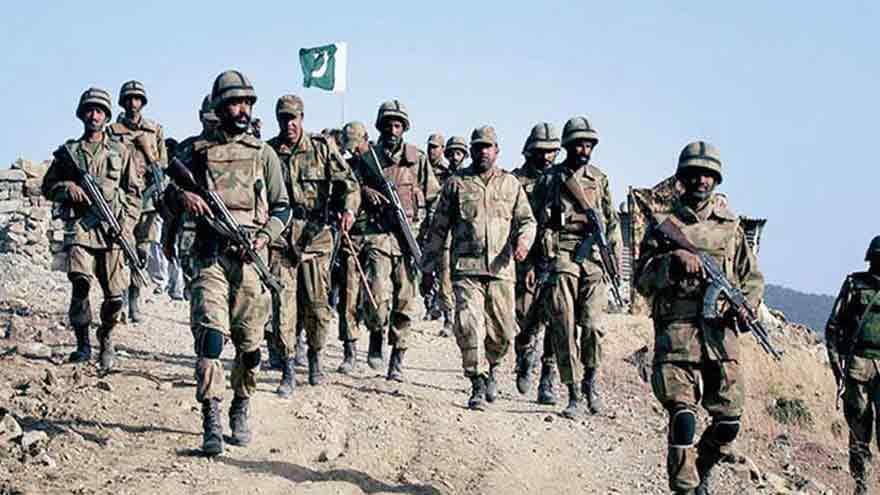
Security forces have killed five more terrorists in the ongoing Operation Shaban in Balochistan, security sources said, as the joint counterterrorism campaign continues to press militant networks across the province. The latest killings add to a steadily rising toll in one of the most sustained security operations Balochistan has seen in recent years.
The development comes at a time when Balochistan has been on edge following a string of deadly attacks on security personnel and civilians. Officials say the operation will not stop until every last militant in the targeted areas has been eliminated.
Background
Operation Shaban was launched in the aftermath of a deadly assault on the Mangi Dam police station in Ziarat, an attack that left several police personnel martyred and shocked the wider province. In the days that followed, militants also struck other locations in Balochistan, including a convoy attack near Winder in the Bela area that killed several soldiers.
Faced with this surge in violence, the Pakistan Army, the Frontier Corps (FC) Balochistan and the Balochistan Police launched a coordinated campaign under the name Operation Shaban. The operation specifically targets militants belonging to the banned group that Pakistani authorities refer to as Fitna al-Khawarij, a term officially used for the proscribed Tehreek-e-Taliban Pakistan (TTP). A parallel set of intelligence-based operations has also targeted the outlawed Balochistan Liberation Army (BLA), which officials refer to as Fitna al-Hindustan.
Balochistan has struggled with recurring waves of militancy for years. Security officials say the frequency and intensity of attacks has increased since the Afghan Taliban took power in Kabul in 2021, a development Pakistani officials argue has given militant networks greater freedom to organise and launch cross-border operations.
Details
According to security sources, the latest five militants were killed in a mix of ground and aerial operations targeting hideouts used by Fitna al-Khawarij fighters in Balochistan’s rugged terrain. The operation has relied heavily on coordinated troop movements backed by helicopter support and Pakistan Air Force assets to reach positions in hard-to-access mountainous areas.
Since Operation Shaban and related intelligence-based operations began on 5 July, the combined number of militants killed in Balochistan has climbed steadily, with different security updates over the following days placing the overall tally at various points between 76 and more than 100, depending on the date of reporting. Officials say weapons, ammunition, hand grenades, mobile phones and banned outfit flags have been recovered from several of the sites where militants were killed, material that is now being examined as part of a broader investigation into the group’s logistics and support networks.
Security officials have also disclosed that the attack on the Mangi Dam police station, which triggered the operation, involved militants who took police personnel hostage before reinforcements arrived. Nine police officers were martyred in that initial engagement, even as officers on the ground managed to kill a number of attackers before backup reached the area.
Quotes
Lt Gen Ahmed Sharif Chaudhry, Director General of the Inter-Services Public Relations (ISPR), has said that India was backing militant groups operating inside Pakistan and alleged that Afghan territory was being used to facilitate terrorist activities, adding that many of the militants involved in recent attacks were believed to be Afghan nationals.
Interior Minister Mohsin Naqvi praised the security forces for their progress in the operation, saying their achievements “will remain a golden chapter in history” and stressed that the complete eradication of terrorism remained a national priority.
A senior security official, commenting on the pace of the campaign, said the operation would continue “until the last terrorist is eliminated,” a line security sources have repeated consistently as the campaign has progressed.
Impact
The continuation of Operation Shaban carries significance well beyond Balochistan’s borders. Regionally, it reflects Islamabad’s effort to reassert control over a province that has long been a flashpoint for separatist and religiously motivated militancy, and where security lapses have historically drawn sharp domestic political criticism.
Nationally, the operation has become a rallying point for the civilian and military leadership. Prime Minister Shehbaz Sharif, President Asif Ali Zardari and Balochistan Chief Minister Mir Sarfraz Bugti have all publicly commended the forces involved, framing the campaign as proof of the state’s resolve against militancy.
The human cost on both sides remains significant. Alongside the militants killed, Balochistan has lost dozens of security personnel and civilians in the wave of attacks that preceded and accompanied the operation. The provincial government has announced compensation packages worth several million rupees for the families of martyred police personnel, along with commitments to cover the educational expenses of their children.
Internationally, the operation is being watched closely given Pakistan’s repeated allegations that neighbouring Afghanistan is being used as a staging ground for attacks, a claim that continues to add friction to an already strained relationship between Islamabad and Kabul.
Conclusion
Security officials have signalled that Operation Shaban is far from over, with ground and aerial operations expected to continue across multiple districts of Balochistan in the coming days. Authorities have urged local residents to cooperate with law enforcement and report suspicious activity as the campaign moves into its next phase.
With the militant death toll continuing to climb and additional intelligence-based operations reportedly underway, further updates from security sources are expected in the days ahead. How the operation ultimately affects the broader security situation in Balochistan, and Pakistan’s relationship with Afghanistan, will likely shape the next stage of the province’s counterterrorism strategy.
FAQs
What is the official state news agency of Pakistan?
The Associated Press of Pakistan (APP) is the country’s official state-run news agency. It is responsible for distributing government-verified news, statements and official announcements to media houses across Pakistan and abroad. APP works closely with government departments, including the Press Information Department (PID), to ensure that official updates, such as those related to security operations like Operation Shaban, are communicated accurately and promptly to the public.
What is the breaking news in Pakistan?
As of the latest updates, one of the major breaking stories in Pakistan concerns the ongoing Operation Shaban in Balochistan, where security forces have continued to kill militants in coordinated ground and aerial operations. The operation has drawn national attention following a series of deadly attacks on police and civilians earlier this month, and it remains one of the most closely followed security developments in the country at present.
Which is the No. 1 newspaper in Pakistan?
Pakistan has several leading newspapers with wide national readership, including Dawn, The News International, Jang and Express Tribune. Among English-language publications, Dawn is widely regarded as the most established and internationally recognised newspaper in the country, known for its long-standing coverage of politics, security and foreign affairs. Readership rankings can vary depending on language, region and circulation figures.