The OpenAI Disney partnership is over — and it ended not with a negotiation but with a shutdown notice that caught Hollywood, Wall Street, and millions of Sora users completely off guard.
OpenAI plans to discontinue its Sora AI video generator six months after the high-profile launch of a standalone app for the service, as the company works to simplify its portfolio of artificial intelligence products. The ChatGPT maker and Walt Disney Co. are also winding down their partnership, which had centred on Sora.
Disney’s much-heralded $1 billion investment in OpenAI is over. The deal is not moving forward.
The collapse of the OpenAI Disney partnership is one of the most dramatic reversals in the short but turbulent history of AI’s relationship with Hollywood — a $1 billion deal announced with fanfare just three months ago, now reduced to a single line of farewell text on the Sora app’s final screen.
Background
To understand why the OpenAI Disney partnership mattered so much — and why its collapse matters even more — it helps to understand what it was supposed to be.
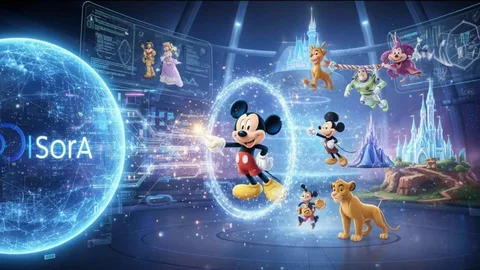
Under the three-year licensing agreement, Sora would have been able to generate user-prompted videos from a set of more than 200 masked, animated or creature characters from Disney, Marvel, Pixar and Star Wars. Sora and ChatGPT Images were to generate fan-inspired videos with Disney’s licensed characters in early 2026 — with Disney+ adding a curated selection of Sora-generated videos.
The OpenAI Disney partnership was not just a content deal. Disney had previously agreed to license iconic characters including Mickey Mouse and Cinderella to OpenAI for use on Sora and to take a $1 billion stake in the startup. The deal was entirely in stock warrants rather than a cash licensing fee.
When it was announced, the OpenAI Disney partnership was described as a turning point — the moment the most IP-rich company in entertainment history decided to work with AI rather than fight it. The agreement was seen as a turning point for the tech industry and Hollywood, coming after major studios had issued legal challenges to AI firms over the use of their IP.
Three months later, it is gone.
Sora AI Disney Characters — What Was Promised
The sora ai disney characters feature was the centrepiece of the entire partnership — and the element that generated the most excitement and the most anxiety in equal measure across the entertainment industry.
As part of the original deal, Disney agreed to license some characters for use in Sora, specifically characters unassociated with any talent likenesses or voices. While you might see Elsa building an icy Death Star, you definitely would not hear voice actor Idina Menzel singing about how Princess Leia needs to let it go.
The sora ai disney characters library was carefully scoped to avoid the talent rights issues that had made Hollywood so hostile to AI in the first place. The text-to-video model quickly raised copyright concerns in Hollywood, prompting pushback from the Motion Picture Association, unions like SAG-AFTRA and A-list stars like Bryan Cranston. OpenAI CEO Sam Altman later updated Sora’s copyright controls and offered monetisation in the app for creators to help address Hollywood’s concerns.
The sora ai disney characters launch was expected in early 2026. It never came. The OpenAI Disney partnership collapsed before a single Disney-licensed video was publicly generated through the system.
On disney sora reddit, fan communities had been building anticipation for months — sharing concept videos, speculating about which characters would be available, and debating whether the deal would democratise Disney storytelling or degrade it. That conversation now takes a different form entirely: what went wrong, and what comes next.
Why Sora Shut Down
OpenAI gave no official explanation for the Sora closure beyond a brief statement acknowledging disappointment and promising data preservation details.
OpenAI told the BBC that it has discontinued Sora so that it can focus on other developments, such as robotics that will help people solve real-world, physical tasks. The firm said it aims to create other forms of advanced AI, including agentic technology capable of autonomously completing tasks with little human oversight. OpenAI plans to apply the same technology used to teach AI how to produce realistic videos to training robots.
The resource reallocation angle was underscored by industry reporting. The shutdown is part of OpenAI’s effort to redirect computing resources and top talent to productivity tools for enterprise and individual users. Last week, the company said it would combine the ChatGPT desktop app, coding tool Codex and browser into a super app.
Competitive pressure also formed part of the backdrop. Sora faced a growing number of competitors in the AI video-making market. That list includes China’s Seedance, which created controversy after realistic videos featuring Hollywood characters generated using the app went viral online.
The Sora 2 system used an opt-out model for copyrighted material. Rights holders had to request removal instead of granting permission upfront. That approach drew strong criticism. In November, a Japanese trade group representing major animation studios demanded OpenAI stop using their content.
The shutdown puts Google in a position of power when it comes to AI video generation, making it essentially the only player in the space with scale, though it has thus far not inked any deals with IP holders.
Disney’s Response — Diplomatic but Pointed
The OpenAI Disney partnership collapse produced a Disney statement that was careful in its wording and revealing in its tone.
A Disney spokesperson said the company appreciated the constructive collaboration between its teams and what it learned from the partnership, and would continue to engage with AI platforms to find new ways to meet fans where they are while responsibly embracing new technologies that respect IP and the rights of creators.
Hollywood Reporter editors noted that Disney’s statement — saying they respect OpenAI’s decision to exit the video generation business and to shift its priorities elsewhere — seemed like a pretty big screw-you. The question raised immediately was whether it was just a screw-you to OpenAI or a screw-you to AI-generated content more broadly.
The consensus from industry observers was that Disney — sitting on the largest IP library in entertainment history — would not walk away from the commercial potential of AI video generation permanently. A company sitting on that much IP does not just walk away from the chance to mine it with the help of AI and user-generated video. This could just be a chance for a mulligan. Google and ByteDance have a golf course waiting.
The Financial Fallout
The end of the OpenAI Disney partnership immediately registered in the market.
Even though Disney unveiled its investment in OpenAI in December, it appears no actual money changed hands as the deal was never finalised. Disney had agreed to take a $1 billion stake, but the financial close never occurred before OpenAI pulled the plug on Sora.
For OpenAI, the Sora closure arrives against a backdrop of enormous financial momentum elsewhere. OpenAI recently announced a $110 billion investment at a $730 billion pre-money valuation, which includes $30 billion from SoftBank, $30 billion from Nvidia, and $50 billion from Amazon. OpenAI could consider a potential initial public offering as soon as the fourth quarter of this year.
The end of the OpenAI Disney partnership is therefore a product decision wrapped inside a company that has never been more financially powerful — a reminder that even the most high-profile AI partnerships can be cancelled when strategic priorities shift faster than contracts can close.
Quotes
“We’re saying goodbye to Sora. To everyone who created with Sora, shared it, and built community around it: thank you. What you made with Sora mattered, and we know this news is disappointing.” — OpenAI Sora Team, official closure statement
“We respect OpenAI’s decision to exit the video generation business and to shift its priorities elsewhere.” — Disney Spokesperson
“We appreciate the constructive collaboration between our teams and what we learned from it, and we will continue to engage with AI platforms to find new ways to meet fans where they are while responsibly embracing new technologies that respect IP and the rights of creators.” — Disney Spokesperson
“The deal is not moving forward.” — Disney Insider, on the $1 billion OpenAI investment
“OpenAI doesn’t have a clear, well-chosen lane and strategy.” — Hollywood Reporter Senior Editor, on the Sora closure
Impact
For OpenAI, the Sora shutdown and the end of the OpenAI Disney partnership mark a deliberate pivot — away from consumer video generation and toward robotics, enterprise AI, and the super app strategy. For Hollywood, the fight over AI and intellectual property is far from over. Sora’s shutdown reflects more than a product decision. It shows how quickly legal, creative, and business pressures can reshape AI development.
For disney invest in openai conversations on Wall Street, the collapse of the deal removes what had been framed as a landmark validation of AI by the most traditionally IP-protective company in the world. No money changed hands. No sora ai disney characters were ever publicly generated. The OpenAI Disney partnership existed for three months — announced, celebrated, and cancelled before it produced a single public deliverable.
For the broader AI-Hollywood relationship, the episode leaves the industry in an uncertain position. The only scaled AI video generation platform with any Disney-adjacent deal is now gone, leaving Google’s Veo and Chinese platforms like Seedance as the main remaining players in a field that OpenAI’s departure has suddenly made significantly less competitive for Western studios.
FAQs
Did Disney partner with OpenAI?
Yes — and then ended the partnership three months later. In December, Disney became the first major studio to license intellectual property to OpenAI to use in its AI video tools. The three-year deal allowed Sora users to create AI videos with Disney characters like Mickey Mouse and Yoda from Star Wars.Disney had also agreed to take a $1 billion stake in OpenAI, structured entirely as stock warrants rather than cash. When OpenAI shut down Sora, Disney confirmed the OpenAI Disney partnership was over — and that no money had actually been transferred before the deal collapsed.
Why did Sora shut down?
OpenAI said it discontinued Sora to focus on other developments including robotics that will help people solve real-world physical tasks, and agentic AI technology capable of autonomously completing tasks with little human oversight.Industry reporting pointed to a resource reallocation decision — redirecting computing power and top talent toward enterprise productivity tools and a combined super app. Competitive pressure from Chinese AI video platforms, ongoing copyright disputes, and the opt-out model that drew industry criticism also formed part of the backdrop for the closure.
Who owns the other 51% of OpenAI?
There is no single entity that owns 51% of OpenAI — ownership is distributed across multiple stakeholders. Its largest stakeholders include the nonprofit OpenAI Foundation with about 26%, Microsoft with around 27%, and a broad group of employees and private investors holding roughly 47%, including major strategic backers like SoftBank Group.The February 2026 funding round raised $110 billion — Amazon committed $50 billion, Nvidia committed $30 billion, and SoftBank committed $30 billion. CEO Sam Altman reportedly holds zero percent equity in OpenAI — an unusual arrangement for a tech company of this scale. The nonprofit OpenAI Foundation appoints the entire board and maintains mission control despite being a minority shareholder by equity value.
Conclusion
The OpenAI Disney partnership lasted exactly as long as Sora itself — which is to say, not long enough to deliver what either side promised.
Sora’s shutdown reflects more than a product decision. It shows how quickly legal, creative, and business pressures can reshape AI development. For OpenAI, the next phase likely shifts toward integrating video tools into its core ecosystem.
For Disney, the question is simply which AI platform it chooses next. A company with over 200 licensable characters, a streaming service hungry for engagement, and a new CEO navigating an AI-saturated entertainment landscape will not stay out of AI video generation for long.
The OpenAI Disney partnership is over. The deal that was supposed to define how AI and Hollywood work together turned out to define something different entirely — how fast that relationship can fall apart when one partner decides the product is no longer worth building.