Myanmar’s military, known as the Tatmadaw, remains one of Southeast Asia’s most significant armed forces yet it is deeply entangled in a brutal civil war of its own making. For 2026, Myanmar is ranked 35 out of 145 countries considered for the annual Global Firepower review, holding a Power Index score of 0.6265.Despite this ranking, the military faces growing resistance, international sanctions, and a legitimacy crisis that shows no signs of ending.
Background: The Tatmadaw and Its History
Myanmar’s military, officially called the Tatmadaw, has dominated the country’s politics for most of its post-independence history. The Tatmadaw is the armed forces of Myanmar, administered by the Ministry of Defence and composed of the Myanmar Army, the Myanmar Navy, and the Myanmar Air Force. Auxiliary services include the Myanmar Police Force, the Border Guard Forces, the Myanmar Coast Guard, and the People’s Militia Units.
Myanmar’s state military has been intermittently fighting ethnic armed groups based largely in the country’s border regions since it first seized power in 1962. A partial restoration of democracy began in 2008, and elections in 2015 brought in a civilian-led government however, the military retained a significant amount of power.
This history of political dominance set the stage for the dramatic events of 2021, which continue to define Myanmar’s present-day reality.
The Myanmar Military Coup of 2021: What Happened and Why
The Myanmar military coup stands as one of the most consequential political events in modern Southeast Asian history. The coup d’état in Myanmar began on the morning of 1 February 2021, when democratically elected members of the ruling party, the National League for Democracy (NLD), were deposed by the Tatmadaw, which then vested power in a military junta. President Win Myint and State Counsellor Aung San Suu Kyi were detained, along with ministers and their deputies.
The military’s stated reason was election fraud. The military seized power in February 2021, alleging massive fraud in elections won by Suu Kyi’s NLD. International observers at the time said the poll was largely free and fair.
However, deeper reasons were at play. After the NLD won another landslide victory in 2020, the military resorted to allegations of voter fraud. When the NLD refused to accept the Tatmadaw’s efforts to retain its power advantages, Commander-in-Chief Min Aung Hlaing orchestrated the coup on February 1, 2021. Many analysts believe personal political survival played a key role Hlaing was set to face mandatory retirement and potential prosecution if civilian rule continued.
Myanmar Military Power: Rank in the World 2026
Understanding the military rank of Myanmar in the world requires looking at multiple dimensions manpower, equipment, budget, and operational capacity.
Myanmar ranks 36th in the Military Power Rankings. Known as the Tatmadaw, Myanmar’s military is one of the largest in Southeast Asia and plays a dominant role in the country’s internal and external affairs. Its force structure is built around counterinsurgency, territorial control, and regime preservation.
Myanmar’s military strength is defined by size, combat exposure, and defensive adaptation, with extensive ground forces deployed across multiple conflict zones and garrisons, maintaining strong control over border regions and ethnic territories.
The Myanmar military rank 2026 reflects a force that is formidable on home soil but constrained beyond its borders. Myanmar’s power is real but limited formidable in domestic conflict, but constrained in the broader theater of conventional warfare
How Many Army Personnel Does Myanmar Have?
The question of how many army personnel are in Myanmar is complicated by the ongoing civil war, defections, and troop losses. Official numbers differ from battlefield realities.
Myanmar has approximately 201,000 active military personnel, including army, navy, and air force service members.However, some estimates place the broader figure higher.
The Tatmadaw maintains a large standing army relative to the region, with an estimated 300,000 personnel deployed across multiple conflict zones and garrisons.The gap between these figures reflects ongoing desertions, battlefield casualties, and the difficulty of verifying numbers inside a conflict zone.
After Myanmar regained independence in 1948, its armed forces grew steadily. Following the 1988 pro-democracy uprising, the new military regime launched a massive expansion program, and by the early 2000s it was widely accepted that the Tatmadaw had grown to about 400,000 service personnel making it among the largest in the region.Since then, the numbers have declined due to political and military pressures.
Myanmar military personnel today face severe morale challenges. Morale is reportedly low, there have been more than 2,500 defections, and reports suggest the junta is forming its own militias and recalling veterans all signs that the generals are deeply concerned about manpower
Myanmar Military Budget 2025 and 2026
Myanmar’s military budget has been a source of controversy, especially given the humanitarian crisis unfolding inside the country.
Myanmar’s annual defense budget is approximately $5.0 billion, covering personnel costs, equipment procurement, operations, and maintenance of military forces.
Historically, the military has also funded itself through business interests beyond the official budget. The military generates substantial revenue through two conglomerates the Myanma Economic Holdings Limited and the Myanmar Economic Corporation. Revenues from these business interests are kept “off-book,” enabling the military to autonomously finance military affairs with limited civilian oversight. Between 1990 and 2020, Myanmar’s military officers received US$18 billion in dividends from MEHL alone.
The Myanmar military budget 2025 faces significant stress due to international sanctions targeting aviation fuel and key imports. The military faces severe constraints, including international sanctions targeting aviation fuel and the erosion of its professional officer corps through prolonged attrition.
Myanmar Military Power on the Battlefield: Civil War Reality
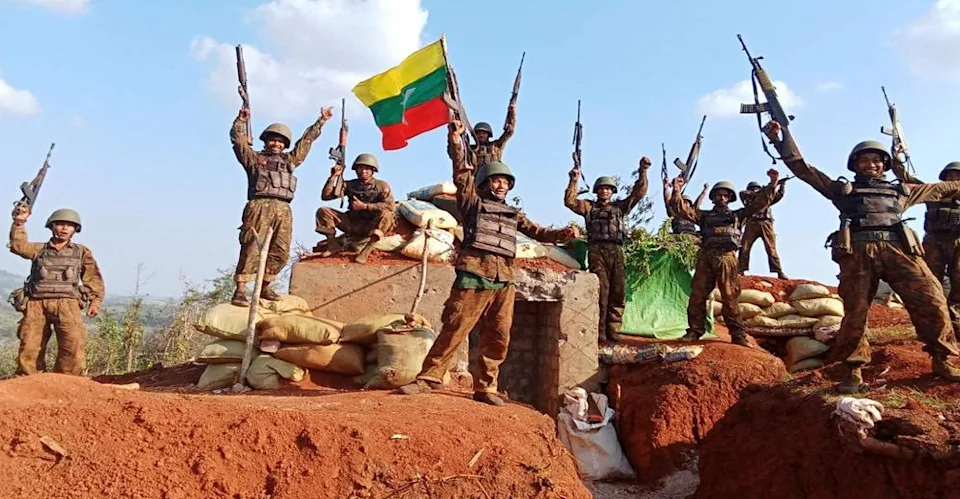
Despite its official ranking and budget, Myanmar’s military power is being severely tested in the field. The ongoing civil war sparked directly by the Myanmar military coup has exposed serious weaknesses.
By late 2023, resistance forces were in control of more than half of Myanmar’s territory, prompting international observers to speculate that the junta’s collapse was imminent. However, throughout 2024 and 2025 the junta used superior air power, divisions within the resistance, and a war of attrition to retain control over major urban areas.
The Myanmar civil war began following the military coup on 1 February 2021. The seizure of power triggered mass anti-coup demonstrations and a violent crackdown by the Tatmadaw, which significantly escalated the country’s longstanding insurgencies.
To April 2025, 6,486 civilians have been reported killed during the civil war, including 1,494 women and 751 children, according to the NGO Assistance Association for Political Prisoners.The UN estimates that millions more require urgent humanitarian assistance.
A devastating earthquake in March 2025 added to the crisis. On March 28, a magnitude-7.7 earthquake struck central Myanmar, leaving more than 3,600 people dead, injuring thousands, and destroying more than 10,000 structures, including hospitals, temples, and bridges. Both the junta and the NUG declared temporary ceasefires, though fighting soon resumed.
Myanmar Military’s International Alliances and Arms Suppliers
Myanmar’s military power is sustained largely through foreign partnerships, as Western sanctions have cut off traditional supply routes.
Myanmar maintains no formal alliance memberships with major international pacts such as NATO. Instead, it relies on bilateral defense cooperation with Russia and China. Russia serves as a primary supplier of advanced military hardware and technical expertise, with both nations signing 2025 roadmaps for cooperation in nuclear and space technology.
China has the biggest influence of any country in Myanmar. It has supported the military regime in part to protect its significant investments in the country, and has been pushing the Tatmadaw to hold elections though most analysts believe these will be highly challenging to hold amid the ongoing conflict.
China and Russia have also shielded the junta diplomatically. It was reported in February 2021 that China blocked the UN Security Council from releasing a joint statement condemning the military coup in Myanmar. In May 2022, China and Russia similarly blocked another UN Security Council statement expressing concern at the situation.
The Controversial Election of December 2025
In a bold bid to legitimize its rule, the military staged elections in late 2025. Voters queued at polling stations in Myanmar in December 2025 to vote in a controversial election the military junta claimed would return democratic rule, nearly five years after it seized power. The country’s most popular politician Aung San Suu Kyi remained in prison and its most successful political party had been dissolved.
The ballot was dominated by parties perceived to be close to the military, and hundreds had been arrested under a new law criminalizing obstruction, disruption, and criticism of the poll. There were whole swaths of the country where voting did not take place, as the junta continued to battle a patchwork of ethnic rebels and pro-democracy fighters.
International critics called it a sham, and most opposition leaders and ordinary citizens inside Myanmar shared that view.
Quotes: What Experts and Analysts Say
One political analyst observed that since Min Aung Hlaing refuses to engage in dialogue with opposition parties, holding superficially open elections is his government’s best remaining prospect for escaping the ongoing conflict and eventually gaining some degree of international legitimacy.
Richard Horsey, Myanmar adviser for International Crisis Group, stated: “The election for the military is first and foremost an opportunity to correct what it saw as an unacceptable result five years ago, when its opponent, the National League for Democracy, won a landslide second term.”
Analysts consistently point to the same conclusion: Myanmar’s military power may be real in the field, but its political legitimacy is collapsing from within.
Impact: Regional and Global Consequences
The crisis unleashed by the Myanmar military coup has far-reaching consequences beyond the country’s borders.
The UN Refugee Agency estimates that as of March 2025 there are over 3.5 million internally displaced persons in Myanmar. The UN’s humanitarian appeal for 2025 is seeking US$1.1 billion in funding to support 5.5 million people, though a total of 19.9 million people are projected to be in need.
Myanmar’s neighbors particularly Thailand, China, and India face growing instability along shared borders. The country’s descent into conflict has also created a vacuum exploited by criminal networks. Myanmar’s ongoing conflict has already created significant humanitarian need, compounded further by the 2025 earthquake, while the world’s largest aid donor the US has significantly cut its international assistance.
Myanmar’s position as a buffer state between China and India gives it outsized geopolitical importance, meaning that the military’s survival or collapse will have consequences across the entire region.
Conclusion: What Comes Next for Myanmar’s Military?
The Tatmadaw’s future is deeply uncertain. The SAC’s long-term strategy includes holding national elections to legitimize its authority, a goal that has dictated current offensive operations intended to clear and secure contested townships.But those elections have been widely dismissed as fraudulent.
Most analysts believe that the military junta is in a difficult situation, having lost control of significant amounts of territory and being significantly unpopular.Myanmar’s military power once considered the unchallenged force in the country is now fighting for survival against a population that has largely turned against it.
The coming months will be critical. Whether through continued military offensives, political maneuvering, or eventual negotiation, Myanmar’s future will be decided not just by the power of the Tatmadaw, but by the will of its own people.
FAQs
What type of government is Myanmar under?
Myanmar is currently under a military junta government, officially called the State Administration Council (SAC). Following the 2021 coup, power was transferred to Commander-in-Chief of Defence Services Senior General Min Aung Hlaing, who declared a state of emergency and dissolved the elected civilian government.Despite holding an election in December 2025, the country remains effectively under military authoritarian rule.
Why did the military overthrow the government in Myanmar?
The Tatmadaw claimed that the 2020 general elections had 8.6 million voter irregularities, but presented no evidence.Analysts believe the real reason was to preserve military dominance after a decade of growing civilian power. The coup may have also been driven by Min Aung Hlaing’s personal interest in avoiding mandatory retirement and potential prosecution under continued civilian rule.
How powerful is the Myanmar military?
For 2026, Myanmar is ranked 35 out of 145 countries in the Global Firepower review.Known as the Tatmadaw, Myanmar’s military is one of the largest in Southeast Asia, with a force structure built around counterinsurgency, territorial control, and regime preservation. Its power is formidable in domestic conflict, but constrained in conventional warfare against peer adversaries.