What Comes Back From Orbit
By Sarah Abraham USA
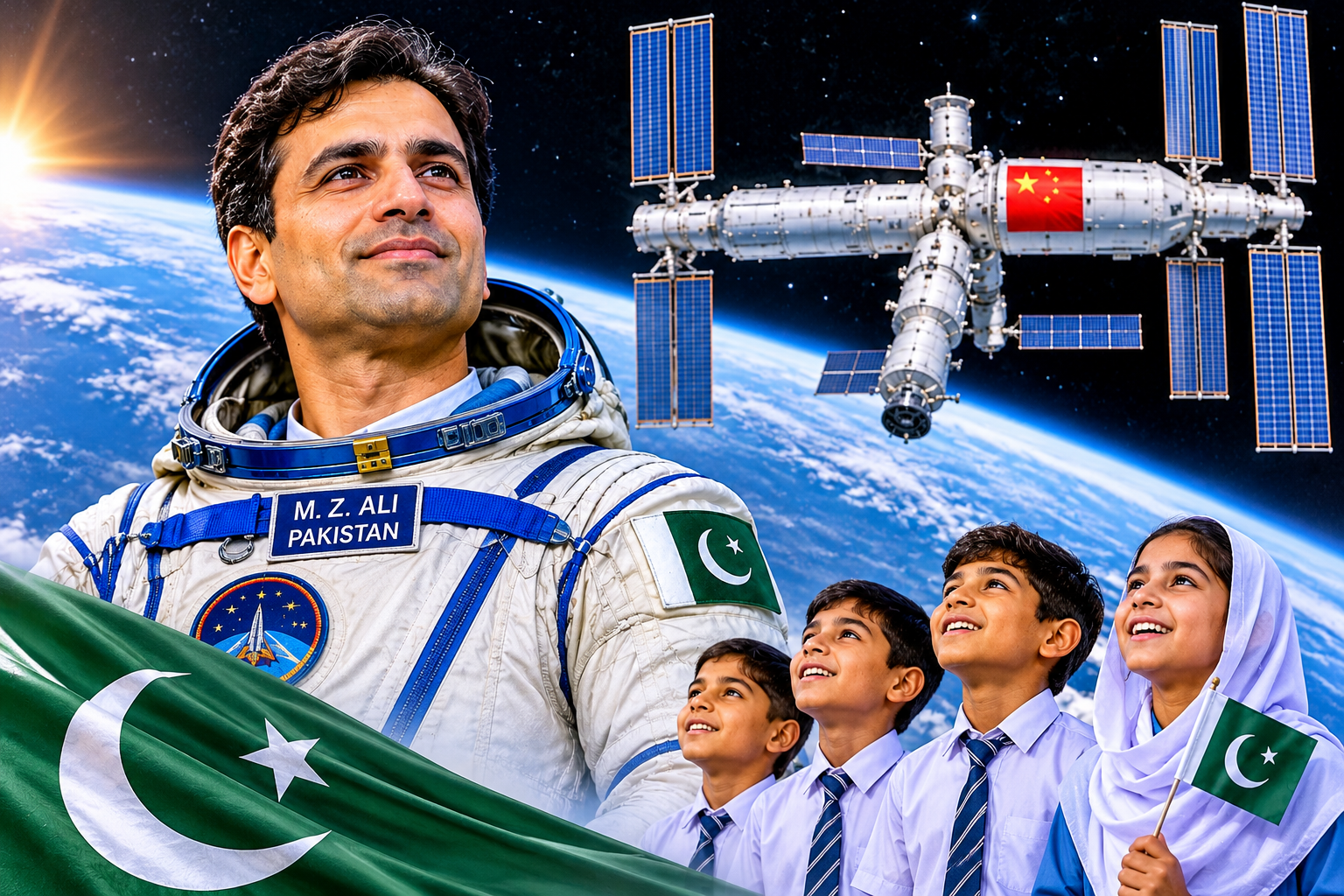
There was a cake waiting for Muhammad Zeeshan Ali when he reached China’s Tiangong space station. The astronauts already aboard had prepared it for the three new arrivals. When the hatch opened, the crews embraced. A little more than six hours earlier, on 25 November 2026, Ali had lifted off from the Jiuquan Satellite Launch Centre in the Gobi Desert aboard Shenzhou 24 with mission commander Tang Hongbo and flight engineer Wu Yi. The 40 year old Pakistan Air Force wing commander from Sargodha became the first Pakistani to orbit Earth and the first non Chinese astronaut to enter Tiangong.
Joint Research Mission and Quinoa Seed Experiment
Namira Salim had reached space on a suborbital flight in October 2023. Ali’s orbital mission brings a further opportunity. As a payload specialist, he is helping carry out joint research in space. One project, led by the University of Agriculture Faisalabad, involves 32 samples of quinoa seed. The researchers want to know how long seeds can remain viable after exposure to the conditions of space. When the results come in, a Pakistani schoolchild ought to be able to find out what the scientists learnt.
Seven Months of Training in China
Ali trained in China for about seven months. He had flown fighter aircraft, but the spacecraft’s controls, software and spoken announcements were in a language he had to learn. At the pre flight press conference, he quoted a line of Chinese verse about climbing higher to see farther. I keep thinking about that choice. He had spent months learning to listen for instructions on which his crew might depend. Somewhere in those months, he had also found the words he wanted to say before leaving Earth.
Students in Pakistan Watch the Launch
Students in Pakistan watched the launch at organised screenings. I imagined one of them still thinking about it after the screens had gone dark.
From Sargodha to Tiangong
The Gobi shook beneath a blade of flame,
And Sargodha awoke to hear his name.
Through thinning air he rose with Tang and Wu,
And Earth below curved into deeper blue.
The hatch swung wide. Their hosts were just inside.
Six people floated briefly side by side.
The seeds from home had travelled far to show
What might survive and what might one day grow.
Back home, a girl looked up into the night
And searched the sky for one small moving light.
She drew its orbit, marked the homeward track,
And left a space to write when he came back.
Before he’d even touched the ground once more,
Her paper rocket cleared the bedroom door.
Tracking Tiangong With SUPARCO
Tiangong takes about 90 minutes to circle Earth. SUPARCO’s mission website tracks the station and predicts when it will pass over Pakistani cities. A teacher could give a class a globe and ask why the station traces a different path across the map on its next circuit. One pupil could trace the orbit while another turns the globe beneath it. Soon the class would be able to explain something that had seemed puzzling on the screen.
What Can Space Research Offer Pakistani Schools?
It is fair to ask what research in orbit can offer schools with urgent needs on the ground. The Chinese and Pakistani teams plan to publish their findings jointly. Alongside the scientific papers, SUPARCO and the participating universities could issue short, printable accounts in Urdu and English. Each could explain what the researchers measured, what they compared it with and what questions remained. An inconclusive result deserves a page as much as a striking one. Pupils get few chances to see how scientists decide that the evidence leaves a question open.
Teaching Evidence Through the Faisalabad Seed Project
The Faisalabad project would make a good first page. How do you tell whether a seed has survived? How do you tell whether the journey made the difference? A teacher can put those questions to a class and start with a few seeds on a windowsill. By the time the pupils ask what happened to the samples in orbit, they will have some idea of what evidence they would need to see before drawing a conclusion of their own.
The Return Mission and a Hope for Sargodha
The mission plan calls for Ali to return aboard Shenzhou 23 with two members of the previous crew. I hope a school in Sargodha invites him to speak and leaves enough time for questions after the photographs. Someone will ask what Earth looked like through the window. Someone else may ask what happened to the seeds. I hope there is a copy of the results on the desk between them and that Ali can pull up a chair and go through it with her.