

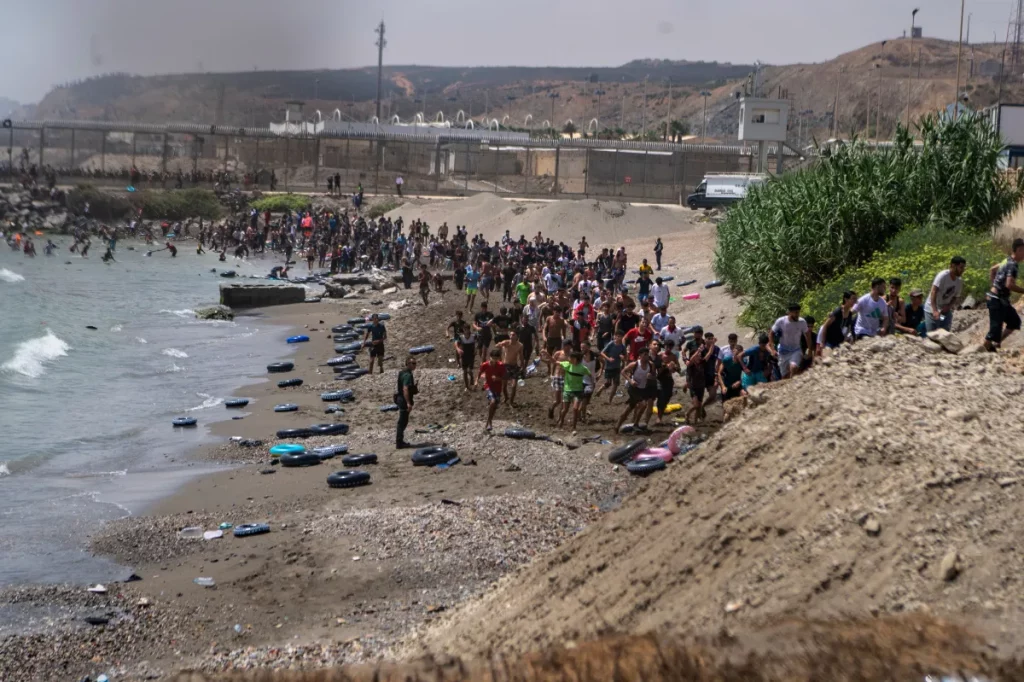

At least 18 people have died as thousands of Morocco migrants crossed into the Spanish enclave of Ceuta this week, marking one of the largest single surges in years. The Spain migrants Ceuta crisis has now prompted Madrid to deploy the army, with Prime Minister Pedro Sánchez expected to visit the territory in person as pressure mounts from local officials and opposition parties alike.
Background
Ceuta is a small Spanish territory located on the northern coast of Africa, separated from mainland Spain by the Strait of Gibraltar but bordered entirely by Morocco. For decades, its unusual geography has made it a flashpoint for irregular migration, since it offers a land route into the European Union without requiring a sea crossing. Previous surges, most notably in May 2021, saw thousands of people enter the enclave within days after Moroccan border guards appeared to loosen enforcement.
This latest wave follows a ruling earlier in July by Spain’s Supreme Court, which found that migrants intercepted at sea while trying to reach Ceuta or Melilla cannot be automatically returned to Morocco. Authorities say smuggling networks have seized on that decision, using it to encourage larger numbers of people to attempt the crossing in the belief that they are less likely to be sent back.
Details
Spanish officials estimate that close to 2,000 people have entered Ceuta since Wednesday, with the situation escalating sharply on Thursday when large crowds breached the border fence near the Tarajal crossing. Many migrants swam around the barriers that extend into the sea, while others scaled fencing on land. A Guardia Civil spokesperson described the shift as “an explosion” after weeks of what had been a slower, steadier flow of Morocco migrants Ceuta arrivals.
Local authorities in Ceuta say reception centers are now well beyond capacity. The head of the regional government has formally asked Madrid to declare a national emergency and take direct control of the response, warning that the city cannot manage the numbers on its own. The Spanish Interior Ministry initially resisted declaring a national emergency but confirmed on Thursday evening that the Armed Forces would be sent to reinforce the Civil Guard and restore order along the border.
The scale of the Spain migrants Ceuta emergency has also drawn comparisons to 2021, when roughly 10,000 people entered the enclave over the course of two days amid a diplomatic dispute between Madrid and Rabat. Moroccan authorities have so far made no public comment on this week’s crossings, and the country’s Interior Ministry has not responded to requests for a statement.
Quotes
Rachid Sbihi, who heads the association representing Civil Guard officers in Ceuta, told reporters that the border had “totally collapsed” under the pressure, adding that it was not possible to give precise numbers because migrants were crossing continuously throughout the day. He called the scene at the frontier “absolute chaos.”
Achraf Maimouni of the Moroccan Association for Human Rights described the situation on the Moroccan side as “exceptional,” noting that the Tarajal border area appeared to have opened under unusual circumstances that allowed large groups to approach the fence largely unchallenged.
Spain’s Interior Ministry said it was working closely with Moroccan counterparts to manage the surge, while placing much of the blame on organized smuggling networks it accuses of exploiting the recent court ruling to push more people toward the crossing points.
Impact
The Morocco migrants Ceuta crisis has quickly taken on a wider European dimension. Italian Prime Minister Giorgia Meloni threatened to suspend her country’s participation in the Schengen open-border arrangement with Spain, framing the move as necessary “to defend our borders and ensure the safety of our citizens,” despite Italy not sharing a land border with Spain.
At the EU level, Migration Commissioner Magnus Brunner said Brussels remained in constant contact with Spanish authorities, stressing that securing the bloc’s external borders was central to the fight against illegal migration. The European Commission has offered operational support through Frontex, the EU’s border and coast guard agency, to help Spain manage arrivals and returns.
The rising death toll has added urgency to the response. Early reports on Thursday put the number of fatalities at nine, but that figure climbed to at least 18 by Friday as more bodies were recovered from the crossing routes, underscoring the risks migrants are willing to take to reach Ceuta. The human cost has renewed debate across Europe about border enforcement, humanitarian obligations, and the role that smuggling networks play in encouraging dangerous crossings.
Conclusion
Pedro Sánchez is expected to travel to Ceuta alongside Interior Minister Fernando Grande-Marlaska as political pressure builds from opposition parties demanding a firmer response. With the military now being deployed and Brussels signaling support through Frontex, the coming days are likely to determine whether Spain can stabilize the border or whether the Spain migrants Ceuta situation continues to escalate. Diplomatic talks between Madrid and Rabat are expected to intensify, and further updates on returns, casualty figures, and EU involvement are anticipated as the crisis develops.
FAQs
What’s happening in Ceuta, Spain?
Ceuta, a Spanish territory on the North African coast, is experiencing a major surge in irregular border crossings from Morocco. Thousands of migrants have entered the enclave in recent days, mostly by swimming around border fences or breaching them on land, and at least 18 people have died in the attempt. The scale of arrivals has overwhelmed local reception centers, prompting Spain to deploy its military to help restore order at the frontier.
What’s happening in Spain with migrants?
Spain is facing one of its largest migration surges in years, concentrated at the Ceuta border with Morocco. A recent Supreme Court ruling limiting the automatic return of migrants intercepted at sea is believed to have encouraged smuggling networks to push more people toward the crossing. In response, Madrid has mobilized the Armed Forces, and Prime Minister Pedro Sánchez is expected to visit Ceuta as the government works to bring the situation under control.
Is Ceuta Moroccan or Spanish?
Ceuta is Spanish territory, governed by Spain since the 17th century, even though it sits on the North African coast and is bordered entirely by Morocco. Morocco has historically disputed Spanish sovereignty over the enclave, but Ceuta remains an autonomous Spanish city and, by extension, part of the European Union, which is part of why it draws so many people attempting to reach Europe by land.