

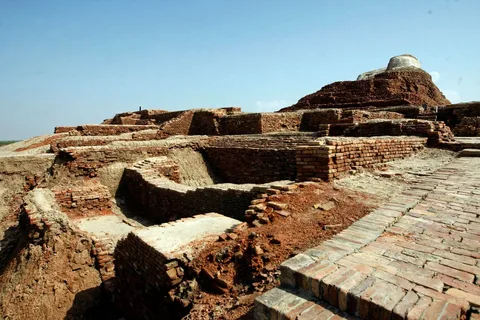

Mohenjo-Daro, one of the oldest planned cities on Earth, was a thriving urban center of the Harappa Mohenjo-Daro culture over 4,500 years ago. Located in present-day Pakistan, it belonged to the Indus Valley Civilization one of the world’s earliest and most sophisticated ancient societies. Despite decades of research, the story of how Mohenjo-Daro was destroyed and why its people vanished continues to puzzle historians and archaeologists around the world.
Background: What Was the Mohenjo-Daro Civilization?
The Mohenjo-Daro Civilization was part of the larger Indus Valley Civilization, which flourished roughly between 3300 BCE and 1300 BCE across parts of modern-day Pakistan, India, and Afghanistan. At its height, the civilization was one of the most advanced in the ancient world, with cities that rivaled and in some ways surpassed those of ancient Egypt and Mesopotamia.
Mohenjo-Daro, which translates from Sindhi as “Mound of the Dead,” was one of the two largest cities of this civilization, the other being Harappa. Together, Harappa Mohenjo-Daro represent the twin pillars of a culture that was extraordinarily organized, peaceful, and technically skilled. Scholars believe the city may have housed up to 40,000 residents at its peak, making it one of the most populated urban centers of its time.
Where Is Mohenjo-Daro Located?
Mohenjo-Daro is located in the Larkana District of Sindh Province, Pakistan, along the western bank of the Indus River. It sits approximately 510 kilometers northeast of the city of Karachi. The site was first discovered in 1921 by archaeologist Rakhaldas Bandyopadhyay, and formal excavations began shortly after, revealing a city that had been hidden beneath layers of earth for thousands of years.
Today, Mohenjo-Daro located within Pakistan is a UNESCO World Heritage Site, recognized for its outstanding universal value and its critical importance to understanding early human civilization. It is one of the most visited archaeological sites in South Asia, attracting researchers, tourists, and historians from around the globe.
Mohenjo-Daro History: A City Built Ahead of Its Time
The Mohenjo-Daro history stretches back to approximately 2500 BCE, when the city was already a fully developed urban settlement. What makes its history so astonishing is the level of planning and civic infrastructure that existed at a time when most of the world was still living in scattered rural communities.
The city was divided into two main sections: the Citadel, a raised platform that housed public buildings, granaries, and what is believed to be a ritual bathing area, and the Lower Town, where the majority of the population lived and worked. Streets were laid out in a precise grid pattern, with main roads running north to south and smaller lanes branching off at right angles. The city’s layout suggests the presence of a central governing authority though no evidence of a palace, king, or ruling class has ever been found, which adds to the enduring mystery of the Mohenjo-Daro Civilization.
Homes were built from fired bricks of a standard size, with multiple rooms, courtyards, and in many cases, their own private wells. The level of construction quality was so high that many of these structures have survived thousands of years and can still be seen at the site today.
The Mohenjo-Daro Drainage System: Ancient Engineering Marvel
Perhaps the most celebrated achievement of the Mohenjo-Daro Civilization is its drainage system one of the most advanced sanitation networks ever built in the ancient world. The Mohenjo-Daro drainage system was a city-wide network of covered drains, sewage channels, and waste disposal systems that connected individual homes to larger street drains, which in turn emptied into the main sewage system outside the city.
Every house had its own bathroom, and wastewater flowed through clay pipes into street-level drains covered with large baked bricks. Inspection holes were built into the drains at regular intervals so workers could access and clean them. This level of civic sanitation was not seen again in the world until the Roman Empire, more than 2,000 years later.
The Great Bath of Mohenjo-Daro a large public water tank measuring 12 meters long, 7 meters wide, and 2.4 meters deep is considered a masterpiece of ancient construction. Lined with waterproof bitumen and surrounded by changing rooms and small private baths, it likely served both a social and a religious purpose. The existence of the Great Bath and the sophisticated Mohenjo-Daro drainage system together point to a culture that placed enormous value on water, cleanliness, and communal life.
How Was Mohenjo-Daro Destroyed?
The question of how was Mohenjo-Daro destroyed has been debated by researchers for over a century, and no single answer has yet been confirmed. Several theories have been proposed, each supported by different pieces of archaeological evidence.
Flooding: One of the most widely accepted theories is that the Indus River repeatedly flooded the city, gradually destroying its foundations and making the land uninhabitable. Evidence of thick silt deposits found throughout the site supports this idea. Prominent archaeologist Dr George F. Dales, who conducted important excavations at Mohenjo-Daro in 1964, explored hydrological theories suggesting that the decline of the entire Indus Valley Civilization was linked to major changes in river patterns and climate.
Aryan Invasion: An older theory, largely discredited today, suggested that the city was conquered and destroyed by invading Aryan tribes. A collection of skeletal remains found at the site was once used to support this idea, but modern forensic analysis has shown the deaths occurred at different times and do not point to a single violent event.
Climate Change and Drought: Many modern researchers now believe that long-term climate change particularly a shift toward drier conditions disrupted agriculture, reduced the flow of the Indus River, and slowly made the city impossible to sustain. As resources dried up, the population likely migrated eastward toward the Ganges plain.
Epidemic Disease: Some scholars have proposed that a large-scale epidemic may have contributed to the city’s decline, though physical evidence for this remains limited.
The most honest answer to how was Mohenjo-Daro destroyed is probably a combination of all these factors environmental stress, repeated flooding, agricultural decline, and population migration working together over centuries to gradually empty one of the ancient world’s great cities.
Quotes From Experts
Senior archaeologist Dr Jonathan Mark Kenoyer of the University of Wisconsin, Madison, highlighted that early maps of Mohenjo-Daro were based on very limited information and have since been proven incorrect, noting that the city is in fact made up of many different mounds and neighborhoods spread across a much larger area than originally believed.
Archaeologist and historian Dr Kaleemullah Lashari noted that many questions around Mohenjo-Daro remain unanswered to this day, largely because after the original excavations in the early and mid-1900s, the focus shifted to safeguarding existing relics rather than pursuing further excavation a situation made worse when foreign researchers were unable to return due to the 1965 India-Pakistan war.
New Discoveries: Mohenjo-Daro Preservation and Recent Research
The question of Mohenjo-Daro preservation has become increasingly urgent in recent years. The site faces serious threats from monsoon rains, rising groundwater, salt erosion, and the slow deterioration of its unbaked mud brick structures. UNESCO has repeatedly warned that without immediate and sustained conservation efforts, parts of the site could be lost permanently.
Recent fieldwork carried out over three seasons in 2025 and 2026 by the Sindh Exploration and Archaeological Society in collaboration with the Department of Antiquities, Government of Sindh, has significantly revised researchers’ understanding of the site’s early urban development. The project integrated archaeological research, conservation, museum improvement, scientific analysis, and digital documentation to enhance understanding and long-term preservation of Mohenjo-Daro.
One of the most important findings was that what was previously identified as a defensive bund at the western edge of the citadel mound is in fact a substantial mud brick perimeter city wall constructed during the early Harappan period a discovery that fundamentally changes how archaeologists understand the city’s origins and planning.
Radiocarbon dating of charcoal samples from excavated layers produced dates ranging between approximately 2708 and 2576 BCE for the earliest wall construction, providing the first firm chronological evidence that the city’s defensive perimeter was built during the early Harappan period.
Detailed Mohenjo-Daro preservation pdf reports from these recent seasons, documenting the conservation methods, scientific analyses, and 3D drone mapping of the site, are being compiled for international heritage organizations and are expected to inform future preservation strategies for the site.
Harappa Mohenjo-Daro: Sister Cities of a Lost World
The connection between Harappa Mohenjo-Daro goes far deeper than geography. Both cities belonged to the same civilization, used the same standardized brick sizes, followed the same city planning principles, and appear to have shared a common writing system — one that has never been fully deciphered. Harappa, located in Punjab, and Mohenjo-Daro, located in Sindh, were the two largest urban centers of the Indus Valley world, and together they give archaeologists the most detailed picture available of how this ancient civilization lived.
What is particularly striking about the Harappa Mohenjo-Daro culture is what it did not have. There is no evidence of large armies, fortified military structures, or weapons of war in significant quantities. There are no royal tombs filled with treasure, no monuments to individual rulers, and no obvious class hierarchy written into the city’s architecture. The Mohenjo-Daro Civilization appears to have been remarkably egalitarian a society more focused on trade, craft, and community than on conquest or royal power.
Mohenjo Daro Movie and Cultural Legacy
The Mohenjo Daro movie released in 2016, directed by Ashutosh Gowariker and starring Hrithik Roshan, brought widespread popular attention to the Mohenjo-Daro history and the Indus Valley Civilization. Though a work of fiction, the Mohenjo Daro movie sparked genuine curiosity about the ancient site and introduced millions of viewers across South Asia and beyond to one of history’s most fascinating lost civilizations.
The film’s release renewed calls for better Mohenjo-Daro preservation and greater investment in archaeological research at the site. It also highlighted the cultural significance of Mohenjo-Daro as a shared heritage site not just for Pakistan, but for the entire South Asian region and the global historical community.
Global and Regional Impact
The Mohenjo-Daro Civilization matters far beyond the borders of Pakistan. It is one of only four places in the world where civilization arose independently alongside ancient Mesopotamia, Egypt, and China. Understanding how the Indus Valley Civilization developed, thrived, and ultimately declined gives historians crucial insights into the broader patterns of human development, urbanization, and collapse.
For Pakistan, Mohenjo-Daro located in Sindh is a source of immense national and cultural pride. The site appears on the reverse of the Pakistani 20-rupee note and is one of the country’s most internationally recognized cultural landmarks. Its continued preservation is not just a local concern it is a global responsibility.
Conclusion and Future Outlook
The story of the Mohenjo-Daro Civilization is far from complete. With recent fieldwork revising long-held assumptions about the city’s layout, age, and construction, and with new digital documentation and conservation technologies being applied to the site, the next decade promises significant new discoveries. The challenge now is ensuring that the physical remains of this extraordinary place survive long enough for future generations to study and appreciate.
Mohenjo-Daro preservation efforts must be scaled up significantly, with sustained international funding, modern conservation technology, and coordinated research programs bringing together Pakistani archaeologists and their global counterparts. The ancient city that once stood as proof of humanity’s earliest urban ambitions deserves nothing less than our best efforts to keep it standing.
Frequently Asked Questions (FAQs)
In which year was Mohenjo-Daro destroyed?
Mohenjo-Daro was not destroyed in a single dramatic event in one specific year. The city experienced a long, gradual decline that unfolded over several centuries, roughly between 1900 BCE and 1300 BCE. Archaeological evidence suggests that the city went through repeated episodes of flooding and rebuilding before it was eventually abandoned entirely. Some layers of destruction at the site date back further, with early structures showing signs of damage and reconstruction as far back as 2500 BCE. The most widely accepted view among modern historians and archaeologists is that the Mohenjo-Daro Civilization collapsed slowly due to a combination of climate change, shifting river courses, agricultural failure, and large-scale population migration rather than a single catastrophic event in any one year.
What is the mystery of Mohenjo-Daro?
The mystery of Mohenjo-Daro operates on multiple levels, and each layer is more fascinating than the last. First and most striking is the absence of any identifiable ruling class no palaces, no royal tombs, no monumental statues of kings or gods have ever been found. This is almost unique among ancient civilizations and raises deep questions about how the city was actually governed. Second, the Indus Valley script found on thousands of seals and tablets discovered at Mohenjo-Daro and Harappa has never been deciphered, meaning we cannot read what the people of the Mohenjo-Daro Civilization wrote, thought, or believed. Third, the question of how was Mohenjo-Daro destroyed whether by flood, invasion, drought, disease, or slow migration remains hotly debated. Finally, the remarkable uniformity of brick sizes, city planning, and weights and measures across hundreds of Indus Valley sites separated by vast distances suggests a level of central coordination that we do not yet fully understand.
Which country is famous for Mohenjo-Daro ruins?
Pakistan is the country most famous for the Mohenjo-Daro ruins. The site is located in the Larkana District of Sindh Province in Pakistan, making it one of the country’s most important and internationally recognized historical landmarks. Pakistan officially manages and maintains the site, which has been a UNESCO World Heritage Site since 1980. The ruins of Mohenjo-Daro located in Pakistan attract archaeologists, historians, students, and tourists from all over the world. India is also deeply connected to the broader history of the Harappa Mohenjo-Daro civilization, as many Indus Valley sites including Harappa itself are located in present-day Pakistan, while other significant sites like Dholavira and Lothal are located in India. Together, both countries share the ancient heritage of the Indus Valley Civilization, but Mohenjo-Daro specifically belongs to Pakistan.