
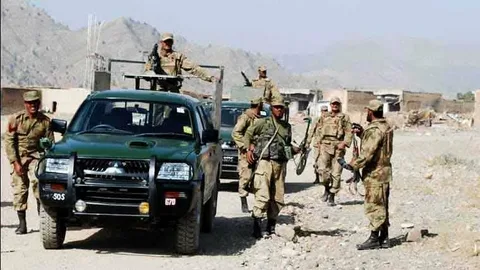
The Lakki Marwat operation ISPR has confirmed the killing of 5 terrorists in a security forces operation conducted in the Lakki Marwat district of Khyber Pakhtunkhwa — with the Inter-Services Public Relations stating that the operation was conducted on the basis of actionable intelligence about the presence of terrorist elements in the area.
The Lakki Marwat operation ISPR announcement follows a sustained pattern of intelligence-based operations that Pakistan’s security forces have been conducting across KPK and the former tribal belt — reflecting the ongoing counterterrorism campaign that has intensified significantly following the resurgence of TTP — Tehrik-i-Taliban Pakistan — activity in the region.
Lakki Marwat operation ISPR casualties include 5 terrorists killed and the recovery of weapons and ammunition from the site — with ISPR stating that the operation was successfully conducted and that the security forces sanitised the area following the engagement. According to ISPR, the killed terrorists were involved in terrorist activities against security forces and civilians in the region.
Background: Lakki Marwat Operation ISPR — Understanding the Security Context
Lakki Marwat — The District and Its Security Challenges
Lakki Marwat is a district in Khyber Pakhtunkhwa province located in the former Bannu Division — an area that has historically been among the most challenging security environments in Pakistan due to its geographic proximity to the erstwhile FATA tribal belt and the Afghanistan border region from which militant groups have historically operated.
The Lakki Marwat operation ISPR is not an isolated incident but rather the latest in a sustained series of security operations that Pakistan’s military and intelligence establishment has been conducting in the KPK belt — reflecting the continued presence of TTP and affiliated militant networks that have used the district and surrounding areas as operational territory for attacks on security forces and civilians alike.
Lakki Marwat district has suffered significantly from terrorist violence over the years — with multiple high-profile attacks including a devastating suicide bombing at a volleyball ground in January 2010 that killed over 100 civilians remaining among the most painful episodes in the district’s recent history. The Lakki Marwat operation ISPR reflects the security establishment’s ongoing commitment to preventing a return to the levels of terrorist violence that previously devastated the district.
Pakistan’s Ongoing Counterterrorism Campaign
The Lakki Marwat operation ISPR is one component of Pakistan’s broader counterterrorism campaign — Operation Azm-e-Istehkam — the current overarching military operation framework that encompasses intelligence-based operations across KPK and Balochistan targeting TTP and allied militant groups.
Pakistan’s security forces have conducted hundreds of intelligence-based operations across KPK in recent months — with ISPR regularly announcing the results of operations that collectively reflect a sustained and intensive counterterrorism effort across the province. The Lakki Marwat operation ISPR fits within this broader operational pattern — representing the granular, intelligence-driven approach to counterterrorism that has replaced the large-scale conventional military sweeps of earlier operations like Zarb-e-Azb.
The TTP resurgence that has driven the current operational tempo — including the Lakki Marwat operation ISPR — is directly connected to the changed security environment following the Taliban’s return to power in Afghanistan in August 2021. The Afghan Taliban’s takeover removed the pressure that US and NATO forces had applied to militant sanctuaries in eastern Afghanistan — creating space for TTP reorganisation, rearmament, and the resumption of cross-border operations against Pakistani security forces and civilians.
Lakki Marwat Operation ISPR — Operational Details
How the Operation Was Conducted
The Lakki Marwat operation ISPR was conducted on the basis of actionable intelligence — the standard operational framework for the intelligence-based operations that Pakistan’s security forces have been conducting across KPK with increasing frequency and effectiveness.
Actionable intelligence-based operations represent a significant evolution from the broad-based clearance operations that characterised earlier phases of Pakistan’s counterterrorism campaign. Rather than deploying large conventional forces to sweep areas, the current approach involves smaller, highly mobile special operations teams acting on specific intelligence about the location, identity, and activities of targeted individuals — reducing civilian disruption while increasing operational precision.
The Lakki Marwat operation ISPR engagement resulted in the killing of 5 terrorists — with ISPR confirming that the security forces suffered no casualties in the operation. The recovery of weapons and ammunition from the site of the Lakki Marwat operation ISPR is consistent with the standard ISPR reporting format for successful counterterrorism operations across KPK.
Weapons Recovered
The Lakki Marwat operation ISPR weapons recovery — while specifics of the recovered items were not detailed beyond ISPR’s standard confirmation of weapons and ammunition — is operationally significant because it reduces the materiel available to militant networks operating in the district and provides intelligence about weapons supply chains that feeds into subsequent operations.
Weapons recovery in operations like the Lakki Marwat operation ISPR also serves an important communication function — demonstrating to local communities that the security forces are actively degrading militant capacity in their area and providing tangible evidence of operational success beyond the casualty figures alone.
ISPR Statement — What Was Said
Lakki Marwat Operation ISPR — Official Communication
ISPR — the Inter-Services Public Relations directorate of the Pakistan Armed Forces — serves as the primary official communication channel for military operations across Pakistan. ISPR statements about operations like the Lakki Marwat operation ISPR follow a consistent format — confirming the location, nature, and results of the operation while providing the essential details of terrorist casualties and weapons recovery.
The Lakki Marwat operation ISPR statement confirmed that security forces conducted the intelligence-based operation in Lakki Marwat district, that 5 terrorists were killed in the engagement, that weapons and ammunition were recovered from the site, and that the killed terrorists had been involved in terrorist activities against security forces and the local population.
ISPR’s communication of the Lakki Marwat operation ISPR results is part of a deliberate information strategy — maintaining public awareness of counterterrorism operations, demonstrating institutional commitment to the security of KPK communities, and providing the accountability record that legitimate military operations require in a democratic framework.
Pakistan Military Operations Against Terrorism
Major Pakistan Military Operations Against Terrorism — Historical Context
Pakistan military operations against terrorism have evolved through several distinct phases since the post-9/11 period — beginning with the first military deployments to the tribal belt in 2002 and developing through increasingly sophisticated operational frameworks over the subsequent 2 decades.
The major Pakistan military operations against terrorism include Operation Rah-e-Haq — conducted in Swat between 2007 and 2009 to clear the Pakistani Taliban from the Swat Valley. Operation Rah-e-Nijat — the 2009 South Waziristan operation that was the largest Pakistan military operation against terrorism at that time, involving 30,000 troops in a comprehensive clearance of the South Waziristan Agency. Operation Zarb-e-Azb — launched in June 2014 in North Waziristan, this remains the largest and most consequential of all Pakistan military operations against terrorism, displacing over a million people and conducting over 5 years of sustained military operations that significantly degraded TTP infrastructure. Operation Radd-ul-Fasaad — launched in 2017 as a nationwide consolidation operation following Zarb-e-Azb, focusing on eliminating residual terrorist presence across Pakistan. Operation Azm-e-Istehkam — the current operational framework under which the Lakki Marwat operation ISPR was conducted.
Current Operational Environment
Pakistan military operations against terrorism in the current environment are characterised by a higher frequency of smaller, intelligence-based operations rather than large conventional military sweeps — reflecting both the evolution of military strategy and the nature of the current TTP threat which has fragmented into smaller cells operating across a wider geographic area than the concentrated North Waziristan sanctuary that Zarb-e-Azb targeted.
The Lakki Marwat operation ISPR is representative of this current Pakistan military operations against terrorism approach — targeted, intelligence-driven, and focused on specific individuals and groups rather than broad territorial control.
Operation Al Mizan — Context
What Is Operation Al Mizan
Operation Al Mizan was Pakistan’s first major military operation in the tribal areas — conducted in South Waziristan in 2002 and 2003 following the US invasion of Afghanistan and the movement of Al-Qaeda and Taliban elements across the border into Pakistani territory.
Operation Al Mizan represented a fundamental shift in Pakistan’s tribal area security policy — with the military entering the FATA tribal belt in a direct combat role for the first time in Pakistan’s post-independence history. The operation targeted Al-Qaeda and foreign militants who had established themselves in South Waziristan following their expulsion from Afghanistan.
Operation Al Mizan set the precedent and the operational template for all subsequent Pakistan military operations against terrorism in the tribal belt — establishing the intelligence-based approach, the coordination between military and FC forces, and the targeting framework that continues to characterise operations including the Lakki Marwat operation ISPR today.
Operation Al Mizan also exposed the limitations of military operations alone in addressing the terrorist presence in the tribal areas — with militants dispersing in response to military pressure and reconstituting in adjacent areas, a pattern that subsequent operations including Zarb-e-Azb and the current Azm-e-Istehkam framework have attempted to address through more comprehensive and sustained approaches.
Quotes on Lakki Marwat Operation ISPR
ISPR stated in the official Lakki Marwat operation ISPR announcement that security forces conducted an intelligence-based operation in Lakki Marwat district and successfully killed 5 terrorists — adding that weapons and ammunition were recovered from the site and that the killed terrorists had been actively involved in terrorist activities against security forces and civilians in the area.
KPK Chief Minister Ali Amin Gandapur praised the security forces following the Lakki Marwat operation ISPR announcement — stating that the provincial government stood fully behind Pakistan military operations against terrorism in KPK and that the killing of 5 terrorists in Lakki Marwat demonstrated the effectiveness of the intelligence-based operations approach.
A senior security analyst commenting on the Lakki Marwat operation ISPR told Pakistani media that the operation was consistent with the broader pattern of sustained counterterrorism activity across KPK — adding that the frequency and effectiveness of operations like Lakki Marwat operation ISPR reflected the improving quality of intelligence cooperation between military, FC, and civilian intelligence agencies in the province.
Local community leaders in Lakki Marwat welcomed the Lakki Marwat operation ISPR announcement — with a district elder telling Dawn that the local population supported security forces operations against the terrorist elements that had been causing fear and disruption in the district, adding that the community hoped the operations would continue until the area was permanently cleared.
Former ISPR Director General Major General Babar Iftikhar described operations like the Lakki Marwat operation ISPR as the sharp end of Pakistan’s comprehensive counterterrorism strategy — stating that intelligence-based operations targeting specific militants had proven significantly more effective and less disruptive to civilian life than the large-scale conventional operations of earlier phases of Pakistan military operations against terrorism.
Impact: What the Lakki Marwat Operation ISPR Means
Immediate Security Impact
The immediate security impact of the Lakki Marwat operation ISPR — 5 terrorists killed and weapons recovered — is measurable but contextually limited. Individual operations, however successful, do not eliminate the structural factors driving terrorist activity in KPK — including the cross-border sanctuaries in Afghanistan, the socioeconomic vulnerabilities that militant networks exploit for recruitment, and the governance gaps that allow terrorist organisations to maintain local presence.
The cumulative impact of sustained operations like the Lakki Marwat operation ISPR is more significant than any single engagement — with the consistent operational pressure on TTP networks across KPK degrading their capacity, disrupting their planning cycles, and raising the operational costs of maintaining a presence in districts where security forces are actively hunting them.
Community Confidence
The Lakki Marwat operation ISPR contributes to the community confidence-building dimension of Pakistan’s counterterrorism strategy — demonstrating to local populations that security forces are active, capable, and committed to protecting them from the terrorist violence that has devastated KPK communities over the past 2 decades.
Community confidence in security forces is operationally critical because it generates the human intelligence that makes operations like the Lakki Marwat operation ISPR possible — with local populations providing information about terrorist presence and activity when they trust that security forces will act on that information effectively and protect them from retaliation.
Pakistan Afghanistan Relations
The sustained operational tempo of Pakistan military operations against terrorism — including the Lakki Marwat operation ISPR — continues to be a source of friction in Pakistan Afghanistan relations, with Islamabad pressing Kabul to deny TTP the Afghan territory from which it plans and supports operations against Pakistani security forces.
The Afghan Taliban government has consistently rejected Pakistani accusations of providing TTP sanctuary — creating a bilateral impasse that represents one of the most significant strategic challenges facing Pakistan’s counterterrorism campaign and that no single operation like the Lakki Marwat operation ISPR can resolve.
Frequently Asked Questions
What Is Operation Al Mizan?
Operation Al Mizan was Pakistan’s first major military operation in the tribal areas — conducted in South Waziristan in 2002 and 2003 following the movement of Al-Qaeda and Taliban elements into Pakistani territory after the US invasion of Afghanistan. The operation targeted foreign militants who had established themselves in the tribal belt and represented the first time Pakistani military forces entered FATA in a direct combat role since independence. Operation Al Mizan set the foundation for all subsequent Pakistan military operations against terrorism including the major operations — Rah-e-Haq, Rah-e-Nijat, Zarb-e-Azb, Radd-ul-Fasaad — and the current Azm-e-Istehkam framework under which the Lakki Marwat operation ISPR was conducted.
When Did India Surgical Strike in Pakistan?
India claimed to have conducted a surgical strike across the Line of Control into Pakistani-administered Kashmir on September 28 to 29, 2016 — following the Uri attack in which militants killed 18 Indian Army soldiers at a brigade headquarters in Jammu and Kashmir. India claimed its special forces crossed the LoC and struck multiple militant launch pads in Pakistani-administered Kashmir. Pakistan denied that any Indian forces crossed the LoC — stating that there had been cross-border firing and that Pakistani forces had repulsed the incursion. The surgical strike claim was never independently verified and remains disputed between the 2 countries. India claimed a second surgical strike in February 2019 — the Balakot airstrike following the Pulwama attack — which Pakistan acknowledged but disputed the damage claims. Neither incident resulted in a broader military conflict between the 2 nuclear-armed neighbours.
What Are the Military Operations Against Terrorism in Pakistan?
Pakistan’s major military operations against terrorism include Operation Al Mizan in South Waziristan in 2002 to 2003. Operation Rah-e-Haq in Swat from 2007 to 2009. Operation Rah-e-Nijat in South Waziristan in 2009. Operation Sherdil in Bajaur in 2008. Operation Zarb-e-Azb in North Waziristan from 2014 to 2019 — the largest and most consequential Pakistan military operation against terrorism. Operation Radd-ul-Fasaad launched nationwide in 2017. Operation Azm-e-Istehkam — the current ongoing framework under which intelligence-based operations including the Lakki Marwat operation ISPR are being conducted across KPK and Balochistan. Each of these Pakistan military operations against terrorism has targeted different militant groups and geographic areas — collectively representing over 2 decades of sustained military engagement against terrorist networks operating in Pakistan’s western regions.
Conclusion
The Lakki Marwat operation ISPR — 5 terrorists killed, weapons recovered, area sanitised — is a single data point in a counterterrorism campaign that is measured not in individual engagements but in the cumulative pressure that sustained operations apply to militant networks across KPK.
Pakistan military operations against terrorism have evolved enormously from the first tentative deployments of Operation Al Mizan in 2002 — developing through the large-scale conventional operations of Zarb-e-Azb to the current intelligence-based approach that the Lakki Marwat operation ISPR exemplifies. Each phase has reflected the operational lessons of the previous one and the changed nature of the threat being addressed.
The Lakki Marwat operation ISPR is not the last such operation — it is one of many that Pakistan’s security forces will conduct in the weeks and months ahead as they maintain the operational pressure on TTP and allied militant networks that represents the military dimension of a counterterrorism challenge whose ultimate resolution requires political, economic, and diplomatic solutions that no number of successful operations alone can deliver.