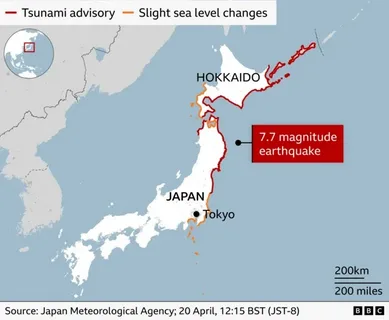
The quake hit on Monday at 4:53 p.m. local time off Iwate prefecture on the Pacific coast, according to the Japan Meteorological Agency (JMA). It was felt across a wide area, shaking buildings in Tokyo, hundreds of kilometres to the south.
This powerful disturbance originated at a relatively shallow depth of 19 kilometres, and the Japan Meteorological Agency confirmed that the tremor registered an upper 5 on the Japanese seismic intensity scale in multiple districts, including Aomori, Iwate, and Miyagi. The Japan earthquake alert was immediately broadcast nationwide through official channels, TV broadcasts, and the distinctive Japan earthquake alert sound that warns citizens to take cover.
Tsunami Warning Japan: The Immediate Response
Authorities issued a tsunami alert for waves up to 3 metres (10ft) high. Two hours after the tremor, tsunami waves as high as 80cm had been detected, and the warning was later downgraded to a tsunami advisory.
The JMA had warned that the first tsunami waves could reach parts of the northern coastline immediately, urging people to evacuate immediately from coastal regions and riverside areas to safer places such as high ground or an evacuation building.
Sirens blared and tsunami warning announcements were heard on loudspeakers in the coastal Japanese town of Ofunato after the earthquake struck off the country’s east coast.The Japan earthquake alert live coverage on NHK kept millions of viewers informed in real time.
Background: Japan’s Earthquake History
Japan sits in one of the most seismically active zones on Earth. Japan is one of the world’s most earthquake-prone countries, sitting on the Pacific “Ring of Fire,” where several tectonic plates meet. It experiences about 1,500 earthquakes each year and accounts for almost 18 percent of the world’s seismic activity.
Since 2011, when a 9.0-magnitude earthquake and tsunami triggered meltdowns at three reactors at the Fukushima Daiichi nuclear power plant, Japan has significantly strengthened its earthquake warning systems and evacuation protocols.
The Sanriku Coast, where this quake struck, has a long and tragic seismic history. The same region was devastated in 2011, making the Japan earthquake alert all the more alarming to residents with living memory of that disaster.
Japan Earthquake Alert Map: Areas Under Warning
The JMA issued a tsunami warning for waves reaching up to 3 metres high in parts of Iwate Prefecture, Aomori, and Hokkaido Prefectures. These warnings were later downgraded to advisories, before being lifted at 23:50 JST.
Evacuation orders were issued to 82,811 households and 175,957 people from a total of 13 cities, 21 towns, and 6 villages in Hokkaido, Aomori, Iwate, Miyagi, and Fukushima Prefectures.
The Japan earthquake alert map broadcast on NHK and major news outlets showed the vast stretch of coastline affected, from Chiba in the south to Hokkaido in the north.
Megaquake Advisory: A Rare and Serious Warning
The most alarming development following the quake was the issuance of a rare megaquake advisory. Residents in 182 towns across seven prefectures were urged to be on alert for a potential stronger earthquake and to confirm evacuation routes and shelters.
This marks only the second time such a specific warning has been utilized since its creation. The only previous occurrence was recorded in December 2025.
Officials from Japan’s Cabinet Office and the Japan Meteorological Agency said there was a 1% chance of an earthquake of magnitude 8 or stronger striking along two deep-sea trenches in the Pacific in the next week, compared to a 0.1% chance during normal times.
Official Quotes: What Leaders Said
Prime Minister Sanae Takaichi said the government had set up a crisis management team and was working to assess the impact of the earthquake. “For those of you who live in areas for which the warnings have been issued, please evacuate to higher, safer places such as higher ground,” Takaichi told reporters.
Earthquake geologist Wendy Bohon noted that “it is important for people who may be at risk to understand that another large earthquake is possible, even if it is unlikely.”She added that earthquakes make other earthquakes more likely by releasing stress along nearby fault lines.
Damage and Casualties: What We Know
Six people were injured two in Hokkaido, one in Aomori, and three in Iwate prefectures. Two of the victims were seriously injured. At least 39 buildings were damaged in Aomori Prefecture, and a road was damaged in Ishinomaki, Miyagi Prefecture.
An 80-centimetre-high tsunami struck Kuji, Iwate, while 40-centimetre waves were observed at Miyako and Urakawa in Hokkaido. Given the scale of the Japan earthquake alert, authorities said the limited damage was a relief.
Tokyo Electric Power Company confirmed no abnormalities were detected at its Fukushima Daiichi and Fukushima Daini nuclear power plants, although workers were evacuated as a precaution.
Japan Earthquake Prediction: What Experts Are Saying
Such megaquake advisories are designed not as forecasts but as alerts: individuals should be aware of the elevated risk, know where their evacuation routes are, and have their go bags of emergency supplies ready.
The likeliest scenario is that Monday’s 7.7-magnitude tremor was the main event and that the seismic activity is now dying down. However, for the next few days, millions of people along the coast will be primed to flee just in case the odds are against them.
Japan earthquake prediction tools and seismic monitoring networks remain on high alert through at least April 27, when the advisory is set to expire.
Transport and Infrastructure Impact
Bullet train services resumed operations on Monday evening after being suspended due to power outages caused by the earthquake. Affected trains included services between Tokyo and Shin-Aomori stations, and Akita and Morioka stations in northern Japan.
Roughly 200 households lost power in Hiraizumi, Iwate.Authorities worked through the night to restore services and assess damage to roads and infrastructure across affected prefectures.
Global Impact and Regional Concern
Japan’s earthquake alerts carry global significance due to the country’s dense population, advanced nuclear infrastructure, and economic importance. The Japan earthquake alert BBC coverage and other international broadcasters provided live updates as the situation developed.
Memories remain strong of the devastating magnitude 9 earthquake and tsunami that struck northeastern Japan in 2011, killing about 18,500 people and triggering the Fukushima nuclear disaster.That shared trauma means any major Japan earthquake alert triggers a deeply personal response from millions of residents.
Internationally, neighbouring countries and Pacific-rim nations were also monitoring the tsunami warning Japan had issued, tracking wave activity across open ocean as a precaution.
Conclusion: What Comes Next
The April 20 Sanriku earthquake has put Japan on edge. Authorities have extended the megaquake advisory until April 27, urging all residents in coastal zones to remain prepared and stay close to Japan earthquake alert live updates on NHK and official government channels.
The JMA issued an Off the Coast of Hokkaido and Sanriku Subsequent Earthquake Advisory until April 27, warning about the possibility of a stronger earthquake.
Experts agree that while a megaquake remains statistically unlikely, the elevated risk period requires the public to stay informed, keep emergency kits ready, and follow all official Japan earthquake alert instructions without delay.
FAQs
Does Japan have an earthquake warning?
Yes. Japan operates one of the most advanced earthquake early warning systems in the world, run by the Japan Meteorological Agency (JMA). The system detects initial seismic waves and sends Japan earthquake alert sound notifications via TV, radio, mobile phones, and public loudspeakers within seconds of a quake being detected.
Where did the earthquake hit in Japan today?
The earthquake struck off the Sanriku Coast of Honshu, near Iwate Prefecture, in northeastern Japan. It hit at 4:53 p.m. local time on April 20, 2026, at a depth of approximately 19 kilometres beneath the seafloor along the Japan Trench.
Where was the 7.7 earthquake today?
The 7.7-magnitude earthquake was located off the northeastern coast of Japan, in waters off Iwate prefecture along the Sanriku coastline. The Japan Meteorological Agency later revised its magnitude upward to 7.7 from an initial reading of 7.5. It was felt as far south as Tokyo, several hundred kilometres from the epicentre.