

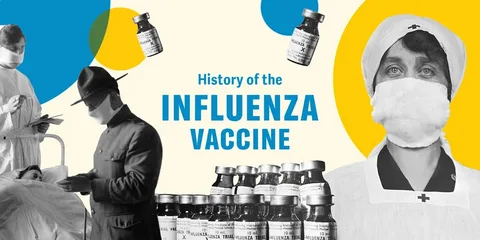

The influenza vaccine, commonly called the flu shot, is a preventive medicine designed to reduce the risk of infection from influenza viruses. Vaccination against influenza began in the 1930s, with large-scale availability in the United States beginning in 1945. Both the World Health Organization and the US Centers for Disease Control and Prevention (CDC) recommend yearly vaccination for nearly all people over the age of six months, especially those at high risk. The vaccine works by training the immune system to recognize and fight flu viruses. It does not treat influenza but reduces the risk of getting it. Even if a vaccinated person still gets the flu, the symptoms may be less severe or not last as long.
Annual vaccination against influenza A and B viruses is recommended in the US for everyone six months or older without a contraindication.This wide recommendation reflects how seriously global health authorities take the annual flu burden.
Influenza History Timeline: From Pandemic to Prevention
Understanding the influenza history timeline helps explain why the vaccine was developed with such urgency.
The H1N1 influenza pandemic that swept across the world from 1918 to 1919, sometimes called “the mother of all pandemics,” involved a particularly virulent new strain of the influenza A virus. The 1918 pandemic is estimated to have infected 500 million people worldwide, killing between 20 and 50 million.
Early attempts to fight the flu failed because scientists were targeting the wrong thing. For many years, influenza was thought to be caused by a bacterial infection. It was not until the 1930s, when the influenza virus was identified, that progress towards an effective vaccine could really begin.
In 1933, British researchers Wilson Smith, C.H. Andrewes, and P.P. Laidlaw at London’s National Institute for Medical Research made a breakthrough when they isolated and identified the influenza virus.This discovery changed everything.
In the 1940s, Thomas Francis Jr., MD and Jonas Salk, MD served as lead researchers at the University of Michigan to develop the first inactivated flu vaccine with support from the U.S. Army. Their vaccine used fertilized chicken eggs in a method still used to produce most flu vaccines today.
In 1945, the inactivated influenza vaccine was licensed for use in civilians. In 1942, a bivalent (two-component) vaccine that offered protection against influenza A and influenza B viruses was produced after the discovery of influenza B viruses.
In 1960, the U.S. Surgeon General, in response to substantial morbidity and mortality during the 1957–58 pandemic, recommended annual influenza vaccination for people with chronic debilitating disease, people aged 65 years or older, and pregnant women.
When Did the Flu Vaccine Become Mainstream?
The flu vaccine did not become truly widespread overnight. In 2010, the ACIP began recommending annual influenza vaccination for those six months of age and older.This marked the turning point when the flu vaccine became a universal public health recommendation rather than one limited to high-risk groups.
Today, flu vaccines are accessible to nearly everyone and recommended for those six months or older. According to the CDC, hundreds of millions of Americans have safely received flu vaccines over the past 50 years, and extensive research has supported the safety of flu vaccines.
For the 2025–2026 flu season, vaccine manufacturers have projected they will supply the United States with as many as 154 million doses.That scale of distribution reflects how deeply the flu vaccine is now embedded in mainstream medicine.
First Flu Vaccine Problems: What Went Wrong Early On
The early history of the influenza vaccine was not without serious setbacks. These first flu vaccine problems shaped how we think about vaccine development and safety today.
Early flu vaccines contained only inactivated influenza virus type A (monovalent) but, by 1942, there was a bivalent vaccine containing both influenza type A and influenza type B. This early vaccine caused localized and systemic reactions, especially in children.
During the 1947 flu season, researchers discovered that existing vaccines were ineffective against the flu viruses circulating at the time.This was a wake-up call that revealed how rapidly the virus mutates.
One of the most dramatic examples of early flu vaccine problems came in 1976. The vaccination program was rushed, yet plagued by delays and public relations problems. An excess in deaths of 25 over normal annual levels as well as 400 excess hospitalizations, both from Guillain–Barré syndrome, were estimated to have occurred from the vaccination program itself, demonstrating that the vaccine itself is not free of risks.
Early researchers like Jonas Salk faced innumerable pitfalls: scores of broken eggs, a pellet that disintegrated upon removal, and a vaccine that still contained live virus a danger that could have caused serious illness instead of preventing it.
How Is the Flu Vaccine Predicted Each Year?
One of the most fascinating and technically complex aspects of the influenza vaccine is how it is selected each year. The flu virus changes constantly, which means scientists must effectively predict the future.
Because new strains appear frequently, the seasonal flu vaccine usually changes each year, as scientists determine how the virus has mutated and spread.
The annual effectiveness of influenza vaccines is evaluated by public health organizations. The CDC has monitored seasonal influenza vaccine effectiveness each year since 2004. Vaccine efficacy and effectiveness can vary widely by season, subtype, age group, and vaccine type. A key determinant is the antigenic match between vaccine strains and circulating strains.
The 2025–2026 egg-based trivalent vaccines are formulated with A/Victoria/4897/2022 (H1N1) pdm09-like, A/Croatia/10136RV/2023 (H3N2)-like, and B/Austria/1359417/2021 (B/Victoria lineage)-like viruses.
The WHO plays a central role in this prediction process. The World Health Organization established the Worldwide Influenza Centre in 1948 and the Global Influenza Surveillance and Response System (GISRS) in 1952. Scientists can now manufacture vaccines based on monitoring virus strains in circulation around the world, updating the strains targeted by the vaccine in response.
Influenza Vaccine Dose for Adults: What You Need to Know
The influenza vaccine dose for adults varies depending on age and health status.
The American College of Physicians (ACP) issued new influenza vaccine practice points stating that everyone ages 18 to 64 years who are not pregnant or immunocompromised should receive either a standard-dose trivalent or a standard-dose quadrivalent influenza vaccine for the 2025–2026 influenza season. Those aged 65 years or older who are not immunocompromised should receive either a high-dose trivalent or a high-dose quadrivalent egg-based influenza vaccine.
Adults 65 and older receive higher-dose formulations because aging naturally weakens immune response, requiring a stronger stimulus to produce adequate protection. The ACIP preferentially recommends that adults 65 years or older receive a high-dose (Fluzone High-Dose), adjuvanted (Fluad), or recombinant (Flublok) vaccine.
In general, most adults receive a single dose of influenza vaccine per season, administered by injection into the muscle, typically in the upper arm.
Influenza Vaccine Price: How Much Does It Cost?
The influenza vaccine price is a concern for many patients, though costs have been kept relatively accessible through insurance and public health programs.
Influenza vaccines have a cost between approximately $11 and $22 per dose through CDC programs, making them one of the most cost-effective preventive health investments available.
Most health care insurance plans cover the annual flu vaccination as part of preventive care. Flu vaccination is often available at no or low cost to people who do not have insurance.Medicare also covers flu vaccines without applying deductibles or coinsurance.
For enhanced formulations used in older adults, the influenza vaccine price can be higher. Part B payment for seasonal flu vaccines is based on 95% of the average wholesale price. In 2024, CMS began offering an additional payment to providers for administering flu vaccines in the home to Medicare beneficiaries, with an additional payment for 2025 of approximately $40.
Private market prices without insurance can range considerably higher, but pharmacies, community health clinics, and employer programs often offer the flu shot at reduced or no cost.
Influenza Vaccine Benefits: Why It Matters
The influenza vaccine benefits go well beyond individual protection. At a population level, widespread flu vaccination reduces hospitalizations, deaths, and the spread of disease across communities.
During the 2024–2025 influenza season in the US, vaccination was associated with up to a 78% reduction in the risk of influenza-associated hospitalization in children and adolescents.
Influenza vaccination had a pooled vaccine effectiveness of 48% in adults between the ages of 18 and 64 years and 67% in children against hospitalization.
When circulating influenza viruses are drifted from viruses represented in flu vaccines, vaccine effectiveness may be reduced, but flu vaccination continues to provide benefits including protection against severe flu illness, hospitalization, and death; protection against other circulating influenza viruses; and help to reduce the overall community spread of flu.
Trivalent vaccines are projected to save $100 million per year in direct medical costs. When considering other indirect costs, total savings could reach $7.1 billion per year.
Expert Voices on the Flu Vaccine
The American College of Physicians has stated that influenza vaccines help prevent morbidity and mortality.Medical experts and public health bodies worldwide have consistently supported annual flu vaccination as a core preventive health measure.
More recently, influenza vaccines developed using cell-based and recombinant technologies have become available. These technologies limit the risk of egg-adaptive mutations, which can affect antigenic match and impair vaccine effectiveness. They also have potential for faster scale-up and reduce reliance on eggs for production, which is particularly important in a pandemic scenario.
Impact: Global and Regional Significance
The influenza vaccine is on the World Health Organization’s List of Essential Medicines. The European Centre for Disease Prevention and Control (ECDC) also recommends yearly vaccination of high-risk groups, particularly pregnant women, the elderly, children between six months and five years, and those with certain health problems.
Influenza vaccines that provide more effective immunity to seasonal influenza as well as protection against a broad range of emerging influenza viruses with pandemic potential are needed to reduce the public health burden of influenza and enhance pandemic preparedness.
What’s Next: The Future of the Influenza Vaccine
Research on next-generation flu vaccines is advancing rapidly. Scientists are pursuing a “universal” influenza vaccine that would protect against multiple strains without requiring an annual shot. Next-generation influenza vaccines have the potential to overcome the limitations of current seasonal influenza vaccines by providing more efficacious, broader, and longer-lasting protection and enhanced pandemic preparedness.
mRNA technology, which proved transformative in COVID-19 vaccine development, is also being explored for influenza. While influenza vaccines developed using mRNA technologies have not yet been licensed, they are anticipated to become available in the near future and have shown potential for superior efficacy when compared to traditional inactivated vaccines.
The coming years may redefine what we know about flu vaccine, shifting it from an annual obligation to a longer-lasting, broader shield against influenza.
FAQs
How is the influenza vaccine developed?
Each year, the WHO and national health agencies analyze global flu surveillance data to identify which strains are most likely to circulate in the upcoming season. Vaccine manufacturers then produce formulations targeting those specific strains, primarily using fertilized eggs or newer cell-based and recombinant technologies. The entire process typically takes about six months from strain selection to distribution.
Does valacyclovir interfere with vaccines?
Antiviral drugs active against herpesviruses such as acyclovir or valacyclovir might reduce the efficacy of vaccines containing live, attenuated varicella zoster virus. These drugs should be discontinued at least 24 hours before administration, if possible.Importantly, antiviral drugs used for treatment or prophylaxis of influenza virus infections have no effect on the response to inactivated influenza vaccineThis means the standard flu shot is not affected by valacyclovir only the live nasal spray version (LAIV) requires special caution with antiviral timing. Always consult your doctor before making any changes to medication schedules around vaccination.
When did they develop flu shots? Clinical trials began in the 1930s and researchers worked closely with U.S. military officials during World War II. In 1945, the first flu vaccine was approved for military use in the U.S. The following year, the vaccine was approved for civilians.The first nasal spray flu vaccine was licensed in June 2003. Annual flu vaccination for all ages six months and older became the universal recommendation in 2010.