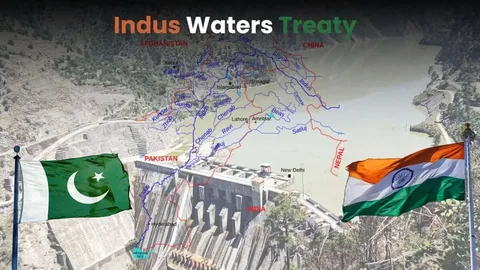
The Indus Water Treaty has outlasted wars, military standoffs, and decades of political hostility between India and Pakistan. That is not a small thing. Signed in 1960, it divided the rivers of the Indus basin between two newly separated countries that have fought multiple armed conflicts since. The treaty kept working through all of it.
Whether it continues to work through the current period of tensions over hydroelectric dam disputes, shifting geopolitics, and the added pressure of climate change on river systems is the question the Indus water Treaty current status discussions are really asking.
Background of the Indus Water Treaty
The Indus water Treaty 1960 between India and Pakistan emerged from a decade of post-partition negotiation. When British India was divided in 1947, the canal irrigation network that fed much of the subcontinent’s agriculture was sliced by the new border in ways that created immediate conflict over water access.
The World Bank stepped in as mediator, and after nine years of negotiation, Jawaharlal Nehru and Ayub Khan signed the agreement in Karachi on September 19, 1960. The settlement was not a compromise in the usual sense it was a division. India got the three eastern rivers: Ravi, Beas, and Sutlej. Pakistan got the three western rivers: Indus, Jhelum, and Chenab, with India permitted only limited use of those for specific purposes.
The division was designed to give each country a clean allocation rather than shared management of contested rivers — a design choice that turned out to be durable precisely because it reduced the daily points of friction.
Indus Water Treaty Main Points
The Indus water Treaty main points go considerably deeper than the river division. The agreement runs to detailed technical annexures covering permissible uses, dam design standards, spillway specifications, reservoir dimensions, and data sharing requirements.
The critical asymmetry: Pakistan has unrestricted use of its western rivers for agriculture, drinking water, and energy. India can use those same rivers for non-consumptive purposes run-of-river hydroelectric generation, limited irrigation under specific conditions defined in the treaty. India has no right to store significant volumes of western river water or divert flows in ways that would reduce availability downstream.
The Indus Water Commission was built into the treaty as the operational mechanism for keeping this relationship functional. Each country appoints a permanent commissioner. The commission meets regularly, shares hydrological data, conducts site inspections, and works through technical objections before they become diplomatic disputes.
The dispute resolution ladder is also explicit in the treaty: technical disagreements go to the commissioners; unresolved matters go to a neutral expert; from there, arbitration through the Permanent Court of Arbitration is available. The World Bank is named as the body that facilitates this process.
Indus Water Commission and Its Role
The Indus Water Commission is why the treaty is still alive. Diplomacy between India and Pakistan has broken down repeatedly over six decades. The commission kept meeting anyway reviewing project designs, exchanging river data, flagging objections — because the treaty obligates both countries to maintain it regardless of bilateral political conditions.
That institutional continuity matters enormously. It means that even during periods when formal government-to-government contact is frozen, there is still a channel through which water-related technical communication happens. Disputes that might otherwise drift toward confrontation get processed through a structured mechanism instead.
The current work of the commission has focused heavily on India’s hydroelectric projects on the western rivers Kishanganga on the Jhelum and Ratle on the Chenab have been the central cases. Pakistan has raised formal objections to both, arguing that design elements violate treaty conditions. India has disputed those characterizations. Both countries have initiated parallel dispute resolution processes, which has itself become a source of friction.
Why the Indus Water Treaty Is Important
The Indus basin is not an abstract policy question. It is the agricultural and water system on which the lives of hundreds of millions of people in Pakistan and significant populations in northern India directly depend.
For Pakistan, the situation is stark: more than 80 percent of the country’s irrigation comes from the Indus system. The western rivers Indus, Jhelum, Chenab supply the canal networks that water the Punjab and Sindh breadbaskets. Pakistan is one of the most water-stressed countries in the world, and its water stress is structurally tied to what happens to those rivers.
For India, the treaty’s significance is different but real. Jammu and Kashmir’s hydroelectric development depends on what India can build on the western rivers within treaty limits. The strategic dimension controlling or being seen to control river access — also carries political weight domestically.
The combination makes the treaty one of the few areas where both countries have strong incentive to keep the formal agreement intact even as the political relationship deteriorates. That incentive has held for sixty years. Whether it continues to hold under current pressure is genuinely uncertain.
Indus Water Treaty Suspended Debate
“Indus water Treaty suspended” has appeared in Indian political discourse at various points, most prominently after the 2016 Uri attack, when statements from Indian officials suggested the treaty might be revisited.The legal reality is more constrained than the political rhetoric. The treaty has no unilateral exit mechanism. Either party can request modifications through a defined process, but no party can simply announce suspension. International arbitration mechanisms are available to the other side if the treaty is unilaterally violated. The World Bank’s institutional involvement gives any breach international visibility immediately.
That architecture is deliberate. The treaty’s drafters understood that the political relationship between India and Pakistan would not be smooth and built the agreement to survive precisely that. Unilateral suspension would create immediate legal exposure, international consequences, and could trigger arbitration decisions that India or Pakistan might find worse than the treaty’s existing terms.
Pakistan’s response to any suspension discussion is consistent: it treats the treaty as essential to national water security and is prepared to pursue every available legal avenue if it is undermined. Given the downstream stakes for Pakistani agriculture, that position is not diplomatic posturing.
Current Disputes Between India and Pakistan
The active disputes center on Kishanganga and Ratle both Indian hydroelectric projects on western rivers where Pakistan argues specific design elements exceed what the treaty permits.he technical arguments are genuinely complex: concerns about reservoir capacity, the height of spillway gates, the timing and volume of water that can be held during construction. These details determine whether a project affects the flow Pakistan depends on, and the treaty’s annexures govern them specifically.
India’s position is that both projects comply with treaty provisions and that Pakistan is using treaty mechanisms to delay legitimate infrastructure development. Pakistan’s position is that its objections are technically grounded and that India’s projects require modification before they can proceed.
Both countries have simultaneously initiated different dispute resolution tracks Pakistan going to the Permanent Court of Arbitration, India requesting a neutral expert which has created a procedural conflict about which process should govern. That conflict is itself unresolved.Climate change sits underneath all of this and makes it more urgent. Himalayan glaciers are retreating. Snowmelt patterns are shifting. The volume and timing of river flows that the 1960 treaty was designed around will not match what actually flows in the coming decades. The treaty has no explicit mechanism for adjusting to hydrological change.
Global and Regional Impact
The Indus Water Treaty is studied internationally as one of the most instructive examples of transboundary water cooperation specifically because it has functioned between two nuclear-armed states that have fought multiple wars.
That case study value is real, but it comes with a complication: the treaty’s success was partly a product of conditions that are changing. It worked because both countries had clear allocations and a dispute mechanism. Climate change is altering the supply side in ways the allocation was not designed to accommodate. Political conditions are straining the dispute mechanism.
International water diplomacy experts who study the treaty tend to argue that it needs modernization — updated provisions for climate variability, expanded data sharing, possibly renegotiation of storage and usage terms. Getting India and Pakistan to agree on that update in the current political environment is a different challenge from any technical one.
For a region where agriculture and water supply are tied to the same river system, the stakes of getting this wrong are not abstract.
Indus Water Treaty PDF and Academic Interest
The Indus water Treaty PDF is widely downloaded and used in legal, environmental, and policy research. The treaty and its annexures are public documents and provide the primary source material for understanding what is and is not permitted.
Indus water Treaty UPSC preparation materials use the agreement as a key case study in international relations, environmental law, and South Asian geopolitics. The treaty’s structure a negotiated allocation with technical annexures, a permanent commission, and a defined dispute ladder — is taught as a model for bilateral resource agreements.
Academic research on the treaty has increasingly focused on climate vulnerability and adaptation specifically, how a sixty-year-old agreement built around stable river flows responds to a future where those flows are less stable.
Who Signed the Indus Water Treaty?
The treaty was signed on September 19, 1960, in Karachi. Indian Prime Minister Jawaharlal Nehru and Pakistani President Ayub Khan signed for their respective governments. World Bank President Eugene Black was also a signatory, reflecting the institution’s role as guarantor of the negotiation process.
The agreement is referred to as the Sindhu Jal Samjhauta in Hindi-language and Urdu-language discussions — the same treaty, different names across contexts.
Conclusion
The Indus Water Treaty is still active, still operational through the commission, and still the legal framework governing how India and Pakistan share the rivers they depend on. The Indus water Treaty current status is functional but stressed.
The stresses are not new in kind technical disputes over hydroelectric projects, political rhetoric about suspension, underlying mistrust between the governments but they are intensifying in scale. Climate change has added a variable that neither side knows how to manage within the existing framework.
The sixty-year track record is evidence that the treaty is more durable than the political relationship it sits within. Whether it remains durable as the pressures accumulate is the question without a clean answer.
FAQs
Who signed the Sindhu Jal Samjhauta?
The Sindhu Jal Samjhauta the Indus Water Treaty was signed on September 19, 1960, in Karachi by Indian Prime Minister Jawaharlal Nehru, Pakistani President Ayub Khan, and World Bank President Eugene Black. The World Bank’s signatory role reflected its position as mediator and institutional guarantor of the nine-year negotiation process that produced the agreement.
What is the main dispute between Pakistan and India under the treaty?
The active disputes center on Indian hydroelectric projects on the western rivers specifically Kishanganga on the Jhelum and Ratle on the Chenab. Pakistan argues that design elements of both projects exceed what the treaty permits, potentially affecting downstream water flow. India maintains that the projects comply with treaty provisions. Both countries have initiated parallel dispute resolution processes through different mechanisms, which has itself created a procedural conflict that remains unresolved. These technical disputes reflect the broader tension over how much India can develop on rivers that flow into Pakistan.
Does India have dams on Indus River?
India has built hydroelectric and water management projects on rivers within the Indus basin, particularly on the Jhelum and Chenab. The treaty permits this, with conditions: India can use the western rivers for run-of-river hydroelectric generation and limited irrigation, but cannot build large storage reservoirs or divert flows in ways that would significantly reduce Pakistan’s allocation. Whether specific Indian projects stay within those conditions is the substance of the current disputes, and both sides have submitted their technical arguments to international dispute mechanisms.