India’s Democratic Contradictions
by Muhammad Mohsin Iqbal
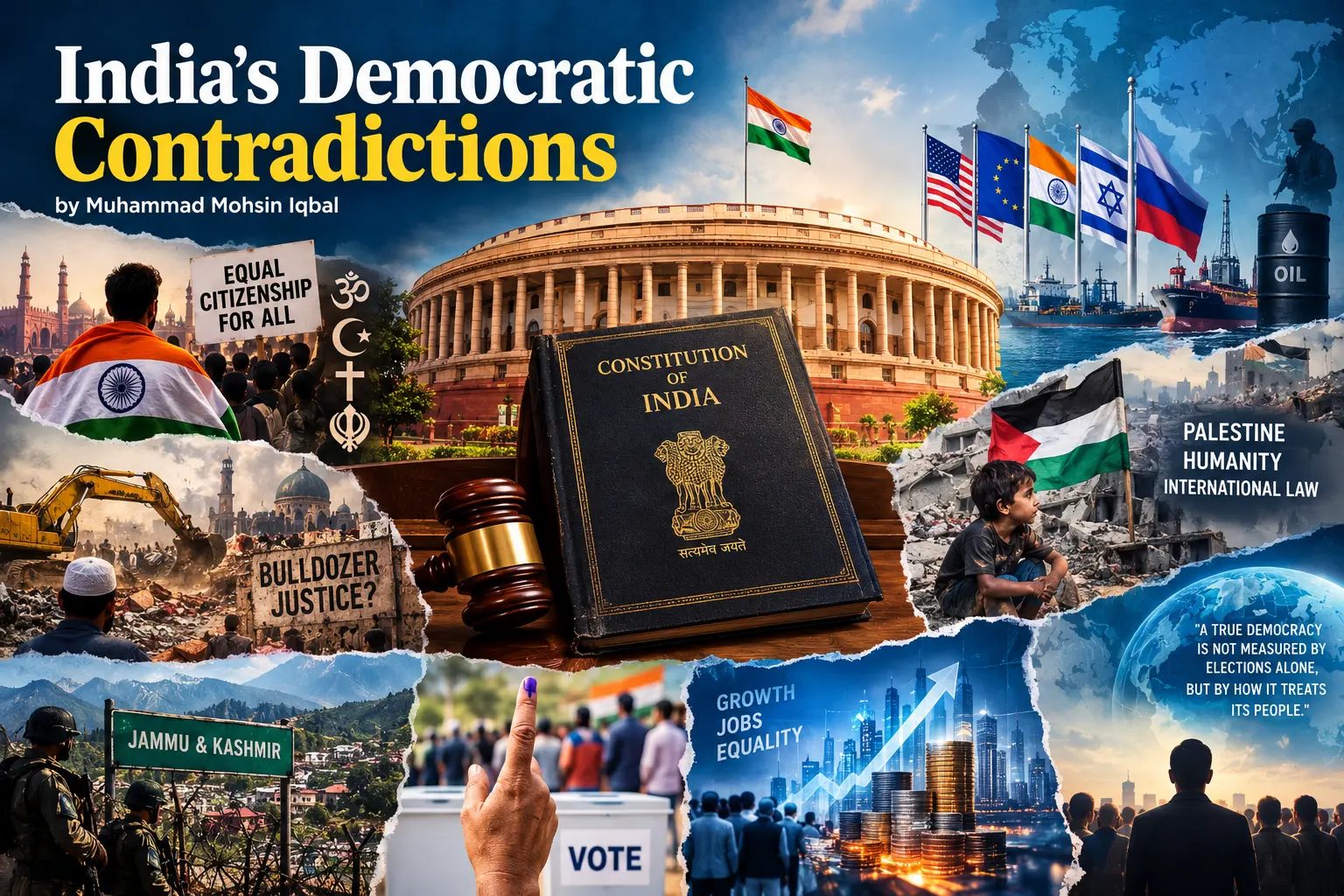
India’s claim to democratic greatness rests on its vast electorate, constitutional framework and extraordinary diversity. Yet democracy is measured not merely by the frequency of elections or the size of the population, but by the protection of fundamental freedoms, the independence of institutions and the equal treatment of citizens. By these standards, India faces serious questions that economic growth and international influence cannot indefinitely conceal.
Under the Bharatiya Janata Party (BJP), Indian politics has increasingly been shaped by Hindutva, an ideology that places Hindu identity at the centre of national consciousness. The issue is not the religious beliefs of India’s Hindu majority, but the political use of religion to define national belonging. When one faith appears more closely associated with patriotism than others, equal citizenship becomes vulnerable. A republic founded on diversity cannot sustain its unity by allowing religious identity to determine who belongs more fully to the nation.
India’s constitutional commitment to secularism has consequently come under strain. The Citizenship Amendment Act, demolitions of Muslim-owned properties under the controversial practice known as “bulldozer justice”, and recurring communal violence have raised concerns about the impartial application of the law. The violence in Manipur, which caused deaths, displacement and the destruction of places of worship, exposed the consequences of deepening ethnic and religious divisions. Inflammatory rhetoric against minorities has added to fears that intolerance is becoming an accepted feature of political discourse. When the state fails to protect vulnerable communities impartially, its constitutional promises lose credibility.
Indian-administered Jammu and Kashmir presents another test of democratic accountability. The abrogation of Article 370 in August 2019 altered the region’s constitutional status and was followed by extensive security restrictions and a communications blackout. New Delhi defended its decision in the name of integration, security and development. Yet administrative control cannot, by itself, resolve political grievances. Durable stability requires civil liberties, representative government and opportunities for peaceful expression. Restrictions on dissent risk deepening the alienation they are intended to overcome.
Questions about electoral integrity and institutional independence have further complicated India’s democratic image. Disputes concerning voter registration, electoral administration and the treatment of opposition parties demand impartial scrutiny. Allegations of irregularities must be investigated through transparent procedures rather than dismissed or accepted along partisan lines. Electoral victory confers the authority to govern, not immunity from accountability. A democracy demonstrates its strength by ensuring fair competition, protecting peaceful opposition and allowing independent institutions to examine the conduct of those in power.
International assessments reflect these concerns. V-Dem has classified India as an electoral autocracy, while Freedom House has raised questions about political rights and civil liberties. Such evaluations are open to methodological debate, but the issues underlying them deserve serious consideration. Regular elections cannot compensate for restrictions on expression, weakened institutional independence or an environment in which opposition parties struggle to operate freely.
Economic progress presents a similarly complicated picture. India has advanced considerably in technology, infrastructure, manufacturing and digital services, strengthening its position in the global economy. Yet growth alone does not guarantee shared prosperity. Youth unemployment, economic insecurity and unequal opportunities continue to challenge the promise of development. Concerns about concentrated wealth and the influence of powerful business interests also raise questions about the relationship between political authority and private capital. A rising national economy may command international admiration while leaving substantial sections of its population dissatisfied.
India’s international standing has also been tested by allegations concerning operations against Sikh activists abroad. Investigations in Canada and the United States into alleged Indian-linked plots have raised serious questions about transnational repression and respect for foreign sovereignty. Such allegations must be resolved through credible evidence and due process. If established, the conduct involved would represent a grave breach of international norms. No state can convincingly defend its own sovereignty while disregarding that of others.
India’s foreign policy reveals another tension between strategic autonomy and the consistent application of international principles. New Delhi maintains close relations with the United States, purchases advanced weapons from France and Israel, and continues to depend substantially on Russia for energy and military equipment. Its Russian oil purchases and abstentions on several United Nations resolutions concerning Ukraine reflect its determination to preserve strategic flexibility. These choices are not inherently illegitimate; sovereign states have the right to pursue their national interests. The question is whether international law and democratic principles remain guiding commitments or are applied selectively when strategic convenience demands it.
The Palestinian question presents a similar challenge. India has historically supported Palestinian statehood and a two-state settlement, yet its expanding cooperation with Israel has continued amid the immense suffering of civilians in Gaza. Strategic partnerships cannot absolve governments of their responsibilities under international humanitarian law. A credible foreign policy must reconcile national interests with the protection of civilians and the principles a country publicly endorses.
India’s ambition to become a leading global power is neither unreasonable nor unwarranted. Its economic potential, technological capabilities and strategic position ensure that it will remain influential. But influence is not synonymous with moral authority, and geopolitical importance must not shield any government from scrutiny. Equally, criticism of official policies should never become hostility towards the Indian people.
India’s central challenge is to reconcile majoritarian politics with the requirements of a plural society. Religious nationalism may generate electoral support, but it cannot replace constitutional restraint, social cohesion or economic opportunity. Strategic flexibility may protect immediate interests, but international credibility depends upon consistency and respect for the sovereignty of others.
Ultimately, India’s democratic future will be judged not simply by electoral victories, economic achievements or military strength, but by whether its institutions protect the vulnerable, its minorities enjoy equal citizenship and its government remains accountable to the law. For a country aspiring to global leadership, the decisive test is not how confidently it proclaims its greatness, but how faithfully it honours the constitutional promises and international obligations on which that greatness must rest.