

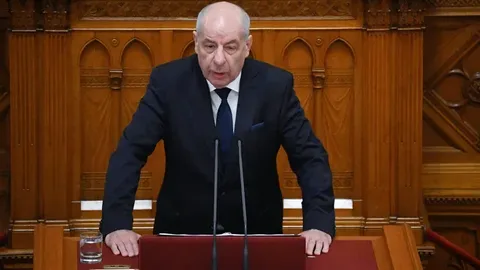

Hungary’s parliament has passed a sweeping constitutional amendment removing President Tamas Sulyok from office, marking one of the most dramatic political shifts in the country’s modern history. The vote, carried out on July 13, 2026, inside the iconic Hungarian Parliament building in Budapest, signals a decisive break from the 16-year rule of former Prime Minister Viktor Orban and his Fidesz party.
What Happened Inside the Hungarian Parliament?
The Hungarian Parliament approved the constitutional amendment with 139 votes in favour and only six opposing, in the 199-member legislative body. The vote took place in the grand hall of the Hungarian Parliament, officially known as the Országház or the National Assembly of Hungary one of the oldest and largest parliament buildings in all of Europe.
The amendment contains one defining sentence that ends Sulyok’s presidency: “On the day following the entry into force of this constitutional amendment, the mandate of the President shall terminate.” Tamas Sulyok now faces a stark choice either he signs his own dismissal within five days or faces impeachment proceedings.
Tisza lawmakers held a standing ovation after the vote, while lawmakers from Orban’s far-right Fidesz party boycotted the parliamentary session entirely. The images from inside the Hungarian Parliament captured an empty chair where the Hungarian president would normally sit a powerful symbol of the political moment.
Background: How Did Hungary Get Here?
To understand the significance of this vote, it is important to know the Hungarian parliament composition and how power shifted in 2026. Hungarians voted out the right-wing nationalist Orban in April, with new Prime Minister Peter Magyar’s Tisza Party winning in a landslide, ending 16 years of power for Orban’s Fidesz party, which had come to dominate many aspects of the country.
The Hungarian Parliament is formally known as the National Assembly (Országgyűlés). It sits in Budapest along the Danube River and is one of the most recognizable legislative buildings in the world. The building, completed in 1902, houses 199 parliamentary seats and has become central to the current political drama unfolding in Hungary.
Viktor Orban was a bête noire in the European Union for his far-right views and was accused of turning Hungary into an authoritarian state by changing the constitution to centralize power and control nearly all state institutions. But in April, Orban was ousted from power by Magyar, an upstart 45-year-old politician who defected from Fidesz in February 2024 and struck a chord with Hungarians by making public denunciations about the party’s corruption.
The Hungarian Parliament Parties and the Composition After April 2026
The current Hungarian parliament composition reflects a dramatic reversal of the political balance that defined the country for nearly two decades. Magyar’s centre-right Tisza Party now commands a two-thirds supermajority in the 199-seat Hungarian Parliament, giving it the power to amend the constitution without relying on any other party.
After winning in a landslide election in April, current Prime Minister Peter Magyar and his pro-European, centre-right Tisza party hold a two-thirds majority in Parliament, allowing them to make constitutional changes and roll back many of the policies Orban implemented during his 16 years in power.
The Hungarian parliament parties now divide broadly between the ruling Tisza bloc and the opposition Fidesz camp, which despite losing the election still holds a significant minority within the National Assembly. The sharp ideological divide between the two groups was on full display during Monday’s historic session.
Full Details of the Constitutional Amendment
The amendment also includes judicial reforms, a new office to investigate financial abuses from the Orban era, and a 12-year term limit on lawmakers. This term limit has immediate political consequences even within the new ruling bloc.
The amendment stipulates that lawmakers can only serve a maximum of 12 years, and it also sets an age limit of 70 for judges at the Constitutional Court. This would require its current head, Orban ally Peter Polt, to retire. The head of Fidesz’s parliamentary group, Gergely Gulyas, resigned on Monday over the amendment, saying it meant he could not run in the next election due to the length of time he has already been a member of parliament.
Magyar has branded his broader reform effort “Operation Cleansing Fire” or “Operation Clean Sweep.” This programme seeks to install a new constitution, purge state institutions, and establish an anticorruption office with sweeping powers to investigate corruption from the Orban era.
Quotes: What Leaders Said About the Hungarian Parliament Vote
Magyar told parliament ahead of the vote: “It would be a betrayal of the Hungarian nation if we did not touch this constitution.”
Magyar called the vote “a crucial milestone in dismantling the Orban political and economic mafia.”
Fidesz caucus leader Gergely Gulyas said the amendment “breaks up the legal system, undermines the rule of law and restricts democracy” before announcing his resignation as caucus leader.
Amnesty International Hungary’s communications director Aron Demeter said: “We agree with the goal. We also believe that President Sulyok is unworthy of the office. But it also matters how he is removed from office.” The human rights organization openly criticized the method of removal stripping a sitting president through a single constitutional sentence as potentially setting a troubling precedent regardless of the political context.
What Happens Inside the Hungarian Parliament Next?
Now that the amendment has passed inside the Hungarian Parliament, the political clock is ticking. Sulyok needs to sign the amendment within five days for it to become law. He has not publicly stated whether he will do so. However, Magyar’s government has already made clear that if Sulyok refuses, impeachment proceedings will begin immediately.
The measure would immediately bring an end to Sulyok’s term in office and pave the way for parliament to elect a new president. The new president elected by the Hungarian Parliament would be expected to align with Magyar’s pro-European, rule-of-law agenda a sharp contrast to the Orban-era appointments that previously filled Hungary’s top institutions.
Fidesz supporters called for a candlelight vigil outside Hungary’s parliament building on Monday evening to demonstrate against what they called the “tyranny” of Magyar’s government. The vigil drew a smaller crowd than anticipated, suggesting that while Orban’s base remains loyal, its political momentum has significantly weakened since the April election defeat.
Global and Regional Impact
The vote inside the Hungarian Parliament carries significance far beyond the country’s borders. Hungary has been a persistent source of tension within the European Union for the past decade, with Orban’s government clashing repeatedly with Brussels over democratic backsliding, judicial independence, media freedom, and the rule of law.
The political transformation now underway visible in the Hungarian parliament news dominating European headlines represents a potential realignment of Hungary’s relationship with the European Union. Magyar has positioned his government as firmly pro-European, and the removal of Orban-era holdovers from key institutions is expected to open the door to a smoother relationship with Brussels and the restoration of EU funding that was frozen during the Orban years.
Regional observers are watching the Hungarian parliament news closely, as Hungary’s shift could influence political dynamics across Central and Eastern Europe, where right-wing nationalist parties have drawn inspiration from Orban’s model of governance for years.
What Makes the Hungarian Parliament Significant in This Moment?
The Hungarian Parliament building itself its official name being Országház, meaning “House of the Country” is more than just a venue. It is a symbol of national identity. An April 2026 photo of the National Assembly building in Budapest shows Hungary’s parliament standing as a landmark amid the country’s transformation.
Visitors who purchase Hungarian parliament tickets gain access to one of the world’s most lavishly designed legislative chambers, featuring the Hungarian Holy Crown in the central dome hall, Gothic Revival architecture, and more than 691 rooms across its massive interior. The Hungarian parliament inside is as historically significant as any parliament building in Europe, and its halls are now witnessing history in real time.
The Hungarian parliament name Országháza in its full form carries the weight of over a century of Hungarian political life, and the events of July 13, 2026 have added a new defining chapter to that long history.
Conclusion: What Comes Next?
Hungary is moving rapidly. Magyar’s government has shown it intends to fulfill its election promises at speed, using the constitutional tools available to a supermajority parliament. The removal of President Sulyok is not the end of this process it is a beginning.
The coming weeks will see the election of a new president, continued judicial reforms, the establishment of an anti-corruption body, and likely further constitutional changes as Magyar presses ahead with “Operation Cleansing Fire.” Each move will be debated fiercely within the Hungarian parliament parties, with Fidesz opposing every step and Tisza pressing forward with what it calls the restoration of democratic governance.
For ordinary Hungarians including those who purchase Hungarian parliament tickets each year to tour its magnificent interior the building now represents not just national heritage but national renewal. The Hungarian parliament composition, the votes cast within its chambers, and the news coming out of Budapest in the days ahead will shape Hungary’s direction for years to come.
Frequently Asked Questions (FAQs)
Can you visit the Hungarian Parliament for free?
The Hungarian Parliament, known officially as the Országháza or National Assembly of Hungary, offers guided tours to visitors year-round, but entry is not entirely free for most visitors. Hungarian parliament tickets are required for standard public tours, and the cost varies depending on nationality EU citizens typically pay a reduced rate compared to non-EU visitors. However, there are select occasions, such as Hungary’s national holidays and specific open days, when entry to certain parts of the Hungarian Parliament inside is offered at no charge. It is advisable to book Hungarian parliament tickets well in advance, as tours of the interior which include the stunning central dome hall, the Hungarian Holy Crown, and the ornate parliamentary chambers are extremely popular and fill up quickly, especially during peak tourist seasons in spring and summer.
Is it worth going inside the Hungarian Parliament?
Absolutely visiting the Hungarian Parliament inside is widely considered one of the most remarkable cultural and architectural experiences in all of Central Europe. The building, completed in 1902 and designed in a Gothic Revival style, is one of the largest parliament buildings in the world and sits majestically on the banks of the Danube River in Budapest. Once inside, visitors are treated to breathtaking interiors including gilded staircases, intricate ceiling mosaics, the ceremonial dome hall, and the display of Hungary’s most sacred historical artifact the Hungarian Holy Crown and coronation regalia. The guided tours available through Hungarian parliament tickets are typically informative and well-organized, covering both the architectural history of the building and the political significance of the Hungarian parliament in the country’s modern democratic life.
What makes the Hungarian Parliament unique?
The Hungarian Parliament stands apart from virtually every other legislative building in the world for a combination of reasons that span architecture, history, and political significance. Its official name is Országháza, which translates as “House of the Country,” and the building lives up to that title in every sense. The structure features 691 rooms, 29 staircases, and approximately 40 kilometres of staircases and corridors spread across its vast interior. The Hungarian parliament composition of architectural styles primarily Neo-Gothic with Renaissance and Baroque elements creates an interior unlike anything else in Europe. The central dome rises to 96 metres, a deliberate reference to the year 896, when the Magyar tribes first settled in the Carpathian Basin.