
Hakim Sultan Ahmed Dawoodi – A Radiant Beacon of Service to Humanity and Nation-Building
By Mian Iftikhar Ahmed
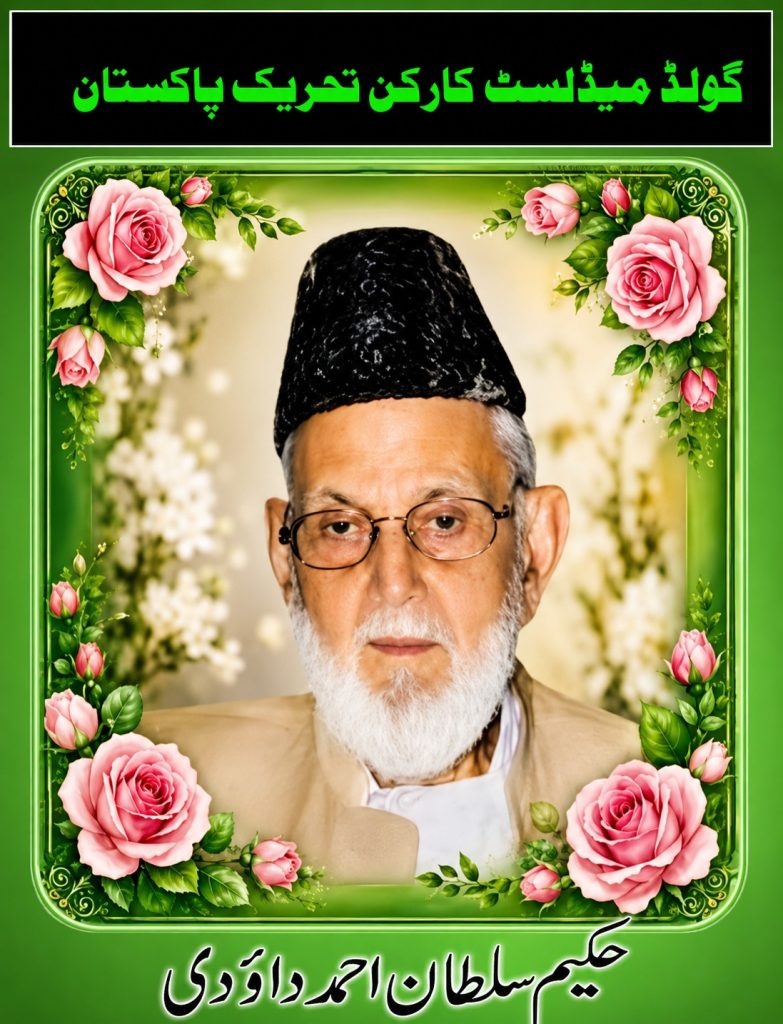
He who lived and sacrificed for the service of humanity and the love of his nation, he who was lovingly called the “Second Quaid-e-Azam,” he whose memory never faded from hearts—a single personality with countless roles—he was Hakim Sultan Ahmed Dawoodi. His illness worsened in August 2008, and he departed from this mortal world on 28 August 2008 at noon. Today marks his 18th death anniversary. He was, in the truest sense, a social dervish who devoted his entire life to the cause of freedom and the reconstruction of his homeland. When I lose myself in the memories of his life, I realize that from childhood, adolescence, youth, to old age, his sole passion remained the dream of a strong Pakistan. When he launched an effective movement during the census of 1938, urging maximum Muslims to register themselves so that the numerical strength of Muslims could increase during election voting, he had to face imprisonment for eighteen months due to Hindu opposition. My mother arrived in Faisalabad in July 1947, while my father remained hidden in the riot-affected areas and reached Pakistan on 21 August after facing extremely distressing conditions. He remained hidden in the riot-torn city of Amritsar until 16 August and after enduring severe hardships, he succeeded in reaching his beloved homeland. From an early age, he wore the Quaid-e-Azam style cap, white shalwar, and shirt, and his physical resemblance to Quaid-e-Azam was so striking that people affectionately called him the “Second Quaid-e-Azam.” His personality carried such dignity that distinguished him from others even from a distance—his stature, distinctive attire, cap on his head, spectacles on his eyes, and a face bearing seriousness along with a unique nobility and composure—his very appearance was a complete introduction in itself. His connection with the eminent spiritual saint, Baba Ji Sarkar Sufi Barkat Ali (may Allah have mercy on him), was established in the 1960s at Dar-ul-Ihsan, Sangla Hill, and remained until his last breath. He was part of the committee that Baba Ji formed to run his center. In the 1980s, Baba Ji established a committee and appointed him as its in-charge. The aim of this committee was to bring the hut-dwelling Gogras into the fold of Islam. By the grace of Allah, this team had the honor of converting one hundred thousand Gogras to Islam within a limited time. They oriented them towards civilized life through education, and after bringing them out of their huts, they built residential colonies for them and settled them there. Baba Ji was so pleased with all this work that he presented them with a beautifully crafted certificate with his own hands. The project of bringing the Gogras into the circle of civilization was also highly praised by the United Nations, and considering it a role model, when UN Secretary-General Ban Ki-moon visited Pakistan in 2007, he honored him with the Global Congratulations Award for Social Scientists, appreciating his service to humanity on behalf of the UN. From 1973 to 2007, he continuously served for thirty-four years under the Patients Welfare Association, which was a project of the Social Welfare Department, Government of Punjab. Under this, he would daily tend to patients at the Civil Hospital and also arrange medicines for the needy. The responsibility for all this work was also entrusted to him by Sufi Barkat Ali (may Allah have mercy on him), and Baba Ji always wished that there should be no negligence in this service. He received the Sitara-e-Imtiaz, the Pakistan Movement Gold Medalist award, along with hundreds of official honors and positions throughout his life, yet he lived with utmost simplicity and kept the lamps of human service burning throughout his life, which remain lit to this day. A road in Faisalabad is named after him—Hakim Sultan Ahmed Dawoodi Road, Peoples Colony No. 1, Faisalabad. He was a good friend, had a pleasant tongue, earned halal sustenance, and possessed a cheerful disposition. Some people depart from the world but never leave our memories. Time keeps passing, seasons keep changing, life moves forward at its own pace, but some faces, some voices, some meetings, and some personalities remain forever alive in the hidden chambers of the heart. The separation of a father is perhaps one such sorrow whose intensity does not diminish with time but rather deepens with age.
Life brings many moments when a person involuntarily remembers his father’s affection, love, advice, prayers, and sheltering shadow with great intensity. The heart desires that if only they could sit before us once more, if only their voice could be heard, if only the opportunity to ask something, share some sorrow, and sit for a few moments under the shade of their prayers could come again, but in life, “again” is not always destined. Hakim Sultan Ahmed Dawoodi, too, is such a loving and unforgettable memory for his children and friends. When his death anniversary arrives, many windows of the past open at once, and the image of Faisalabad’s Kachehri Bazaar, the old newspaper market, the morning bustle, bundles of newspapers, the coming and going of journalists and newspaper sellers, and amidst all this, the dignified personality comes before the eyes. What a wonderful era it was when Kachehri Bazaar was not just a place of business but felt like an important center of the city’s social, journalistic, and political life. In the morning, there was a special vibrancy there. The newspaper market witnessed the movement of those connected to journalism, people from different circles would meet each other, and even a brief meeting would become a beautiful link of connection. Among those familiar faces, the face of Hakim Sultan Ahmed Dawoodi also held its unique identity. He would come to Kachehri Bazaar every morning, and often one would meet him. His personality carried such dignity that distinguished him from others even from a distance. Due to his stature, height, and attire, we lovingly called him the “Second Quaid-e-Azam.” Though this name was given spontaneously, his personality truly possessed such awe, dignity, and composure that made him unique even in a crowd. When he passed by, eyes would automatically turn toward him, and when a meeting would occur, it felt as if the day had begun more pleasantly after meeting an old acquaintance. Today, when the passage of time has swept away so much with it, those old mornings of Kachehri Bazaar have also become part of memories. Many faces that were once part of daily life now appear only in memories. Many voices that once echoed around have now turned into silence. Many people whose meeting was routine, today only memories remain to meet them. Human life is strange—the people whose presence we consider an everyday affair, one day those same people become the most precious capital of our lives. A moment spent with them, a brief meeting, a sentence, a smile, and sometimes just their passing by becomes such a memory that a person carries in their heart throughout their life. Hakim Sultan Ahmed Dawoodi’s memory is also such a memory for me that has not faded in the dust of time; rather, with age, those images of the past are becoming even clearer. Perhaps when a person moves forward in life’s journey, they begin to appreciate their elders and feel their separation more intensely. Mother and father are two such beautiful words in which the love of an entire life is contained. When saying “mother,” the mouth opens because mother is the being before whom a child tells everything in their heart—their happiness, their sorrow, their worries, their weaknesses, and every secret of their heart. And when saying “father,” it feels as if the mouth closes because father often trains for life more through his character than through words. He teaches his children to stand firm before circumstances, to be patient in difficult times, to rise again after failure, to stand on their own feet, to fulfill responsibilities silently, and to keep walking steadily in the sunshine of life. The style of a father’s love may be different, but there is no lack in its depth. A father is like a tree for his children, whose shade provides a sense of protection throughout life. The children are the branches of this tree, his prayers are the shade, and his love is the soil in which the child’s personality grows. But one day this tree grows old and then departs from the world. After that, a person feels the heat of life more intensely than before. When a person himself begins to reach that stage of life where white hair starts appearing, fatigue is felt in the steps, and many experiences of life have come to light, he appreciates the presence of his parents more than ever before. Then he understands that the shadows which we considered ordinary throughout life were actually great blessings from Allah for his children. His behavior with friends and their children was also the same as with his own children. Hakim Sultan Ahmed Dawoodi’s memory also enters the heart with this same feeling. Sometimes the thought comes that if today I could again go and stand in those same old streets of Kachehri Bazaar, search for the atmosphere of that old newspaper market, and try to bring back those same morning moments, perhaps that dignified personality might appear from somewhere—that same tall stature, that same distinctive attire, those same spectacles, and that same style. Perhaps we would smile again upon seeing him and say, “The Second Quaid-e-Azam has arrived.” But time that has passed never returns. People do not meet again in the same form, and the past does not become the present again. However, memories return again and again and take a person to an era where those who have parted are still present. This is the greatest beauty of memories—that they are not bound by time and distance. When a person closes their eyes, scenes from years ago appear before them; hearing the name of an old place brings forgotten voices to mind, and when a departed person is mentioned, their entire personality comes alive in the heart in an instant. Hakim Sultan Ahmed Dawoodi is no longer among us today, but his memory lives on. In those old mornings of Kachehri Bazaar, his memory lives on. In the meetings with him, his memory lives on. In his distinctive appearance and dignified personality, his memory lives on. And most of all, in the hearts of those who saw him closely, met him, and felt his love and affection, his memory lives on. A death anniversary is not merely the act of remembering someone’s date of death; it is also an opportunity to step out of life’s fast-paced race for a few moments and remember those who were once part of our lives and are now part of our memories. Some leave behind wealth, some fame, some positions, and some leave behind such loves and memories that have no price. Hakim Sultan Ahmed Dawoodi also left behind such priceless memories for his children, relatives, friends, and acquaintances. Time passed, circumstances changed, the charms of Kachehri Bazaar changed, the world of newspapers also adopted a new form, but some memories are such that time has no effect on them. They remain preserved in the heart just like a flower kept between the pages of an old book—its fragrance may diminish, but its memory remains. Hakim Sultan Ahmed Dawoodi’s memory is also such a preserved flower for me. Today, on his death anniversary, a prayer arises from the depths of the heart: O Allah, Lord of Majesty! Grant complete forgiveness to Hakim Sultan Ahmed Dawoodi, overlook his shortcomings, slips, and errors with Your grace and kindness. Fill his grave with light, make it a garden from the gardens of Paradise. Make his grave spacious, illuminated, peaceful, and radiant. Remove the terror and loneliness of the grave with Your infinite mercy. Elevate his ranks and grant him a place in the shade of Your mercies. O Allah! Grant him a high station in Jannat-ul-Firdaus, grant him the intercession of the Holy Prophet Muhammad Mustafa (peace be upon him), and on the Day of Judgment, include him among Your beloved and righteous servants. Accept his good deeds, forgive his errors, and grant him such continuous reward that continues to add to his record of deeds even after his departure from this world. Grant patience to his children and family, and grant them the ability to keep the memory of their elder alive with good deeds, prayer, and love. Time will pass, and we too are travelers of this world; one day our memory will also knock on someone’s heart just as Hakim Sultan Ahmed Dawoodi’s memory is knocking on the heart today. Perhaps in the coming time, someone will pass by Kachehri Bazaar, remember some old morning, hear mention of some old newspaper market, and suddenly remember a dignified and unique personality and say with love that Hakim Sultan Ahmed Dawoodi used to come here too, whom we called the “Second Quaid-e-Azam” because of his stature and dignified personality. This is the true life of a person—that even after departing, they remain alive in someone’s memory, in someone’s prayer, in someone’s tearful eyes, and in someone’s smiling lips. Hakim Sultan Ahmed Dawoodi has departed from this world, but his love and memory remain. In those old mornings of Kachehri Bazaar, his memory remains. In the hearts of his people, his memory remains. And in the love of his children, he will forever live like a shady tree. May Allah grant him complete forgiveness, elevate his ranks, fill his grave with light and peace, and grant him a high station in Jannat-ul-Firdaus. Ameen, O Lord of the worlds.