

The Gaza education crisis did not begin overnight. Even before October 2023, Gaza’s education system was under pressure due to decades of blockade, overcrowded classrooms, and limited resources. But what followed after the outbreak of conflict transformed a struggling system into a completely collapsed one.
Since October 2023, formal schooling in Gaza has essentially stopped. According to Gaza education statistics compiled by the Education Cluster Palestine, by late 2025, all schools in Gaza serving approximately 625,000 children had been closed for nearly two years. These are not temporary disruptions they represent a full generational rupture in learning.
The Gaza education crisis 2022 data already showed warning signs, with resource shortages and infrastructure stress. What came after 2023 was a catastrophe at an entirely different scale, one that international bodies including UNESCO Palestine education teams have been struggling to document and respond to.
The Numbers: Gaza Education Statistics Tell a Devastating Story
The scale of destruction is captured clearly in Gaza education statistics gathered by multiple UN agencies.
As of July 2025, as reported by the Education Cluster, 97% of schools sustained some level of damage to their buildings. Further, 518 out of 564 schools will either need full reconstruction or major rehabilitation work to be functional again.
When asking about the percentage of buildings destroyed in Gaza, the education sector paints one of the starkest pictures. Over 95% of school buildings require rehabilitation or reconstruction, 79% of higher education campuses and 60% of vocational training centres have been damaged or destroyed.
Since October 2023, 745,000 students in Gaza have been out of school for more than two academic years, including 88,000 higher education students who have been forced to put their studies on hold.
The financial cost alone is staggering. A Rapid Damage and Needs Assessment conducted in early 2025 indicates that physical damage to the education sector had reached around US$870 million. This figure covers estimated costs to repair or reconstruct damaged schools, technical institutes, and higher education facilities and it is expected to rise.
Schools of Gaza: What Has Been Lost
The schools of Gaza were once the backbone of Palestinian society. Gaza historically had high literacy rates and strong educational participation, particularly at the primary level. Families took enormous pride in their children’s academic achievements.
Today, those same schools are either rubble, shelters for displaced families, or ghost buildings with shattered windows and collapsed roofs. Across Gaza, 40 to 50 million tons of rubble have accumulated, which would need removal before school reconstruction can begin at scale.
The Education Cluster Palestine has documented that debris clearance must be accompanied by restoration of electricity, water, and sanitation networks to school sites before any meaningful learning can resume. The Gaza education crisis is therefore inseparable from the broader collapse of infrastructure.
A UNESCO assessment covering 21 higher education institutions across 38 campuses found that 95% of campuses have been affected, with 22 campuses out of 38 completely destroyed and an additional 14 sustaining different levels of damage.
These are not just buildings. They are laboratories, libraries, lecture halls the entire physical architecture of knowledge that took generations to build.
The 2026 Tawjihi: Defiance Written in Exam Papers
In the middle of this crisis, something remarkable happened. Palestinian Minister of Education Amjad Barham announced the 2026 Tawjihi results on July 24, revealing an overall pass rate of 74 percent higher than the rates of previous years.
More than 106,000 students in the Gaza Strip have taken the Tawjihi exams over the past three years, including 36,900 this year. Around 89,000 students took the examinations this year across the West Bank, including Jerusalem, and the Gaza Strip, in addition to more than 2,000 students who sat for the exams in 46 countries worldwide.
But the cost was immense. More than 1,100 students who were expected to sit for this year’s exams were killed. Three Tawjihi students were killed in the occupied West Bank, while 67 students were unable to take the exams because they are being held in Israeli prisons.
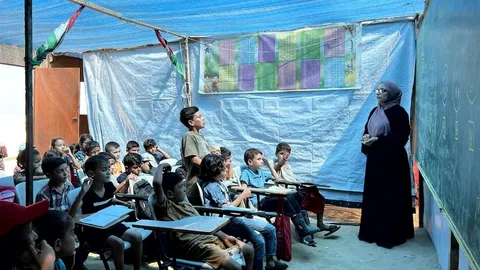
Ranked second nationwide, Ayham Faris, a student from Khan Younis, celebrated inside the modest tent where he had spent the academic year. Having achieved a score of 99.7% in the scientific stream, he said: “This success did not come easily. It came after immense suffering, including our displacement, the destruction of our home in Khan Younis, and life inside a tent that was unfit not only for studying but even for living. We also endured famine during this year. We went to sleep hungry and woke up hungry. But nothing could deter us from excelling.”
Barham stressed that Gaza students have now taken the Tawjihi exams for a third consecutive year under exceptional conditions, including in tents and amid the rubble of destroyed neighborhoods.
World Health Organisation Gaza: Health and Education Are Inseparable
The World Health Organisation Gaza reports make clear that the education crisis cannot be understood in isolation from the health catastrophe. Children who are malnourished, traumatised, and physically injured cannot learn even if a classroom existed.
Famine was declared in Gaza Governorate on 22 August 2025. At least 132,000 children were expected to suffer from acute malnutrition by June 2026, including 41,000 severe cases carrying a high risk of death.
Nearly 42,000 people in Gaza are living with life-changing injuries from the ongoing conflict, including more than 10,000 children, as the health system collapses under relentless strain, the World Health Organization warned.
Many students lack stable housing, health services operate at limited capacity, and malnutrition affects the physical and cognitive development of children. Learning under these conditions is not simply difficult for many children, it is physiologically impossible.
The World Health Organisation Gaza has verified 668 attacks on healthcare facilities in Gaza, resulting in 886 fatalities and 1,355 injuries as of January 2025. When hospitals and schools are both destroyed, an entire generation loses not just its education, but its health and its future simultaneously.
UNESCO Palestine Education: Emergency Response in a Broken System
UNESCO Palestine education programs represent one of the most visible international responses to the Gaza education crisis. Despite the scale of destruction, UNESCO has worked to maintain some form of educational continuity.
UNESCO’s Gaza Virtual Campus will support 20,000 higher education students. In addition, Temporary Learning Spaces in Khan Younis and Deir Al Balah are providing digital access and psychosocial support to more than 10,000 students.
One student using these spaces, Rawan Hammad, described the reality on the ground: “Our lives were turned upside down. Everything changed and education is no longer available.”
Another student, Ayah Kishko, a nursing student who lost family members and was displaced multiple times, decided to resume her studies in one of UNESCO’s Temporary Learning Spaces. Her story is one of thousands students clinging to education as the last thing the war has not yet fully taken from them.
The Education Cluster Palestine, which coordinates humanitarian education responses across the territory, has consistently flagged that the scale of need far outpaces current resources. Coordination documents from the Education Cluster Palestine note that structured, comprehensive schooling has not resumed and the system remains in emergency recovery mode.
Global Impact: Why the World Must Pay Attention
The Gaza education crisis is not only a Palestinian tragedy. It is a warning to the entire international community about what happens when education systems are deliberately or incidentally destroyed in conflict zones.
By February 2026, the cessation of active fighting has enabled limited educational activity. However, structured and comprehensive schooling has not yet resumed. The system remains in emergency recovery mode.
UNESCO, the Education Cluster Palestine, UNICEF, and the World Health Organisation Gaza have all called for immediate, sustained investment in educational recovery. But without physical infrastructure, without safe buildings, without teachers who are themselves displaced and grieving, and without children who are fed and healthy, no amount of programming can substitute for what has been lost.
The Gaza education crisis PDF reports circulating among policymakers describe what specialists are calling “scholasticide” the systematic destruction of the infrastructure of knowledge. This is a term gaining increasing use among researchers and human rights bodies to describe what has occurred in Gaza’s education sector.
What Comes Next
Recovery, if it comes, will take decades. Debris clearance must be accompanied by the restoration of electricity, water, and sanitation networks to school sites. Engineering teams have started explosive ordnance removal in selected zones as a preliminary stage of reconstruction. Progress is slow.
The next step is for UNESCO to scale up its efforts to ensure that all 88,000 higher education students in Gaza can reclaim their right to learn, pursue their studies, and ultimately graduate to build their future.
The international community, including member states, donor nations, and civil society, faces a defining moment. The Gaza education crisis has produced some of the most heartbreaking statistics in modern humanitarian history. Yet behind every statistic is a student who still wants to learn sitting in a tent, holding a pencil, waiting for a classroom that may not come for years.
Frequently Asked Questions (FAQs)
What is the education situation in Gaza?
The education situation in Gaza is among the most severe humanitarian crises in the world today. According to the Education Cluster Palestine, 97% of all school buildings in Gaza have sustained damage, and 518 out of 564 schools require either full reconstruction or major rehabilitation before they can function again. Since October 2023, formal schooling has largely stopped, and by late 2025, all schools serving approximately 625,000 children had been closed for nearly two consecutive academic years. UNESCO Palestine education assessments confirm that 88,000 higher education students have been forced to suspend their studies, and physical damage to the education sector alone has been estimated at around US$870 million.
Is LGBTQ legal in Palestine?
Same-sex relationships are not legally recognized in Palestine. In the Gaza Strip, which is governed by Hamas, homosexuality is criminalized under a combination of Egyptian-era penal codes still in effect, and individuals can face severe legal and social consequences. In the West Bank, governed by the Palestinian Authority, there is no explicit law criminalizing homosexuality, but LGBTQ individuals face significant social stigma, discrimination, and lack of legal protection. There are no legal frameworks for same-sex partnerships, adoption by same-sex couples, or gender recognition. Palestinian LGBTQ individuals often live discreetly due to cultural, religious, and legal pressures. Some have sought asylum in other countries. Human rights organizations including Amnesty International and Human Rights Watch have documented the vulnerability of LGBTQ Palestinians and have called for legal protections.
Why is Gaza in a crisis?
Gaza has been in a deepening crisis for decades, but the situation escalated dramatically after October 7, 2023, when a large-scale military conflict began following a Hamas attack on Israel. Israel’s subsequent military campaign on the Gaza Strip resulted in mass casualties, the destruction of civilian infrastructure, and one of the most severe humanitarian emergencies in recent history. Before the current conflict, Gaza was already under a land, air, and sea blockade that had been in place since 2007, severely restricting the movement of people, goods, medical supplies, and educational materials. The blockade had stunted Gaza’s economy, limited access to clean water, and left the healthcare and education systems chronically underfunded. The post-2023 conflict compounded all of these pre-existing conditions to a catastrophic degree. The World Health Organisation Gaza has documented the near-total collapse of Gaza’s health system, with hospitals bombed, medical staff killed, and medicines blocked from entry.