Pakistan has formally joined the World Artificial Intelligence Cooperation Organisation (WAICO) as a founding member, signed in Shanghai this week. The move comes as domestic interest in a free Artificial Intelligence course in Pakistan continues to grow, with programs like PIAIC and the Prime Minister Free AI Training Program 2026 drawing record enrolment from students and job seekers nationwide.
Background
Deputy Prime Minister and Foreign Minister Ishaq Dar travelled to Shanghai on July 16-17 to sign the WAICO founding agreement on Pakistan’s behalf. He did so at the invitation of Chinese Foreign Minister Wang Yi, joining a China-backed body meant to widen global cooperation on artificial intelligence.
The organisation was first proposed last year by Chinese Premier Li Qiang at the World AI Conference in Shanghai. During Prime Minister Shehbaz Sharif’s visit to China in May 2026, Islamabad had already voiced support for the plan, setting the stage for this week’s signing.
This diplomatic step arrives at the same time Pakistan is pushing hard on AI education at home. Programs like PIAIC, short for the Presidential Initiative for Artificial Intelligence and Computing, and the Prime Minister Free AI Training Program 2026 are central to that push.
Details
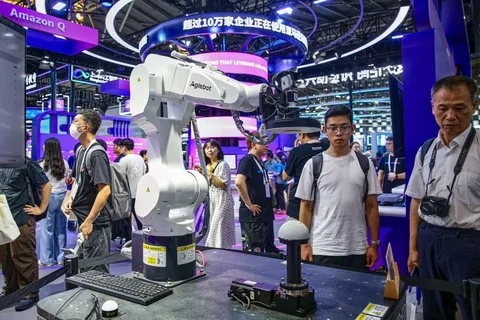
At the Shanghai signing, Dar is also attending the opening of the 2026 World Artificial Intelligence Conference and a high-level meeting on global AI governance. Officials say Pakistan will use the platform to argue for fairer access to AI technology for developing nations.
Back home, this global positioning lines up with a domestic effort to widen access to a free Artificial Intelligence course in Pakistan. PIAIC remains the country’s largest hands-on AI training program, with over 100,000 alumni to date.
The program is structured across multiple quarters and covers practical skills, from foundational AI concepts to building and deploying AI agents. Enrollment is free, and no prior coding background is required, which has made it accessible to a wide range of applicants.
Alongside PIAIC, the government-backed Prime Minister Free AI Training Program 2026 targets an even broader base — reportedly aiming to train up to one million young people in AI, machine learning, and data science. The program is open to applicants aged roughly 17 to 35 from all four provinces plus Azad Jammu and Kashmir.
Many students search specifically for the PIAIC student portal and details on PIAIC courses fee before applying, given how many similar-sounding private AI “bootcamps” now exist online. It’s worth noting PIAIC’s core program is advertised as free, while unrelated private courses may carry fees applicants should always verify directly through official channels before paying anyone.
Interest in PIAIC Admission 2026 has reportedly picked up sharply this year, partly driven by wider public conversation around AI careers, and partly by high-profile success stories, including a young Pakistani-origin entrepreneur’s rise to billionaire status through an AI coding startup.
Quotes
Pakistan’s Foreign Office, in its official statement ahead of the Shanghai trip, said Dar would present Pakistan’s position on expanding international cooperation in artificial intelligence, with a particular focus on the priorities and development requirements of the Global South.
The statement added that Dar intends to stress the need to narrow the global divide in artificial intelligence, improve fair access to AI technologies, strengthen capacity-building and ensure that AI supports sustainable development and shared prosperity.
On the education side, PIAIC’s own messaging frames its mission plainly: Pakistan’s largest hands-on AI Engineering Program, with zero coding experience needed and free enrollment for participants.
Impact
For everyday applicants, this story matters less as diplomacy and more as opportunity. A free Artificial Intelligence course in Pakistan, offered through credible national platforms, gives students in smaller cities a genuine on-ramp into a global industry without needing to relocate or pay expensive private fees.
Regionally, Pakistan positioning itself early inside a founding AI governance body could shape how the country negotiates future AI partnerships, funding, and technology transfer with China and other WAICO members.
There’s also a soft-power angle. As Pakistan AI initiative courses produce more trained graduates, officials may point to programs like PIAIC as evidence the country is building the workforce needed to make use of any international AI cooperation it signs onto.
That said, experts note that signing an international agreement is a separate step from delivering AI skills at scale domestically the real test is whether initiatives like the Prime Minister Free AI Training Program 2026 can actually reach students in under-resourced areas, not just major cities.
Conclusion
Pakistan’s founding membership in WAICO puts the country formally inside global AI governance conversations for the first time. Whether that translates into tangible benefit for students depends heavily on how well domestic programs like PIAIC and the PM’s free AI training initiative are executed and scaled going forward.
For now, applicants interested in a free Artificial Intelligence course in Pakistan are encouraged to check official program websites directly such as PIAIC’s own portal for verified admission dates, eligibility, and course details, rather than relying on third-party pages that may carry outdated or incorrect information.
FAQs
Which country is No. 1 in AI?
Most global AI readiness indexes, including widely cited rankings from Stanford’s AI Index and the Tortoise Global AI Index, currently place the United States at the top, largely due to its concentration of leading AI companies, research funding, and computing infrastructure. China typically ranks second, with strong momentum in AI patents, manufacturing integration, and government-backed initiatives like the one Pakistan has just joined as a founding member. Rankings shift year to year, so it’s worth checking the latest edition of these indexes for the most current standing.
Which 3 jobs will survive AI?
Analysts generally agree that roles requiring deep human judgment, creativity, physical dexterity, or emotional connection are the most resistant to automation. Commonly cited examples include skilled healthcare and caregiving roles (nurses, therapists, doctors), which depend on hands-on human interaction; specialized trades like electricians and plumbers, which require physical adaptability AI cannot replicate; and strategic leadership or relationship-driven roles such as sales and negotiation, where trust and human context matter most. Even these fields are expected to incorporate AI tools rather than remain untouched by them.
Who is the 26-year-old Pakistani billionaire?
Sualeh Asif, originally from Karachi, became one of Pakistan’s youngest self-made billionaires after co-founding the AI coding startup Cursor, which reached a valuation of $29.3 billion following a $2.3 billion funding round. He studied at MIT and represented Pakistan at the International Mathematical Olympiad before building Cursor into one of the fastest-growing companies in the AI sector. His story has become a reference point in Pakistan’s own conversations about AI education and the potential of programs like PIAIC to produce similar talent.