

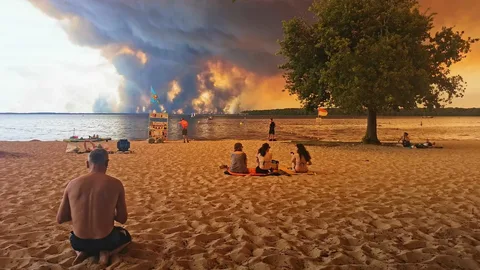

Wildfires in France and Spain have forced more than 200,000 people from their homes and holiday resorts, prompting Spain to declare a national emergency and France to call in military support. The France and Spain wildfires have burned tens of thousands of hectares in just days, fueled by an intense heatwave gripping much of Western Europe.
Background
Wild fires France and Spain have become an almost annual summer event, but this year’s outbreak stands out for its scale and speed. Spain’s environment ministry recorded 29 major forest fires so far in 2026, well above the average of nine fires typically seen between January and the end of July over the past decade.
Around 114,796 hectares have already burned in Spain this year, compared with just 25,133 hectares by the same point last year. Officials have directly linked the surge to prolonged drought and repeated heatwaves, conditions that scientists say have been intensified by human-driven climate change.
The France and Spain wildfires arrived on the back of at least two separate heatwaves since May, according to the World Weather Attribution group, which published a study this week connecting the region’s drought conditions to a heightened wildfire risk across southern Europe.
Details
In France, the worst of the wildfires struck the Gironde and Landes departments in the southwest, near the tourist city of Bordeaux. French Prime Minister Sebastien Lecornu confirmed that more than 141,000 people had been evacuated from the region, with some residents forced to flee by boat as flames swept through the coastal Atlantic tourist area near Lege-Cap-Ferret.
President Emmanuel Macron ordered the French military to mobilize as the fires approached Bordeaux, a sign of just how serious the threat had become to one of the country’s most visited regions. Dozens of firefighters have been injured battling the blazes, though officials in both France and Spain confirmed no deaths had been reported as of Friday.
In Spain, the fires forced the evacuation of roughly 60,000 people in the central Madrid region, where two separate blazes eventually merged amid extreme heat and tinder-dry vegetation. The largest single evacuation took place in San Martin de Valdeiglesias, where most of the 178 residents of a private care home were moved to a municipal sports hall, alongside more than 430 elderly people and people with disabilities evacuated from five care homes in the wider region.
Spanish Prime Minister Pedro Sánchez described the situation as dramatic, noting that the crisis extended beyond Spain’s own regions into neighboring countries as well. Spain’s interior ministry has since requested additional firefighting aircraft through the EU’s civil protection mechanism, a cooperative system designed to pool emergency resources across member states.
Carlos Novillo, the Madrid regional government’s emergency management chief, said the wildfire near the Spanish capital was at its peak and had gone beyond what firefighters could currently contain, with erratic winds threatening to push the flames further despite ongoing efforts to bring the blaze under control.
Quotes
Spanish Prime Minister Pedro Sánchez wrote on social media that the country is experiencing a dramatic situation, not just across several Spanish regions but in neighboring countries as well, as the wildfires continued to spread on Friday.
Carlos Novillo, Madrid’s emergency management chief, warned that the wildfire near the capital was currently beyond the capacity of firefighters to contain, citing erratic wind conditions as a key obstacle to bringing the blaze under control.
French Prime Minister Sebastien Lecornu confirmed the evacuation figures for the Gironde and Landes regions, placing the number of displaced residents in southwestern France at more than 141,000 as authorities continued battling the blazes into the weekend.
Impact
The regional impact of the France and Spain wildfires has been immediate and severe. Beyond the direct threat to homes and holiday resorts, the fires have disrupted tourism in some of Western Europe’s most popular summer destinations, an important part of both countries’ economies during peak travel season.
Emergency services in both countries have been stretched thin, with Spain formally requesting additional water-bombing aircraft through EU channels and France mobilizing military resources to support firefighting crews on the ground. It shows how quickly the fires outpaced existing local firefighting capacity.
The wider European context adds to concerns. Scientists point to this year’s repeated heatwaves and drought conditions as part of a broader pattern linked to climate change, one that has already pushed 2026’s burned area in Spain to more than four times what was recorded by the same point last year.
Beyond the immediate emergency, the wildfires renew pressure on European governments to invest further in wildfire prevention, early detection systems, and cross-border firefighting cooperation, particularly as southern Europe faces increasingly extreme summer conditions year after year.
Conclusion
With winds remaining unpredictable and drought conditions showing little sign of easing, authorities in both France and Spain expect the firefighting effort to continue for several more days at minimum. Spain’s request for EU-coordinated aircraft support suggests officials anticipate the crisis may not be fully under control in the immediate term.
For residents across the Gironde, Landes, and Madrid regions, the coming days will likely determine whether evacuation orders can be lifted or whether the France and Spain wildfires continue to spread further into populated areas.
Frequently Asked Questions
How did the fire start in Spain?
Spanish authorities have not publicly confirmed a single definitive cause for the fires currently burning near Madrid, and investigations into the exact origin points are still ongoing in several affected areas. What is clear is that extreme conditions, including prolonged drought, repeated heatwaves since May, and tinder-dry vegetation, created an environment where fires could ignite easily and spread rapidly once started, regardless of the initial trigger. Spanish officials have noted that this pattern of extreme fire risk has become increasingly common in recent years, driven by broader climate trends affecting the Mediterranean region.
Where in France has been evacuated?
The largest evacuations in France took place across the Gironde and Landes departments in the southwest of the country, near the city of Bordeaux, where French Prime Minister Sebastien Lecornu confirmed more than 141,000 people had been forced to leave their homes. Some of the hardest-hit areas included the coastal tourist region near Lege-Cap-Ferret on France’s Atlantic coast, where residents were seen fleeing by boat as flames approached, in addition to widespread evacuations across inland towns closer to the fire’s path.
Which European country has the most wildfires?
Southern European countries, particularly Spain, Portugal, Greece, and Italy, consistently rank among the hardest-hit by wildfires each year due to their Mediterranean climate, hot dry summers, and dense forested terrain. In 2026 specifically, Spain has recorded a sharp rise in major wildfires, with 29 large fires reported by late July compared with an average of just nine over the same period in past years, making it one of the most significantly affected countries this particular fire season. However, wildfire severity can vary considerably year to year depending on rainfall, temperature patterns, and prevailing wind conditions across the region.