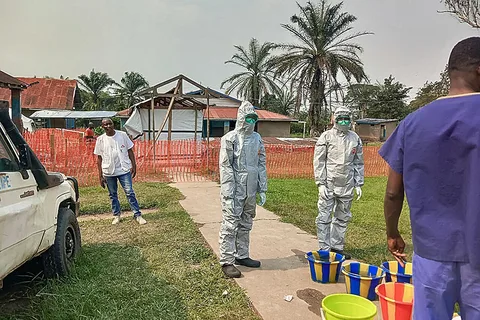
A deadly Ebola outbreak has struck the Democratic Republic of Congo (DRC), killing more than 80 people and infecting hundreds more. The World Health Organization (WHO) has declared it a Public Health Emergency of International Concern (PHEIC). The outbreak has already crossed borders into Uganda, raising fears of wider regional spread.
Background: What Is Happening in DR Congo?
The DRC is no stranger to Ebola. This is already the country’s 17th Ebola outbreak since the virus was first identified in 1976. The latest crisis erupted in Ituri Province, a remote and conflict-affected region in northeastern DRC.
The outbreak was officially declared on 15 May 2026 by the DRC Ministry of Public Health. It is caused by the Bundibugyo strain of the Ebola virus a rarer and more dangerous variant because no licensed vaccine or cure currently exists for it.
The suspected index case was a nurse who died at the Evangelical Medical Centre in Bunia after showing Ebola symptoms that included fever, bleeding, vomiting, and severe weakness. From there, the virus spread rapidly across the health zones of Rwampara, Mongwalu, and Bunia in Ituri Province.
Full Details: Scale of the Ebola Outbreak in DRC
As of mid-May 2026, the situation in DR Congo is serious and rapidly developing.
Health authorities have confirmed 246 suspected Ebola cases and over 80 suspected deaths across at least nine health zones in Ituri Province. Laboratory testing confirmed eight out of thirteen samples as positive for the Bundibugyo Ebola virus.
The outbreak in Rwampara DRC and surrounding zones is alarming because it went undetected for several weeks. The first known suspected case a health worker reportedly developed Ebola symptoms on 24 April 2026, but the outbreak was only confirmed on 14 May 2026. This nearly four-week detection gap allowed the virus to spread silently through communities.
Four healthcare workers died within just four days at Mongwalu General Referral Hospital, pointing to serious failures in infection prevention and control. The Ebola outbreak in DRC is particularly concerning because the Bundibugyo strain has a case fatality rate of 25–50%, meaning up to half of those infected may die.
The outbreak has also reached Uganda. Two confirmed cases were reported in Kampala both individuals who had traveled from DRC with one death already recorded. This cross-border spread triggered the WHO’s decision to declare an international public health emergency.
Ebola Symptoms: What to Watch For
Ebola symptoms typically appear between 2 and 21 days after exposure to the virus. Knowing the Ebola symptoms is critical for early detection and containment.
Early Ebola symptoms include:
- Sudden high fever
- Severe headache
- Fatigue and muscle pain
- Sore throat
As the disease progresses, more severe Ebola symptoms develop, including:
- Vomiting and diarrhoea
- Abdominal pain
- Unexplained bleeding or bruising (hemorrhaging)
- Nosebleeds and vomiting blood
- Multiple organ failure
The progression from early Ebola symptoms to death can happen within days, which is why immediate isolation and medical care are critical. In the current DRC outbreak, patients presented with fever, hemorrhaging, and intense weakness all classic Ebola symptoms consistent with the Bundibugyo strain.
How Does Ebola Spread?
Understanding how Ebola spreads is key to stopping it. Ebola does not spread through the air like the flu or COVID-19. Instead, Ebola spreads through direct contact with the bodily fluids of an infected person including blood, vomit, urine, saliva, sweat, breast milk, and semen.
Ebola spreads in several ways:
- Touching the blood or bodily fluids of a sick person
- Contact with objects contaminated by bodily fluids (needles, bedding, clothing)
- Handling the body of someone who died from Ebola
- Contact with infected animals (such as bats or primates)
In the current DRC outbreak, funeral gatherings played a significant role in how Ebola spread in the community. Health workers have also been infected due to breaches in protective protocols, highlighting the high risks of how Ebola spreads in healthcare settings.
People infected with Ebola are not contagious until symptoms appear. However, once symptoms begin, the risk of transmission is very high especially near the time of death, when viral loads in the body are at their peak.
Ebola Vaccine: Is There a Shot Available?
The Ebola vaccine situation in the current outbreak is a major challenge. While effective Ebola vaccines do exist including Ervebo and Zabdeno/Mvabea, both WHO-prequalified these Ebola vaccines only protect against the Zaire strain of the virus.
The current Ebola outbreak in DRC is caused by the Bundibugyo strain, for which no licensed Ebola vaccine exists. This makes containment significantly harder. There are also no Ebola vaccines in late-stage clinical development that could be rapidly deployed during this outbreak.
This means that traditional public health tools isolation, contact tracing, safe burials, and community engagement are the primary weapons against this outbreak. The absence of a Bundibugyo-specific Ebola vaccine is one of the most serious concerns experts have raised about the 2026 DRC crisis.
Ebola Cure: Is There a Treatment?
There is currently no specific Ebola cure for the Bundibugyo strain. While monoclonal antibody treatments (such as Inmazeb and Ebanga) have proven effective against the Zaire Ebola strain, these treatments do not work against Bundibugyo virus.
The current Ebola cure or rather, the closest thing to one is supportive care. This involves keeping patients hydrated, balancing electrolytes, maintaining oxygen levels, and managing pain. Early and aggressive supportive care has been shown to significantly improve survival rates, even without a specific Ebola cure.
Researchers are studying potential therapeutics for non-Zaire strains, but no Ebola cure specifically targeting Bundibugyo has yet received regulatory approval. This makes early detection and isolation even more critical in the absence of a proper Ebola cure.
Quotes from Officials and Experts
WHO Director-General declared the Ebola outbreak a Public Health Emergency of International Concern (PHEIC) on 16 May 2026, calling on all nations to take preparedness measures.
Dr. Daniela Manno, Clinical Assistant Professor at the London School of Hygiene & Tropical Medicine, said the outbreak is concerning because “transmission may have been ongoing for several weeks before the outbreak was formally recognised” and highlighted the role of insecurity and population movement in complicating the response.
Dr. Anne Cori of Imperial College London noted that due to limited scientific evidence on Bundibugyo, “these outbreaks point to a highly lethal disease with an estimated 1 in 3 cases dying.”
DRC Health Minister Samuel Roger Kamba Mulamba confirmed the outbreak and announced the activation of the country’s public health emergency operations center. Three Ebola treatment centers are being established in eastern Congo to manage the crisis.
Dr. Satish Pillai of the U.S. CDC said the agency is deploying teams to Uganda and DRC for surveillance, contact tracing, and lab testing, and confirmed that there are currently no known exposures on international flights.
Ebola UK Risk: Should Britain Be Worried?
Experts have assessed the Ebola UK risk as very low. During the 2013–2016 West Africa Ebola outbreak which involved nearly 30,000 cases only a handful of cases reached Europe, and most of those were healthcare workers repatriated after being infected.
The UK Health Security Agency is monitoring the DRC Ebola situation closely, but the current advice is clear: the Ebola UK risk for the general public remains minimal. WHO has also advised against the closure of international borders, stating the outbreak does not meet the criteria of a global pandemic like COVID-19.
Border screening measures in both DRC and Uganda are in place to detect travelers showing Ebola symptoms before they board international flights. The Ebola UK risk could increase if these measures fail, but health authorities remain confident in existing protocols.
Global and Regional Impact
The Ebola outbreak in DRC has significant implications for the entire region.
Ituri Province where Rwampara, Mongwalu, and Bunia are located is a conflict zone. Armed groups have previously targeted health workers and vaccine teams, making the response dangerous. Conflict has historically made Ebola outbreaks in eastern DRC much harder to control.
The outbreak has already crossed into Uganda, with two confirmed cases in Kampala. Countries like South Sudan, Rwanda, and Kenya are considered at elevated risk due to cross-border trade routes and refugee movement.
The CDC and WHO are also tracking the situation from the United States. On 18 May 2026, the CDC and Department of Homeland Security implemented enhanced travel screening and entry restrictions to prevent Ebola from reaching the United States. No Ebola cases have been confirmed in the US as of this writing.
The combination of no vaccine, no cure, active conflict, and large-scale population movement in Rwampara DRC and surrounding areas makes this one of the most challenging Ebola crises in recent memory.
Conclusion: What Happens Next?
The Ebola outbreak in DRC is still evolving rapidly. Case numbers are expected to rise as surveillance improves in affected health zones, including Rwampara DRC. WHO and partner organizations are scaling up operations including establishing safe treatment centres, deploying rapid response teams, and conducting community engagement.
The lack of an Ebola vaccine and Ebola cure for the Bundibugyo strain means containment depends entirely on the fundamentals early detection, isolation, contact tracing, and safe burials. Global coordination will be essential.
The world is watching Ituri Province closely. International health agencies are working hard to ensure the Ebola outbreak kills no more than necessary but the road ahead is difficult.
FAQs
How to stop Ebola from spreading?
Stopping Ebola from spreading requires strict isolation of infected patients, safe burial practices, protective equipment for healthcare workers, thorough contact tracing, and community education about how Ebola spreads. Avoiding contact with the bodily fluids of infected people and contaminated objects is the most effective individual prevention method. Where available, Ebola vaccines for the Zaire strain can also help stop spread.
What was the largest outbreak of Ebola?
The largest Ebola outbreak in history was the 2014–2016 West Africa epidemic, which primarily affected Guinea, Sierra Leone, and Liberia. It resulted in over 28,000 cases and more than 11,000 deaths, making it by far the deadliest Ebola crisis ever recorded. This outbreak led to accelerated development of the first Ebola vaccine.
Who has survived Ebola?
Many people have survived Ebola, particularly with access to early and high-quality supportive care. Notable survivors include healthcare workers who were evacuated to specialist hospitals in Europe and the United States during the 2014–2016 outbreak. In DRC’s previous outbreaks, survival rates improved significantly when patients received prompt medical treatment. Survivors can develop immunity but may carry the virus in their system for months afterward, particularly in semen, which is why monitoring and safe practices remain important even after recovery.