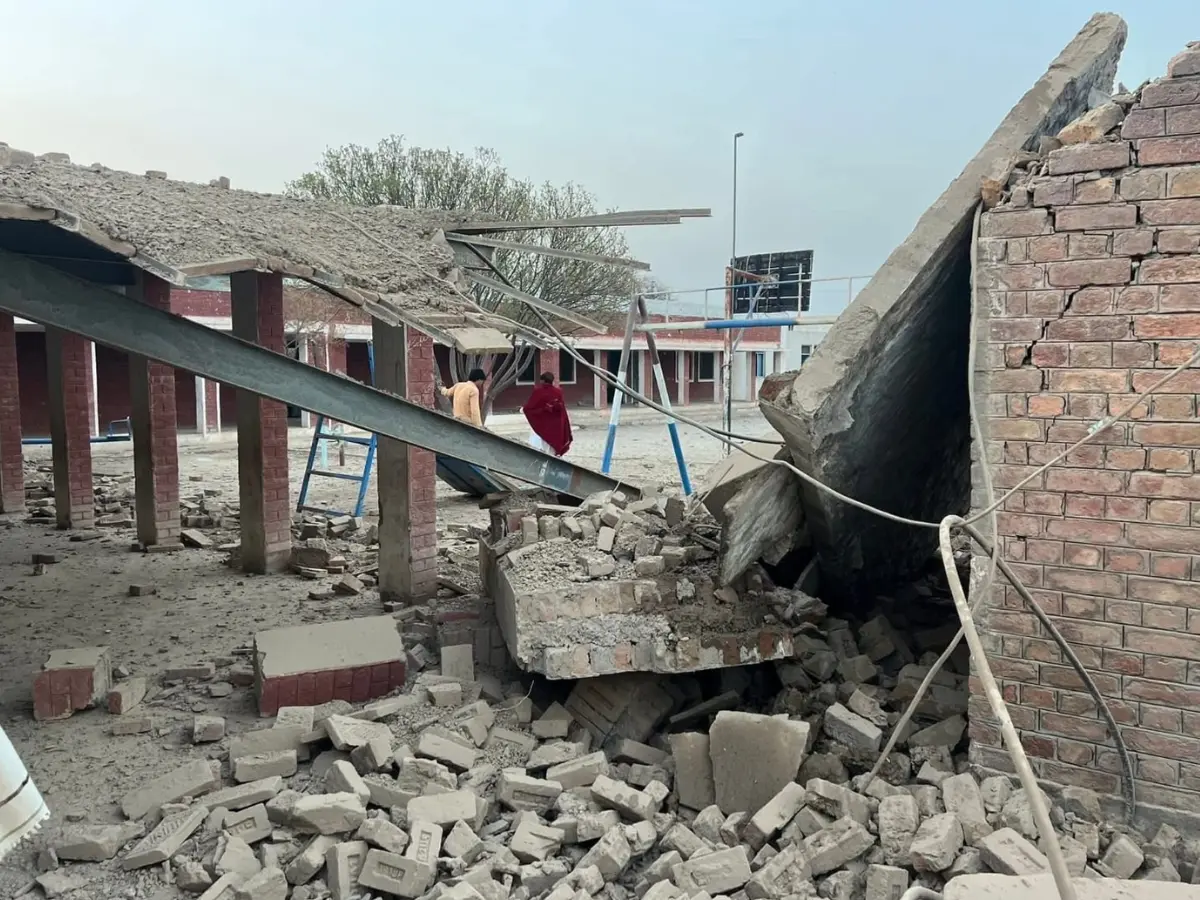
A powerful drone attack in Bannu on Friday night left eight civilians injured, including women, raising serious alarm across Khyber Pakhtunkhwa. The incident comes as the Waziristan operation continues to intensify and security forces conduct fresh intelligence-based operations in Tank and Dera Ismail Khan. South Waziristan news today paints a deeply troubling picture of a region under persistent militant pressure.
Drone Attack in Bannu Injures Eight, Including Women
A dangerous security incident unfolded in Bannu district late Friday night when a quadcopter drone exploded near a residential area. According to police, the drone flew into the area from an unknown location and exploded shortly after falling near a residential area, leaving several people injured.
Eight people were injured in the explosion, including women. Local residents rushed to the scene and shifted the injured to the District Headquarters Hospital Bannu after initially providing first aid.
The administration at the District Headquarters Hospital confirmed that all injured individuals are receiving medical treatment, while some are said to be in critical condition.
The drone attack in Bannu triggered immediate panic among local residents and prompted a swift security response. Authorities sealed off the area as investigations began into the origin and intent of the strike.
Security Agencies Launch Probe Into Bannu Attack
The nature of this drone attack in Bannu has alarmed both security officials and the civilian population. Security sources said the incident is being investigated from multiple angles to determine the nature of the explosion, the origin of the drone, and possible motives.
Local residents expressed deep concern over the incident and urged the government and relevant authorities to conduct an immediate inquiry, identify those responsible, and ensure the protection of civilians.
This is not an isolated event. Last Friday, a suspected cross-border quadcopter strike from Afghanistan wounded two Pakistani personnel. Officials said a quadcopter targeted a security post in Baizai tehsil in KP’s Mohmand district.
The Bannu operation update today reveals a district that has been under sustained threat for months. Bannu district has been the scene of repeated security incidents in recent months, with both civilians and local security forces coming under attack amid a broader surge in militant violence. Violence in Bannu has included attacks on police and jirga members, prompting targeted operations by police and security forces in various localities to disrupt militant networks.
Background What Is Driving Violence in Waziristan and Bannu?
To understand the current Bannu operation update and the wider Waziristan operation, it is important to look at the broader security context in Khyber Pakhtunkhwa.
The region has been facing a systematic campaign of terror carried out by Fitna al-Khwarij, a term used by Pakistani authorities for the banned Tehreek-e-Taliban Pakistan. These militants have intensified attacks on civilian and military targets across South Waziristan, North Waziristan, Bannu, Tank, and DI Khan.
According to a report issued by the Islamabad-based Pak Institute for Peace Studies, Pakistan recorded a sharp rise in militant violence in 2025 despite record militant deaths. The report stated that terrorist attacks increased by 34 per cent while terrorism-related fatalities went up by 21 per cent compared to the previous year. Khyber Pakhtunkhwa witnessed a particularly notable increase in attacks.
Drone attacks have become a favored tactic of militants in the region. Small quadcopters, often loaded with explosives, are deployed against both civilian and military targets, making them difficult to intercept and impossible to ignore.
Waziristan Operation Update ISPR Reports Five Terrorists Killed
Alongside the drone attack in Bannu, fresh Waziristan operation news emerged on May 8 as ISPR confirmed successful intelligence-based operations nearby.
Security forces killed five terrorists in two separate engagements in Khyber Pakhtunkhwa’s Tank and Dera Ismail Khan districts. In Tank district, an intelligence-based operation was conducted on the reported presence of khwarij. After an intense exchange of fire, four khwarij belonging to Indian-sponsored Fitna-al-Khwarij were killed. In a separate IBO conducted in DI Khan district, one additional terrorist was killed during a firefight with security forces.
Weapons and ammunition were also recovered from the killed terrorists, who remained actively involved in numerous terrorist activities in the area.
Security forces also launched a clearance operation to ensure no other militants remained in the area. The military reiterated that Pakistan’s counterterrorism drive under the vision of “Azm-e-Istehkam” would continue without interruption to eliminate foreign-sponsored terrorism.
These operations form part of Pakistan’s ongoing Waziristan operation, which targets militant hideouts across the tribal belt stretching from Tank and DI Khan into South Waziristan.
South Waziristan News Today A Region Under Siege
South Waziristan news today reflects a persistent and deeply rooted security crisis. Just days before the Bannu drone attack, militants attempted a major suicide bombing in the area.
An attempted suicide bombing targeting a security forces check post near Azam Warsak Bazaar in South Waziristan was thwarted. Security sources said the attacker tried to strike the army post with a coach packed with explosives. Pakistan Army personnel acted in time and destroyed the vehicle before it could reach the check post. Police officials said the blast caused damage to a nearby religious seminary, a petrol pump, several shops and the roofs of multiple houses.
One civilian was martyred and 15 others were wounded in the incident. Security forces cordoned off the area and launched a search operation following the attack.
In a separate South Waziristan news today development, cross-border mortar and artillery shells struck Angoor Adda Bazaar in Lower South Waziristan. One of the shells struck a bakery, killing the shopkeeper on the spot. Two of his brothers were also injured and taken to Wana hospital. The shelling caused panic in the area and led to the closure of shops.
Activists and tribal elders strongly condemned what they described as repeated shelling incidents in recent weeks.
Opinion Bannu and Waziristan Are Crying Out for Attention
The drone attack in Bannu tonight is not just another security incident. It is part of a pattern — a systematic, ongoing assault on civilian life in Khyber Pakhtunkhwa that demands urgent national and international attention.
What is particularly troubling is the use of quadcopter drones against residential neighborhoods. These are not sophisticated military-grade weapons. They are commercially available devices being weaponized against ordinary men and women in their own homes. Tonight, those victims included women in Bannu. Last week, children were among the casualties elsewhere in KP.
The Waziristan operation and the Bannu operation updates confirm that security forces are fighting hard. ISPR reports consistently show militants being neutralized and weapons recovered. But the attacks keep coming. The drone attack in Waziristan today and the Bannu strike tonight prove that militant networks remain active, adaptive, and dangerous.
Pakistan needs more than military operations in these regions. It needs development, connectivity, social investment, and political engagement. The PTI strike-related unrest and political tensions in KP further complicate efforts to establish stability. Governance gaps in areas like Bannu and South Waziristan continue to be exploited by those who benefit from chaos.
Dawn PTCL digital infrastructure expansion and Pakistan’s new satellite programs represent the kind of investment that could, over time, help bring these marginalized communities closer to the national mainstream. Connectivity digital and physical is as important as counterterrorism operations in winning the longer battle for peace.
The people of Bannu and Waziristan deserve security. They deserve governance. And they deserve to be more than a news headline.
Impact Regional and National Consequences
The drone attack in Bannu and ongoing Waziristan operation news carry serious implications beyond the immediate casualties.
Cross-border drone and quadcopter attacks signal a dangerous evolution in militant tactics. Pakistan subsequently imposed a countrywide ban on drone flights following a series of quadcopter attacks, including a strike on a mosque in Bannu and attacks on security checkposts in multiple KP districts.
The Afghanistan-Pakistan border remains a fault line of instability. Militants use the porous frontier to launch attacks into Pakistani territory, complicating any lasting resolution to the Waziristan operation.
Regionally, continued instability in South Waziristan news today affects investment, education, healthcare, and everyday life for millions of people. The human cost is immeasurable, and it accumulates daily.
What Comes Next
Security forces have shown resolve in the Waziristan operation and the wider counterterrorism campaign under Azm-e-Istehkam. ISPR continues to report successful IBOs, and the military’s message is clear: the campaign will not stop.
However, the drone attack in Bannu tonight and the broader South Waziristan news today indicate that the threat is evolving faster than simple operations can contain. Pakistan must continue and deepen both its security response and its civilian investment in the region.
The Bannu operation update and future Waziristan operation developments will be closely watched. For now, eight injured civilians in Bannu are a painful reminder that the war at home is far from over.
Frequently Asked Questions (FAQs)
What drone attack killed 3 soldiers?
Several drone and quadcopter attacks have killed Pakistani soldiers in recent months across Khyber Pakhtunkhwa. A Pakistani soldier was killed in a drone attack on a check post in Tank District, and a school was destroyed in a drone strike in North Waziristan as part of a broader pattern of militant quadcopter attacks across the tribal belt. Specific casualty numbers vary by incident, and ISPR regularly updates confirmed figures through official statements.
Why did Obama attack Pakistan?
Between 2009 and 2016, the United States under President Obama authorized CIA-operated drone strikes in Pakistan’s tribal areas, primarily targeting al-Qaeda and Taliban militants who were using the region as a base of operations. These strikes were carried out under a legal framework of self-defense and counterterrorism, targeting militant leadership in North and South Waziristan. They were highly controversial, causing civilian casualties and straining US-Pakistan relations. Pakistan officially protested the strikes as violations of its sovereignty, though some cooperation existed behind the scenes. These American drone strikes are historically distinct from the current quadcopter attacks carried out by local militant groups such as the TTP.
What is a drone missile attack?
A drone missile attack refers to the use of an unmanned aerial vehicle (UAV) armed with missiles or explosives to strike a target from the air without risking the life of a pilot. Military-grade drones used in such attacks can be guided remotely from thousands of kilometers away. In Pakistan’s case, both large military drones used historically by the CIA and small commercially modified quadcopters are used in current attacks. The quadcopter drone attack in Bannu tonight involved a smaller device loaded with explosives, which is now a common low-cost tactic used by militants in Khyber Pakhtunkhwa and the wider tribal region.