
Congo youth poverty tells one of the most painful paradoxes in modern Africa — a country sitting on vast oil wealth whose young population overwhelmingly lives in conditions of deprivation, unemployment, and diminished opportunity that decades of oil revenues have consistently failed to address.
Congo youth poverty has become the defining political and social challenge facing Brazzaville as a generation of young Congolese — educated enough to understand what their country’s resources should be delivering and connected enough through social media to see how peers in other nations live — demands change from a political establishment that has governed the country for decades without translating oil wealth into broad human development.
World Bank data consistently places the Republic of Congo among the most unequal nations on earth — with oil revenues flowing disproportionately to a small elite while Congo youth poverty figures reveal that the majority of the population lives on less than two dollars a day despite the country pumping hundreds of thousands of barrels of oil daily. Democratic Republic of the Congo food insecurity and WFP emergencies across the broader Congo basin add regional context to a poverty crisis that extends far beyond Brazzaville’s borders.
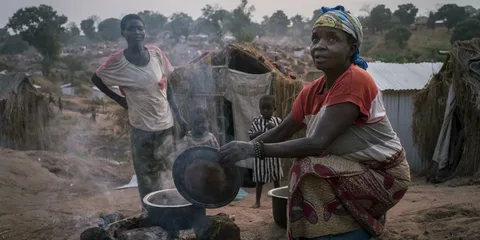
Background: Congo Youth Poverty — How Did This Happen
The Republic of Congo — Not the DRC
Congo youth poverty in this article refers primarily to the Republic of Congo — also known as Congo-Brazzaville — a central African nation of approximately 6 million people distinct from its much larger neighbour the Democratic Republic of the Congo across the Congo River.
The Republic of Congo has been producing oil commercially since the 1970s. At its peak, oil production made Congo-Brazzaville one of sub-Saharan Africa’s significant oil producers — generating revenues that properly managed and equitably distributed should have been sufficient to build world-class infrastructure, universal education, and a diversified economy capable of employing its young population.
Congo youth poverty exists in a country that has been governed for a combined total of over 4 decades by President Denis Sassou Nguesso — whose administration has consistently prioritised elite wealth accumulation over the broad-based development that would reduce Congo youth poverty and deliver the oil wealth dividend that the country’s resources should make possible.
The Resource Curse and Congo Youth Poverty
Congo youth poverty is a textbook expression of the resource curse — the paradox by which countries with abundant natural resources tend to have weaker economic growth, less democracy, and worse development outcomes than countries with fewer natural resources.
In the Republic of Congo, the resource curse has operated through several interconnected mechanisms. Oil revenues have been captured by a narrow political and business elite. Public institutions — schools, hospitals, roads, electricity networks — have been chronically underfunded relative to what oil revenues should make possible. Congo youth poverty rates have remained stubbornly high despite decades of oil production. Debt accumulated against future oil revenues has diverted fiscal resources toward debt service rather than the development spending that would reduce Congo youth poverty.
Oil Wealth vs Congo Youth Poverty — The Painful Paradox
Oil Production and Revenue
The Republic of Congo produces approximately 250,000 to 300,000 barrels of oil per day — a significant volume for a country of 6 million people that should in theory generate substantial per capita revenues available for public investment in reducing Congo youth poverty.
Oil accounts for approximately 65 to 70 percent of government revenues and over 80 percent of export earnings. The country’s entire fiscal position depends on oil price levels and production volumes — making Congo youth poverty directly connected to how oil revenues are collected, managed, and distributed rather than to any fundamental scarcity of resources.
Where the Oil Money Goes
World Bank Congo governance assessments have consistently identified opacity and mismanagement in oil revenue flows as central to understanding why Congo youth poverty persists despite resource wealth.
A significant proportion of oil revenues flow through arrangements between the government and international oil companies — primarily TotalEnergies and Eni — that lack the transparency standards required for public accountability. Congo youth poverty therefore exists not because the country lacks resources but because those resources are not reaching the young majority through public services, employment creation, or direct distribution.
The Republic of Congo’s debt to China — accumulated through borrowing against future oil revenues — has also diverted substantial fiscal resources toward debt service rather than the development spending that would reduce Congo youth poverty. China’s role as both a major oil customer and a major creditor creates a financial relationship that development economists have identified as a structural contributor to the persistence of Congo youth poverty.
Congo Youth Poverty — The Numbers
Poverty Rate and Youth Unemployment
Congo youth poverty statistics paint a stark picture of a country where oil wealth has failed to deliver broad human development across 3 specific dimensions.
Approximately 40 to 45 percent of the Republic of Congo’s population lives below the national poverty line — a figure that places it among the most unequal oil-producing nations in the world. In rural areas the poverty rate rises significantly — with some provinces recording rates above 70 percent. Congo youth poverty is particularly acute because young people aged 15 to 35 represent the largest demographic cohort in a country with a median age of approximately 19 years.
Youth unemployment in the Republic of Congo is estimated at between 35 and 45 percent — with informal sector work and subsistence activities accounting for the majority of youth economic activity. For young Congolese with secondary or tertiary education the disconnect between qualifications and available formal employment is a particular source of the frustration driving demand for change that defines Congo youth poverty discourse today.
Inequality Dimension
The Gini coefficient for the Republic of Congo — a standard measure of income inequality — is estimated at approximately 0.48 to 0.50, placing it among the most unequal countries in Africa. This extreme inequality means that Congo youth poverty coexists with visible elite wealth concentrated in Brazzaville’s affluent neighbourhoods — creating the daily lived experience of injustice that fuels youth frustration and demands for political and economic change.
Democratic Republic of the Congo Food Crisis
Democratic Republic of the Congo Food — Scale of the Crisis
Democratic Republic of the Congo food insecurity represents a separate but contextually important dimension of the broader Congo basin poverty crisis — with the DRC hosting one of the world’s most severe humanitarian emergencies that extends the Congo youth poverty story across the river to a country of over 100 million people.
Democratic Republic of the Congo food crisis is driven by a combination of decades of armed conflict, institutional collapse, displacement, and the breakdown of agricultural systems in conflict-affected eastern provinces. The DRC hosts approximately 7 million internally displaced people — the largest internal displacement crisis in Africa — with displaced populations facing acute democratic Republic of the Congo food insecurity that WFP emergencies response has been unable to fully address given the scale and geographic complexity of the crisis.
Democratic Republic of the Congo food production has been severely disrupted in the most productive agricultural regions of eastern DRC — with armed group activity, forced displacement, and the destruction of farming communities creating the conditions for chronic democratic Republic of the Congo food insecurity that affects millions of people regardless of the country’s underlying agricultural potential.
Democratic Republic of the Congo Food — WFP Response
Democratic Republic of the Congo food emergency response by the World Food Programme has been one of the largest WFP emergencies operations in the world — with the WFP providing food assistance to millions of DRC beneficiaries annually while consistently facing funding shortfalls that prevent it from reaching all those in need.
WFP emergencies in the DRC are classified at the highest operational level — reflecting the severity and scale of the democratic Republic of the Congo food crisis and the limitations of any humanitarian response in a country where conflict, corruption, and infrastructure collapse create access constraints that make democratic Republic of the Congo food delivery extraordinarily difficult even when funding is available.
WFP Emergencies — Congo Context
WFP Emergencies — Republic of Congo and DRC
WFP emergencies operations in the Congo basin span both the Republic of Congo and the DRC — with the two countries presenting very different but equally serious dimensions of the broader regional food and poverty crisis.
WFP emergencies in the Republic of Congo focus primarily on urban food insecurity in Brazzaville and Pointe-Noire — where Congo youth poverty translates into households unable to afford adequate nutrition despite living in a capital city of an oil-producing nation. WFP emergencies data for Congo-Brazzaville documents food insecurity rates that are extraordinary for a country with the Republic of Congo’s oil revenues — reflecting the direct human cost of Congo youth poverty and the oil wealth distribution failure that drives it.
WFP emergencies in the DRC are among the most resource-intensive in the entire WFP global portfolio — with the organisation consistently describing the democratic Republic of the Congo food crisis as one of the world’s worst humanitarian emergencies and calling for sustained donor funding that the competing demands of global WFP emergencies have made difficult to secure at adequate levels.
WFP Emergencies — Funding Challenges
WFP emergencies global funding environment has been severely strained by the simultaneous occurrence of multiple major humanitarian crises — including the Ukraine war, the Gaza conflict, the Sudan crisis, and the broader Iran war regional disruption — creating funding competition that makes WFP emergencies response in the Congo basin particularly vulnerable to underfunding.
WFP emergencies Congo operations have received significantly less than their target funding in recent years — leaving gaps in food assistance coverage that fall disproportionately on the most vulnerable populations including children, pregnant women, and the elderly whose nutritional needs are most acute and whose Congo youth poverty exposure is most severe.
Dominican Republic Poverty Rate — Comparative Context
Dominican Republic Poverty Rate — How It Compares
Dominican Republic poverty rate provides an instructive comparative context for understanding Congo youth poverty — with the Dominican Republic representing a Caribbean nation that has achieved significantly better poverty reduction outcomes than the Republic of Congo despite having far fewer natural resources.
Dominican Republic poverty rate has fallen dramatically over the past 2 decades — declining from approximately 47 percent in 2000 to approximately 23 percent in recent years. This Dominican Republic poverty rate reduction reflects sustained economic growth driven by tourism, manufacturing, and remittances — sectors that have generated broad-based employment and income growth that the Republic of Congo’s oil-dependent economy has failed to replicate.
The Dominican Republic poverty rate comparison with Congo youth poverty illustrates the resource curse paradox in stark terms — a resource-poor Caribbean nation has achieved better poverty outcomes than an oil-rich African nation because it built a diversified economy that creates employment and distributes growth more broadly than oil revenues concentrated in elite hands.
Dominican Republic Poverty Rate — Lessons for Congo
The Dominican Republic poverty rate trajectory offers lessons relevant to Congo youth poverty — specifically the importance of economic diversification, investment in education and human capital, and governance institutions that translate economic growth into broad-based poverty reduction.
Dominican Republic poverty rate improvement was not automatic — it required sustained policy commitment to inclusive growth, investment in education and health infrastructure, and governance reforms that reduced corruption and improved public service delivery. Congo youth poverty will not be reduced without an equivalent policy commitment that the Republic of Congo’s current political establishment has consistently failed to demonstrate.
Youth Voices — Congo Youth Poverty and Hope for Change
What Young Congolese Are Saying
Congo youth poverty is not an abstract statistic for the young Congolese living it — it is the daily reality of limited opportunity, visible inequality, and the gap between what their country’s resources should provide and what their lives actually contain.
Young people in Brazzaville describe driving past gleaming government buildings and elite residences on the way to cramped family homes in under-serviced neighbourhoods as making the injustice of Congo youth poverty visceral and impossible to ignore. University graduates describe spending years searching for formal employment in an economy where connections to the political establishment matter more than qualifications.
Hope for Change
Despite the depth of Congo youth poverty there is genuine and articulated hope for change among young Congolese — grounded in several developments creating new possibilities for accountability and transformation.
Civil society organisations led by young Congolese are building platforms for transparency advocacy — using digital tools to document oil revenue flows and the gap between official narratives and lived Congo youth poverty reality. Social media has given Congo youth poverty a visibility and voice that decades of controlled state media denied it.
The generational shift — as the demographic weight of young Congolese increases relative to older cohorts — is slowly changing the political arithmetic of a country where youth constitute the overwhelming majority of the population. Congo youth poverty will not be solved by demographics alone — but the growing political consciousness of the generation living it is creating pressure for change that is harder to ignore with every passing year.
Quotes on Congo Youth Poverty
A young university graduate in Brazzaville told Reuters that she had studied for 5 years and graduated with honours — only to spend 3 years unable to find formal employment in a country that pumped billions worth of oil every year, adding that her generation wanted change and would not stop demanding it.
World Bank Congo Country Director stated in a recent assessment that the Republic of Congo had the resources to significantly reduce Congo youth poverty and invest in its young population — but that this required governance reforms translating oil revenues into public services and creating conditions for private sector growth and youth employment.
A Congolese civil society leader told the Financial Times that Congo youth poverty was not a natural condition — it was a political choice made by those who controlled oil revenues, and that young Congolese were increasingly aware of that choice and increasingly determined to change it.
Transparency International’s Congo representative stated that oil revenue opacity remained the single biggest obstacle to reducing Congo youth poverty — adding that without knowing exactly what the country earned from oil and where those earnings went it was impossible to hold anyone accountable for the persistence of Congo youth poverty across successive generations.
WFP Congo Country Representative stated that the food insecurity dimension of Congo youth poverty was directly connected to the failure of oil revenues to fund adequate social protection systems — adding that young Congolese experiencing food insecurity alongside the visible wealth generated by the country’s oil production represented one of the most stark illustrations of the resource curse that WFP emergencies operations encountered anywhere in the world.
Impact: What Congo Youth Poverty Means for the Country’s Future
Political Stability Risk
Congo youth poverty creates genuine medium-term political stability risks for a country that has already experienced multiple periods of civil conflict. A young majority population experiencing high unemployment, visible inequality, and persistent poverty — while aware through social media of alternatives available elsewhere — represents a politically volatile demographic whose frustration has historically translated into instability when political channels for change are blocked.
World Bank Congo risk assessments consistently identify Congo youth poverty and youth unemployment as among the most significant drivers of potential instability — making Congo youth poverty not just a development concern but a security concern for the country’s political establishment.
Economic Diversification Imperative
Congo youth poverty is directly linked to the country’s failure to diversify its economy beyond oil dependence. As the global energy transition accelerates and long-term oil demand faces structural decline, the Republic of Congo faces a narrowing window to build the diversified economic foundations that could generate the employment and opportunity that would meaningfully reduce Congo youth poverty.
Agriculture, forestry, tourism, and digital services have been identified as sectors with genuine diversification potential — but realising this potential requires the governance reforms and public investment that oil revenue mismanagement has consistently prevented. The Democratic Republic of the Congo food production potential similarly represents an unrealised development asset whose exploitation is blocked by conflict and governance failure rather than fundamental resource constraints.
Frequently Asked Questions
Is Congo a Rich or Poor Country?
Congo is simultaneously rich in natural resources and poor in human development outcomes — making it one of the most stark examples of the resource curse paradox in the world. The Republic of Congo has substantial oil wealth — producing 250,000 to 300,000 barrels per day — that gives it a per capita GDP significantly above the sub-Saharan African average on paper. But Congo youth poverty affects 40 to 45 percent of the population because oil revenues have not been translated into broad human development. The Democratic Republic of the Congo is resource-rich in minerals including cobalt, coltan, gold, and diamonds — with an estimated 24 trillion dollars in untapped mineral wealth — but is one of the poorest countries on earth in per capita income terms due to decades of conflict, corruption, and institutional failure. Both Congos illustrate the resource curse — natural wealth that generates elite enrichment and international extraction rather than broad-based human development for the majority population experiencing Congo youth poverty.
Why Is Congo a High Risk Country?
Congo is considered a high risk country for 3 primary reasons. First — political risk — the Republic of Congo has been governed for over 4 decades by the same political establishment with limited democratic accountability, creating governance risks that affect investors, aid organisations, and civilians alike. The DRC faces even more acute political risk from ongoing armed conflict in eastern provinces involving dozens of armed groups competing for mineral revenues and territorial control. Second — security risk — the DRC is home to one of the world’s most complex and persistent conflict environments, with over 100 armed groups operating in eastern provinces and a UN peacekeeping mission that has been unable to restore lasting stability despite decades of presence. Third — economic risk — both Congo countries face commodity dependence risks with the Republic of Congo’s oil dependence and the DRC’s mineral dependence creating vulnerability to price shocks, Dutch disease effects, and the governance failures associated with Congo youth poverty and broader resource curse dynamics.
What Country Has the Highest Rate of Poverty?
According to World Bank and UN data, the countries with the highest poverty rates measured by the international poverty line of 2.15 dollars per day include South Sudan — where approximately 76 percent of the population lives below the international poverty line, making it consistently the world’s poorest country by this measure. The DRC follows closely — with approximately 73 percent of its population living below the international poverty line despite its extraordinary mineral wealth. Madagascar, Central African Republic, Burundi, and Niger also consistently rank among the countries with the highest poverty rates globally. The Dominican Republic poverty rate of approximately 23 percent — while still representing significant hardship — is dramatically lower than these African figures, illustrating the range of poverty outcomes across developing nations and providing comparative context for understanding Congo youth poverty within the global poverty landscape. Every country on the highest poverty rate list shares the Congo youth poverty characteristic of institutional failure preventing natural or human resources from translating into broad-based human development.
Conclusion
Congo youth poverty is the most powerful indictment of a development model that has allowed oil wealth to enrich a few while condemning the many to lives of limited opportunity and persistent deprivation.
Congo youth poverty rate stubbornly high despite decades of oil production. Democratic Republic of the Congo food crisis among the world’s most severe. WFP emergencies in the Congo basin chronically underfunded. Dominican Republic poverty rate falling while Congo youth poverty stagnates — the comparison that shows what is possible when governance serves people rather than elites.
The young Congolese demanding change are not asking for charity — they are asking for their share of what their country’s soil produces. The hope they express is not naïve — it is the rational response of a generation that understands what their country has and what their country owes them.
Whether the political will exists to deliver that share before their patience runs out is the question on which the Republic of Congo’s future depends — and on which the world, distracted by more dramatic conflicts elsewhere, has not yet focused the attention that Congo youth poverty deserves.