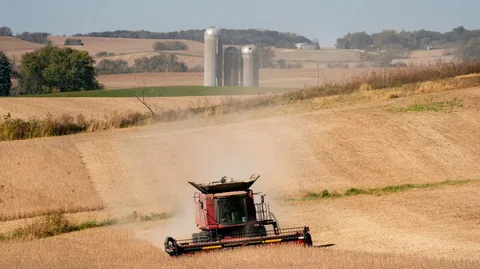
BEIJING, Sept 28, 2026: China is set to cut tariffs on a broad range of US agricultural goods, including corn, wheat, meat and dairy. Soybeans, the biggest US farm item Beijing buys, are not on the list issued by the commerce ministry on Monday. US soybeans will keep facing an extra 10% tariff, which traders say is too high for private buyers to absorb.
Background: How China US Trade Relations Reached This Point
Markets had been waiting for this announcement since last week’s Washington summit between Chinese President Xi Jinping and US President Donald Trump. It was their second meeting this year. Reports on the summit say the leaders agreed to extend a trade truce and to reduce tariffs on both sides.
Agriculture has been at the centre of China US trade relations for years. American farmers lost a lot of ground in China during earlier tariff rounds, and buyers there turned to other suppliers. Under a deal struck last year, Beijing resumed large-scale purchases of US soybeans, and the White House says China agreed to buy 25 million metric tons annually through 2028.
What China’s Tariff Cuts Cover
The commerce ministry’s list covers corn, wheat, sorghum, meat and dairy products, along with vegetable oils and meals. Soyoil and soymeal are included, which makes the omission of whole soybeans stand out even more. According to Reuters calculations, trade in the products on Monday’s list was worth about $17 billion in 2024.
That figure matches the $17 billion in annual farm purchases the White House said Beijing agreed to make in May, once soybeans are set aside. China has not publicly confirmed any such target. Still, the choice of products suggests the China tariff cuts were designed to make that number reachable.
The Soybean Exception
US soybeans keep the additional 10% tariff. Traders have warned that the rate is too high for private crushers, the commercial processors who turn beans into oil and meal, to absorb at normal margins. State-run buyers are a different story, and they have kept buying.
Sinograin and COFCO, two Chinese state agricultural companies, have bought more than 12 million metric tons of US soybeans so far. That is close to half of the 25 million tons the White House cites. Beijing has not confirmed that annual figure either.
A New Trade Council
The two governments also agreed to set up a trade council. Its first job will be to discuss a reciprocal tariff cut on $30 billion worth of products. Tribune reported that the wider package covers about $60 billion of goods, including agricultural and household items.
What Experts Are Saying
Analysts see the soybean decision as political as much as commercial. Feng Chucheng, founder of Hutong Research, said that although soybeans are a non-sensitive trade item, the political significance of China’s soybean purchases is enormous. He suggested Beijing prefers to handle them on a separate track, outside the tariff list.
He also argued that this gives China leverage to restrain US actions, particularly ahead of the American midterm elections. An Asia-based trader who sells soybeans to China, speaking anonymously, said state buyers will keep purchasing. The same trader added that lower tariffs on other goods will help China reach the $17 billion commitment, but will not make US soybeans cheaper than rival supplies.
Impact: Who Gains and Who Waits
For US exporters of corn, wheat, sorghum, beef, pork and dairy, lower Chinese duties should improve their price position in a large market. Whether that turns into higher volumes will depend on shipping costs, exchange rates and what competing suppliers charge. Some of these categories have also had steady demand from Chinese feed and food companies.
US soybean growers face a more mixed picture. Government-backed purchases give them a floor, yet private demand may stay soft while the 10% duty remains. Since Brazil is also a major soybean supplier to China, the tariff gap matters to any buyer comparing prices.
Globally, the announcement is being read as a sign that the truce is holding. Commodity traders will watch how quickly the new duty rates take effect and whether the trade council widens the list. Any change to the soybean tariff would be the biggest signal.
What Happens Next
The next step is the first meeting of the trade council and its talks on the $30 billion reciprocal cut. Traders will also track how much more soybean buying Sinograin and COFCO report as the year goes on. Neither side has said when the soybean tariff might be revisited.
Anyone following US agricultural exports to China should watch for the official start date of the new rates. The commerce ministry’s list is the main document to check for exact product codes.
FAQs
What is the tariff rate from China to the USA?
There is no single rate, because US tariffs on Chinese goods vary by product and by which legal measure applies. Some items face duties introduced in earlier trade disputes, others face newer additions, and some are exempt. Rates have also changed as the two countries negotiated truces.
For an exact figure, importers should check the Harmonized Tariff Schedule and guidance from US Customs and Border Protection for the specific product code. On the Chinese side, the relevant number in this story is the additional 10% tariff that US soybeans still face, while the new list lowers duties on corn, wheat, meat, dairy and other goods.
What happens if China dumps US debt?
China is one of the largest foreign holders of US Treasury securities, though Japan holds more, and China’s holdings have shrunk from their peak over the past decade. If Beijing sold a large amount quickly, Treasury prices would probably fall and yields would rise for a while. That would raise borrowing costs for the US government and could unsettle financial markets more broadly.
Most economists think the damage would be limited and short-lived, though, because other buyers would step in and the Federal Reserve has tools to calm markets. There is also a cost to China: a sudden sale would lower the value of the bonds it still holds and could push the yuan higher, hurting Chinese exporters. That is why it is usually seen as a risky option rather than a practical one.
Did the US impose tariffs on China?
Yes. The US began imposing tariffs on Chinese goods in 2018, and China responded with duties on American products, including farm goods. The dispute went through several rounds and later truces, and it hurt US agricultural exports to China in particular.
The current thaw follows last week’s Xi-Trump summit in Washington, which produced a truce extension and plans for reciprocal cuts. Tribune reported that the two sides agreed cuts covering about $60 billion of goods. China’s latest list is its side of that arrangement for farm products.