

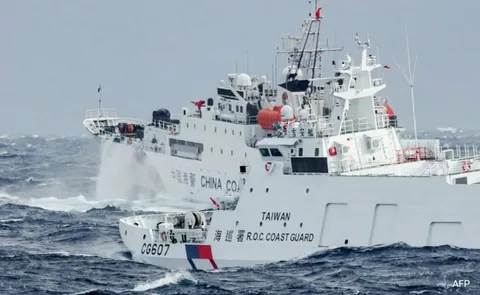

China has expanded coast guard patrols into waters east of Taiwan for the first time in quick succession, raising fears in Taipei that Beijing may be rehearsing a containment strategy. The move marks one of the most significant escalations yet in the China-Taiwan conflict 2026, adding to months of growing military and legal pressure on the self-ruled island.
Background
Understanding the China-Taiwan conflict history helps explain why this week’s patrols matter so much. China’s Communist Party has claimed Taiwan as part of its territory since the Chinese civil war ended in 1949, when the defeated Nationalist government fled to the island and continued governing it separately from the mainland.
For decades, China has vowed eventual “reunification,” by force if necessary, while Taiwan has developed its own democratic government, military, and international relationships without ever formally declaring independence. This unresolved status is at the core of why China-Taiwan relations are so tense today, more than seven decades after the split first occurred.
Beijing has steadily increased pressure on Taipei in recent years through near-daily military flights, large-scale exercises, and what Taiwan calls “lawfare,” using law enforcement and legal claims rather than open military action to assert sovereignty. The People’s Liberation Army staged an exercise in December 2025 that simulated blockading key Taiwanese ports, setting the stage for the coast guard patrols now unfolding in 2026.
Details
According to Al Jazeera, China’s Maritime Safety Administration and coast guard have staged multiple patrols and “special maritime law enforcement operations” through June and July, marking the first time these patrols have moved into waters east of Taiwan in such quick succession. Analysts say the eastern approach is significant because it is Taiwan’s least defended flank and its primary corridor for receiving international support in a crisis.
China’s coast guard formally declared on July 4 that these patrols east of Taiwan would now be considered “routine,” installing a new task group to continue what it calls law enforcement operations in what Beijing describes as its own jurisdictional waters. During earlier patrols in June, Chinese vessels radioed passing cargo ships for information about their crew and destination, actions Taiwan’s government said violated international law.
Taiwan’s Ministry of Foreign Affairs has firmly rejected China’s justification, stating that commercial vessels exercising freedom of navigation were harassed during the operations. Ray Powell, director of the maritime monitoring group SeaLight, described the shift as Beijing “essentially announcing a new normal” in how it operates around the island.
Adding to the complexity of the China-Taiwan conflict Trump has to navigate, the US president’s approach has been described by analysts as compounding ambiguity rather than resolving it. During a May 2026 summit with Chinese leader Xi Jinping in Beijing, Trump said he made no promises to Xi about Taiwan but also declined to confirm whether Washington would defend the island militarily, saying only that he was the one person who knew the answer.
Quotes
Tristan Tang, a nonresident fellow at the US-based National Bureau of Asian Research, told Al Jazeera the shift to eastern patrols carries both strategic and symbolic weight for Taiwan, since it targets the side of the island historically seen as its most secure approach route.
Taiwan’s presidential spokesperson, Karen Kuo, said President Lai Ching-te has consistently pushed for regional peace and stability while maintaining the cross-strait status quo, adding that China’s escalating military pressure remains the single destabilizing factor in the Indo-Pacific region.
US Secretary of State Marco Rubio, addressing concerns after the Trump-Xi summit, said American policy toward Taiwan remained unchanged following the talks, though he acknowledged Taiwan was not a primary focus of the leaders’ discussions that day.
Impact
The regional impact of the China-Taiwan conflict extends well beyond the two direct parties. Japan’s government has signaled it could respond militarily to a Taiwan contingency, and Tokyo has pursued an expanded security agenda alongside talks with the Philippines over disputed maritime boundaries, reflecting how China’s pressure campaign is reshaping alliances across the wider Indo-Pacific region.
Global trade routes are also a growing concern. Analysts monitoring the situation warn that a sustained Chinese presence east of Taiwan could eventually be used to restrict the island’s access to outside trade and military assistance in a future crisis, a scenario that would have direct consequences for global shipping lanes and semiconductor supply chains that run through the region.
Washington’s own posture adds further uncertainty. The Trump administration approved a record arms package to help Taiwan build asymmetric defense capabilities, yet delayed a separate $14 billion arms sale ahead of the Beijing summit, a decision Taiwan’s legislature and US lawmakers both criticized as sending mixed signals to Beijing.
Conclusion
With Beijing signaling it plans to maintain, not scale back, its expanded maritime presence, the coming months are likely to bring closer scrutiny of how Washington, Tokyo, and Taipei respond. Much will depend on whether the delayed US arms package moves forward and whether China continues expanding its coast guard operations beyond the waters east of Taiwan.
For now, the China-Taiwan conflict timeline shows no clear sign of de-escalation, with each side continuing to test the other’s resolve through legal claims, patrols, and carefully calibrated diplomatic statements rather than direct military confrontation.
Frequently Asked Questions
What is the China threat to Taiwan?
China’s threat to Taiwan combines military, legal, and diplomatic pressure rather than relying on a single method. Beijing conducts near-daily military aircraft incursions into Taiwan’s air defense identification zone, stages large-scale naval and army exercises simulating blockades of Taiwanese ports, and has more recently expanded coast guard patrols into waters around the island under the framework of enforcing its claimed jurisdiction. China has also stated it does not rule out using force to achieve what it calls “reunification,” making the possibility of a full military conflict a persistent, though not necessarily imminent, concern for regional security planners and Taiwan’s own government.
Why doesn’t China want Taiwan to be a country?
China’s position rests on the argument that Taiwan has always been part of Chinese territory, tracing back to historical claims that predate the 1949 split following the Chinese civil war. Beijing views any move toward formal Taiwanese independence as a direct challenge to its territorial sovereignty and a red line that could justify military action, and it has consistently pressured other countries and international organizations to avoid recognizing Taiwan as a separate, sovereign state. Beyond historical and nationalist arguments, Chinese leadership also sees Taiwan’s continued separate governance as a strategic vulnerability, given the island’s location along key shipping lanes and its role in global semiconductor manufacturing, making full control over Taiwan a long-standing strategic priority for Beijing.
Is China surrounding Taiwan right now?
China has significantly expanded its military and coast guard presence around Taiwan throughout 2026, including new patrols east of the island that mark a departure from its traditional focus on the Taiwan Strait to the west. While this does not amount to a full blockade or complete encirclement, analysts describe the pattern as a gradual, multi-directional squeeze designed to normalize a stronger Chinese presence on all sides of the island over time. Taiwan’s government has pushed back publicly against these patrols, calling them illegal, while regional partners including Japan and the United States continue monitoring the situation closely for signs of further escalation.