Benazir Bhutto was assassinated on December 27, 2007, shortly after addressing an election rally in Rawalpindi. The attack on Pakistan’s former Prime Minister made headlines around the world and reopened hard questions about political violence, democracy, and security that the country is still grappling with today.
Nearly two decades on, people still look up Benazir Bhutto husband, Benazir Bhutto children, Benazir Bhutto father, and the arc of her political career. Her life is still one of the more closely studied chapters in Pakistan’s democratic history.
Who Was Benazir Bhutto?
Benazir Bhutto became the first woman to lead a Muslim-majority country as Prime Minister, and she ran the Pakistan Peoples Party (PPP), the party her father founded. For a lot of people, she became something close to a global symbol of democratic leadership and women’s political participation.
She was born on June 21, 1953, in Karachi, studied at Harvard, then went on to Oxford. She came back to Pakistan and entered politics after her father was imprisoned and executed.
Her career had real highs and real lows. She served two terms as Prime Minister, but also dealt with sustained political opposition, corruption allegations, and being dismissed from office more than once.
Benazir Bhutto Father: The Political Legacy of Zulfikar Ali Bhutto
Benazir Bhutto’s father was Zulfikar Ali Bhutto, the founder of the PPP, who served as both President and Prime Minister of Pakistan through the 1970s.
He left a real mark on Pakistan’s political system. Then came the military coup led by General Zia-ul-Haq, after which Bhutto was arrested, tried, and executed in 1979 in a verdict that’s remained controversial ever since.
That execution shaped the rest of Benazir’s political life. She took over leadership of the PPP and became the most visible face of Pakistan’s pro-democracy movement through years of military rule, often pointing back to her father’s vision as the basis for her own politics.
Benazir Bhutto Husband: Asif Ali Zardari
Benazir married Asif Ali Zardari in December 1987, and the marriage drew heavy media coverage given that she was already one of the country’s most prominent political figures.
After her assassination in 2007, Zardari took over leadership of the PPP, and following the 2008 general election, he became President of Pakistan. He’s spoken of his late wife repeatedly as a symbol of democracy and described his role as continuing her political mission through the party.
The Bhutto-Zardari family is still a major presence in Pakistani politics today.
Benazir Bhutto Children
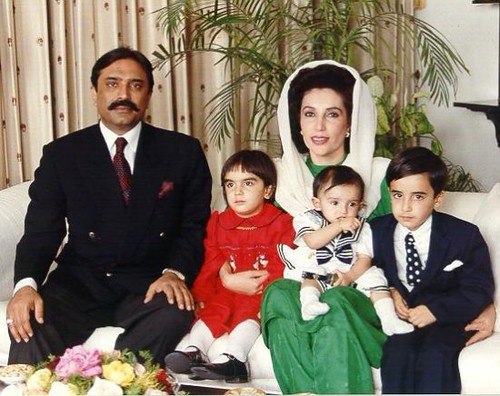
Benazir and Asif Ali Zardari had three children together: Bilawal Bhutto Zardari, Bakhtawar Bhutto Zardari, and Aseefa Bhutto Zardari. All three have stayed connected to public life in their own ways, mostly through the PPP.
Benazir Bhutto Daughter
Benazir had two daughters, Bakhtawar and Aseefa.Bakhtawar has stayed involved in social initiatives and shows up occasionally at political and public events, including representing the family at national ceremonies.
Aseefa has become more visibly active over time, taking part in humanitarian campaigns, healthcare initiatives, and political events alongside her father and brother.
Both have kept their mother’s legacy alive mainly through charitable and public service work rather than electoral politics.
Benazir Bhutto Son
Benazir Bhutto’s son is Bilawal Bhutto Zardari. He entered politics after finishing his education in the UK and became Chairman of the PPP, leading the party through several national elections since.
He’s said more than once that his mother’s vision for democracy still guides his politics, and he tends to focus on democracy, constitutional rights, youth participation, and social development in his public messaging.
Benazir Bhutto Death
Benazir Bhutto died on December 27, 2007, shortly after addressing a large political rally in Rawalpindi. As she was leaving, her convoy came under attack. She was critically wounded and taken to Rawalpindi General Hospital, where doctors confirmed her death.
The assassination happened in the middle of an election campaign and triggered nationwide grief, protests, and a stretch of serious political uncertainty. Governments and international bodies around the world condemned the attack and pushed for an independent investigation.
It’s still considered one of the defining moments in Pakistan’s recent political history.
Benazir Bhutto Death Age
Benazir Bhutto was born on June 21, 1953, and died on December 27, 2007, at age 54. She packed a lot into a relatively short life, becoming one of the best-known female political leaders in the world and leaving a lasting mark on Pakistan’s democratic development.
Political Career and Democratic Vision
Benazir Bhutto first became Prime Minister in 1988 after democratic elections, becoming the first woman to lead a Muslim-majority country’s government in the process.
Her time in office centered on a handful of priorities:
- Democratic governance
- Women’s rights
- Education
- Economic reforms
- Healthcare improvements
- International diplomacy
Her governments ran into plenty of political controversy along the way, but she stuck with democratic elections and civilian leadership as a principle throughout her career.
International Recognition
Bhutto built a reputation well beyond Pakistan. She spoke at major international forums, pushing for democracy, women’s political participation, education, and cooperation between nations.
Her career is often cited as an influence for women who went into public service and politics afterward, and her record continues to come up in academic and historical work on democratic governance.
Lasting Impact on Pakistan
Her assassination shifted Pakistan’s political conversation in a few lasting ways, pushing discussions of political security, democratic continuity, and electoral reform further into the mainstream.
The PPP went on to win the 2008 general election, and her death is often cited as one of the factors behind the sympathy vote that helped the party that year. Her speeches and political writing still come up regularly in debates about democracy and civilian rule in Pakistan, and she remains one of the country’s most recognizable political figures.
Benazir Bhutto and Wikipedia
A lot of people land on Wikipedia first when looking up basic facts about her life. It’s a reasonable starting point, but for anything beyond the basics, it’s worth checking books, official records, historical documents, and established news organizations for a fuller picture of her career, assassination, and legacy.
Conclusion
Benazir Bhutto’s death was a tragedy, but it’s also inseparable from the rest of her story: the political struggle that began after her father’s execution, her years in government, her marriage to Asif Ali Zardari, and the continued public life of her children.
Nearly two decades after the assassination, she’s still remembered as a leader whose vision and commitment to democracy left a real mark on Pakistan’s modern political history.
Frequently Asked Questions (FAQs)
What was the political party of Benazir Bhutto?
She led the Pakistan Peoples Party, founded in 1967 by her father, Zulfikar Ali Bhutto, around democracy, social justice, and welfare for ordinary citizens. After his execution, Benazir became the party’s most prominent figure and led it through multiple elections, serving twice as Prime Minister.
Who is the father of democracy?
It depends on which democracy you mean. Cleisthenes of Athens is usually credited as the father of Athenian democracy for the reforms he introduced around 508 BC. In Pakistan, some of his supporters describe Zulfikar Ali Bhutto as a champion of democracy for his role in promoting civilian rule, though that’s a political label rather than a formal historical title.
Who is the founder of democracy now?
There isn’t one. Modern democracy developed over thousands of years through ancient Greek reformers, constitutional thinkers, and democratic movements worldwide. Today’s democratic systems keep evolving through elected governments, institutions, and public participation rather than any single person’s work.