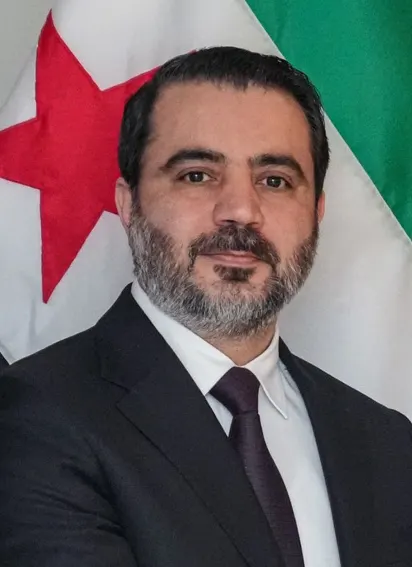
Asaad al-Shaibani, Syria’s current Foreign Minister, has become one of the most closely watched figures in the country’s post-Assad political order. Before holding this office, he spent over a decade inside Syria’s opposition and jihadist-turned-political movements, most notably Al-Nusra Front and its later reincarnation, Hay’at Tahrir al-Sham (HTS). His transformation from a wartime operative into a globally recognized diplomat is one of the more remarkable political arcs to emerge from the Syrian civil war.
Background
Asaad Hassan al-Shaibani was born in 1987 in Abu Ra’asin, in Syria’s northeastern al-Hasakah province, and belongs to the Bani Shayban tribe. His family later moved to Damascus, where he completed his early education before enrolling at Damascus University. He graduated in 2009 with a degree in English Language and Literature, a background that would later serve him well as Syria’s chief diplomat dealing directly with English-speaking governments and institutions. When the Syrian uprising began in 2011, al-Shaibani became actively involved in the opposition movement. Over the following years, he moved deeper into the political and administrative wings of the insurgency, eventually becoming one of the founding figures behind the Syrian Salvation Government, the civil administration that governed opposition-held areas of northwest Syria.
Details: Asaad al-Shaibani’s Life Before Government
This is where the “Asaad al-Shaibani before” search interest mostly centers, and the documented history is extensive. Long before he appeared in a suit at diplomatic summits, al-Shaibani operated under a string of noms de guerre inside Syria’s armed opposition factions. He first rose to prominence within Al-Nusra Front, the al-Qaeda-affiliated group that was one of the dominant rebel factions fighting the Assad regime in its early years. Within Al-Nusra, and later during its rebranding into Jabhat Fateh al-Sham in 2016, al-Shaibani reportedly used aliases including “Hussam al-Shafei” and “Zaid al-Attar.” Under the Zaid al-Attar identity, he became known for overseeing political affairs for the Salvation Government in Idlib. It’s worth being precise here, since the two names are often confused online: al-Shaibani’s documented history is with Al-Nusra Front and its successor groups, which were affiliated with al-Qaeda before formally severing that connection in 2016. He has not been linked in credible reporting to ISIS (the so-called Islamic State), which was in fact a rival and often hostile faction to Al-Nusra and HTS throughout the Syrian war. The two groups fought each other directly at various points in the conflict, so treating them as interchangeable is a factual error worth correcting.
When Hay’at Tahrir al-Sham was formed in 2017 through a merger of several anti-Assad factions, al-Shaibani took charge of the group’s political affairs department, working closely with Ahmed al-Sharaa, who was then known by his own nom de guerre, Abu Mohammad al-Joulani. During this period, al-Shaibani built extensive working relationships with United Nations agencies operating in northwest Syria and became a key point of contact for humanitarian coordination in opposition-held territory. He continued his academic path alongside his political work, earning a master’s degree in political science and international relations from Istanbul Sabahattin Zaim University in Turkey in 2022, and later pursuing further postgraduate study in the same field.
From Insurgent to Foreign Minister
Following the fall of the Assad regime in December 2024, Syria’s new caretaker government, led by Mohammed al-Bashir, appointed al-Shaibani as Foreign Minister on December 21, 2024. He was just 37 years old at the time. He retained the position in the transitional government formed in March 2025 under President Ahmed al-Sharaa. Since taking office, al-Shaibani has undertaken an unusually active diplomatic schedule for a Syrian foreign minister. He became the first Syrian official to visit Russia, Lebanon, the United Kingdom, and China following the collapse of the Assad government, and the first Syrian official to set foot in the United States in 25 years. He has also engaged with delegations from France, Germany, Jordan, Kuwait, and other regional and Western states as Damascus works to rebuild ties severed during decades of Assad-era isolation. One notable recent moment came during his visit to London, where he was photographed raising Syria’s new flag over the Syrian Embassy, marking its reopening after a 14-year closure.
Asaad al-Shaibani on Instagram and Social Media
Part of what has made al-Shaibani a recognizable public figure, beyond his diplomatic itinerary, is his social media presence. He launched an Instagram account in March that quickly grew to more than 900,000 followers, using it to document behind-the-scenes moments from his travels with President al-Sharaa and to showcase Syria’s re-entry into international diplomacy. On X (formerly Twitter), he has built a following of more than 380,000, where he regularly posts updates on his official engagements and commentary on Syria’s foreign policy direction. This level of online visibility is relatively new for a Syrian official and reflects a broader shift in how the country’s post-Assad leadership is choosing to communicate with both domestic and international audiences.
Quotes
Describing Syria’s diplomatic reset following his high-profile visit to London, al-Shaibani wrote on X that Syria was “returning to the world with its free identity,” a phrase that has since been picked up widely by regional media covering the country’s re-entry into international diplomacy. In the same post, he referenced the isolation Syria endured under what he described as Assad’s “chemical weapons regime,” framing the current government’s outreach as a decisive break from the previous era’s foreign policy posture. His social media commentary throughout 2025 and into 2026 has consistently emphasized themes of sovereignty, reintegration, and sanctions relief, messaging that appears designed to reassure both domestic audiences skeptical of the new leadership and international observers watching closely for signs of moderation. He has repeatedly framed his ministry’s work as building “privileged strategic partnerships” with regional states, language that echoes statements issued by the broader transitional government following meetings with US and European delegations. Those who worked alongside al-Shaibani during his years within HTS and the Salvation Government have described him to journalists as shrewd, seasoned, and unusually adept at negotiation for someone who spent most of his career outside formal diplomatic channels. Some analysts covering the region have drawn comparisons between al-Shaibani and Turkish Foreign Minister Hakan Fidan, citing a similar blend of security-background pragmatism and calculated public messaging. Others who tracked his time managing foreign relations and foreign-fighter cases within HTS describe him as someone who understood early on that Syria’s post-war legitimacy would depend heavily on how effectively its new leadership could engage with the UN and Western governments, an instinct that appears to have shaped much of his current ministerial approach.
Impact
Al-Shaibani’s rise from a wartime political operative to Syria’s top diplomat carries significant weight for how the international community assesses Syria’s new government. His background gives him direct insight into the ideological and organizational structure of the forces that now govern Syria, while his diplomatic outreach signals an attempt by Damascus to present a more internationally palatable face. Regionally, his visits to Gulf states, including ongoing engagement with Kuwait and Jordan, have been aimed at rebuilding economic and political ties that were frozen for over a decade. His outreach to Western capitals, including the UK, France, and the US, has centered heavily on pushing for the removal of international sanctions that continue to constrain Syria’s economic recovery. His HTS and Al-Nusra past also remains a point of scrutiny for Western governments and human rights observers, who continue to weigh his personal history against his current diplomatic conduct as Syria seeks to reintegrate into the international system.
Conclusion
Asaad al-Shaibani’s trajectory, from an Al-Nusra Front operative using wartime aliases like Hussam al-Shafei and Zaid al-Attar, to a globally traveling Foreign Minister with hundreds of thousands of social media followers, remains one of the more striking political transformations to come out of the Syrian civil war. Few officials anywhere in the world have moved this directly from an internationally designated militant organization into a formal diplomatic post recognized by governments across Europe, Asia, and North America. Looking ahead, al-Shaibani’s role is likely to become even more central to Syria’s international positioning. With sanctions relief still only partially achieved and reconstruction funding a pressing national priority, his ongoing outreach to Gulf states, European capitals, and Washington will remain a key indicator of how quickly Syria can normalize economically and diplomatically. His continued travel schedule, expected to include further engagements with Western and regional counterparts throughout the remainder of 2026, will likely keep testing how far the international community is willing to extend trust to a foreign ministry led by a former HTS political official.
At the same time, his HTS and Al-Nusra past is unlikely to fully recede from scrutiny. Human rights organizations and some Western lawmakers continue to raise questions about accountability for actions taken during his years inside the opposition’s security and political structures, even as governments engage with him diplomatically. How al-Shaibani and the broader al-Sharaa government navigate that tension, presenting a credible, forward-looking foreign policy while addressing lingering questions about their movement’s past, will likely shape both his personal legacy and Syria’s broader reintegration into the international system in the years ahead.
FAQs
Who is the current Syrian Foreign Minister?
The current Syrian Foreign Minister is Asaad Hassan al-Shaibani, who has held the position since December 21, 2024, when he was appointed under the caretaker government that formed in the immediate aftermath of the Assad regime’s collapse. He retained the post when the transitional government was formally announced in March 2025 under President Ahmed al-Sharaa. Before entering formal government, al-Shaibani spent well over a decade inside Syria’s opposition movement, holding senior roles within Al-Nusra Front, Jabhat Fateh al-Sham, and later Hay’at Tahrir al-Sham, where he operated under several aliases before transitioning fully into diplomacy following the fall of Damascus.
Is Syria now Sunni or Shia?
Syria’s population remains majority Sunni Muslim, and the country’s new transitional leadership, including President Ahmed al-Sharaa and Foreign Minister Asaad al-Shaibani, emerged from Sunni-majority opposition factions that fought against the Assad government throughout the civil war. That said, Syria continues to be one of the most religiously and ethnically diverse countries in the region, home to significant Alawite, Shia, Christian, Druze, Ismaili, and Kurdish communities, among others. The new government has publicly committed to representing this diversity within its institutions, though how that commitment translates into practice, particularly regarding minority representation in government and protection from sectarian violence, remains a closely watched and still-developing issue both domestically and among international observers monitoring Syria’s transition.
Who is the current head of Syria?
Ahmed al-Sharaa, previously known by his nom de guerre Abu Mohammad al-Joulani during his years leading Hay’at Tahrir al-Sham, currently serves as President of Syria’s transitional government following the collapse of the Assad regime in December 2024. Al-Sharaa and al-Shaibani worked closely together for years within HTS, with al-Shaibani heading the group’s political affairs department under al-Sharaa’s leadership, before both transitioned into their current formal governmental roles, al-Sharaa as head of state and al-Shaibani as his chief diplomat responsible for rebuilding Syria’s international relationships.