
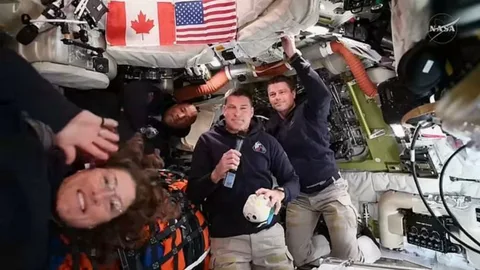
The Artemis moon mission 2026 has delivered one of humanity’s most emotional and awe-inspiring moments in decades. Canadian Space Agency astronaut Jeremy Hansen, currently aboard NASA’s Orion spacecraft en route to the Moon, described his experience during the Artemis 2 launch date and beyond as nothing short of “phenomenal.” Speaking from deep space in a live video call, Hansen said the journey felt like he was “falling out of the sky” a raw, visceral description that captures the sheer drama of humanity’s return to lunar exploration. With Artemis moon pictures now beaming back to Earth and the crew already past the halfway point between our planet and the Moon, the world is watching with held breath.
Background: Humanity’s Long Road Back to the Moon
It has been more than half a century since human beings last ventured beyond low Earth orbit. Apollo 17, launched on December 7, 1972, was the last time astronauts traveled toward the Moon. In 2026, Artemis II sent four astronauts on a lunar flyby, returning humans to deep space and the lunar neighborhood for the first time since Apollo 17.The Artemis program, NASA’s flagship lunar exploration initiative, is designed not simply to repeat the historic flags-and-footprints missions of the Apollo era, but to establish a lasting human presence on and around the Moon. The Artemis moon mission 2026 represents the critical first crewed step in that ambitious journey.
Artemis II is crewed by four astronauts: commander Reid Wiseman, pilot Victor Glover, and mission specialist Christina Koch, all from NASA, along with mission specialist Jeremy Hansen from the Canadian Space Agency.Together, they represent a crew of historic firsts. With Glover, Koch and Hansen aboard, the journey represents the first time a Black astronaut, a woman astronaut, and a non-American astronaut, respectively, have ventured this far from Earth.
Details: The Artemis 2 Launch Date and What Happened Next
The Artemis II crew launched aboard the Orion spacecraft on the Space Launch System rocket from Kennedy Space Center in Florida at 6:35 pm ET.The Artemis 2 launch date April 1, 2026 will go down in history as the day humanity looked up again and aimed for the stars.
The quiet Florida evening was no match for the 8.8 million lb. of thrust that erupted from the base of NASA’s Space Launch System moon rocket. Its engines lit on pad 39B at NASA’s Kennedy Space Center, as onlookers on the grounds and up and down the Florida space coast whooped and cheered.
The path to the Artemis 2 launch date was not without difficulty. The mission faced multiple delays originally targeting November 2024, then September 2025, then early 2026. A hydrogen leak during a wet dress rehearsal in February pushed the launch further to April. But when it finally lifted off, the wait proved worth every moment.
After staying in Earth’s orbit for about 25 hours, NASA confirmed that all Orion critical systems were in order and that Artemis II could continue its trajectory.The spacecraft then performed a crucial translunar injection burn, sending the crew on their way to the Moon.
By Saturday, April 4, the four Artemis astronauts had passed the halfway point between Earth and the Moon — more than 150,000 miles (241,000 kilometers) from home as they zipped toward the first crewed lunar flyby in more than half a century.
Artemis moon pictures captured from within the Orion capsule have given the world breathtaking glimpses of Earth from the vast distances of deep space. An image taken from video provided by NASA shows the Earth from NASA’s Orion spacecraft as it fired its engines heading toward the Moon.These Artemis moon pictures have quickly become among the most shared images of 2026, evoking memories of the iconic “Earthrise” photograph from Apollo 8.
Quotes: Astronaut Hansen Speaks from Deep Space
Perhaps nothing captures the spirit of the Artemis moon mission 2026 better than Jeremy Hansen’s own words. In a live video call hosted by the Canadian Space Agency, Hansen did not speak in the measured, technical language one might expect from a career military pilot. He spoke like a human being overwhelmed by wonder.
Hansen described the translunar injection burn a maneuver that brought Orion within 200 kilometers of Earth before swinging around onto a new course for the Moon. “It just felt like we were falling out of the sky back to Earth, and I said to Reid, ‘It feels like we’re gonna hit it,'” Hansen said. “It’s amazing that we’re actually gonna go around and miss this thing. It was just so close and so to take all of that in was really phenomenal.
On witnessing Earth from a distance no Canadian had ever seen it from before, Hansen said, “By the time we had a bit of a nap and got up, the Earth was just so far away.”When asked what the most shocking thing about his journey was so far, Hansen responded by saying, “Riding the rocket for us has just been extraordinary, and we have all these simulations, but it felt so different for us in real life.” He continued by saying, “the views of the Earth and the crescent Earth is really incredible.”
“Humanity has once again shown what we are capable of, and it’s your hopes for the future that carry us now on this journey around the moon,” Hansen told mission control some 10 minutes after the thruster firing, calling the view “phenomenal.”
Commander Reid Wiseman added his voice to the sense of historic occasion, and Hansen broadcast a message just before liftoff: “We are going for all humanity.””Artemis II is a historic moment for Canada a mission that showcases our national pride and leadership in space innovation,”said a statement from the Canadian government.
On advice for children watching from home, Hansen urged youngsters to “follow your passions, but also share your passions with other people.” “To get big things done like we’re doing in this capsule, to travel to the moon, to fly around the moon, you need a big team behind you.”
Impact: What the Artemis Moon Mission 2026 Means for the World
The significance of the Artemis moon mission 2026 extends far beyond four astronauts in a capsule. This is a geopolitical, scientific, and deeply human moment.
Very much like the Apollo program, Artemis finds itself in a closely watched moon race — not with the old Soviet Union this time, but with China, which has announced its intention to have astronauts on the moon by 2030The Artemis 2 launch date therefore carries the weight of international competition and the question of who will define the next era of lunar presence.
While Apollo was an entirely American enterprise, Artemis flies under the flag of 60 countries, signatories to the Artemis Accords, an international pact whose members vow to support the peaceful exploration of space and contribute money, modules, and astronauts to the Artemis cause.That collaborative spirit is itself historic.
Scientifically, the mission is doing real work. Artemis II will not just be a test of the spacecraft and flight protocols, it will also do hard science.The crew has ten lunar science objectives, using their unique vantage point to study the Moon’s surface in ways that will guide future landing site selection.
During the closest approach to the heavily cratered lunar surface, the astronauts will capture images and describe what they see to teams in mission control on Earth. The features the astronauts observe could help inform the landing sites for future Artemis missions and reveal more about the Moon’s mysterious past.Artemis moon pictures taken during this phase will be among the most scientifically valuable images collected in modern space exploration.
For Canada specifically, the moment is profound. Canadian Space Agency astronaut Jeremy Hansen will make history as the first Canadian to go on a mission around the Moon.The entire country has rallied around this mission, with watch parties, commemorative coins, and a national pride not seen since the country’s greatest moments of achievement.
Conclusion: The Road Ahead Artemis Moon Mission 2026 and Beyond
The Artemis moon mission 2026 is not an end point it is the opening chapter of a generation-defining story. Its farthest distance from Earth is expected to be 252,799 miles (406,841 km).The crew will fly around the far side of the Moon before using lunar gravity to slingshot back toward Earth, splashing down in the Pacific Ocean off the coast of San Diego.
What comes next is even more ambitious. As of April 2026, NASA expects Artemis III to launch in 2027.The Artemis III mission, now in 2027, will be designed to test out systems and operational capabilities in low Earth orbit to prepare for an Artemis IV landing in 2028.Artemis 4 will be the first lunar landing mission in the Artemis programme. Four astronauts will fly to the Moon on board Orion, where they will dock with the Human Landing System. The craft will take two astronauts down to the Moon’s South Pole, a region previously unvisited by humans.
Unlike the Apollo program, Artemis aims not just for the flags-and-footprints model of short stays on the Moon, but for a long-term presence at a lunar base in the south pole, where deposits of ice can provide drinkable water, breathable oxygen, and rocket fuel.Artemis moon pictures will keep arriving. Artemis moon mission 2026 milestones will keep accumulating. And somewhere out there, more than 150,000 miles from home, four astronauts including one Canadian who once saw a photograph of Neil Armstrong on the Moon as a child and decided to aim for the stars are living proof that the dream is very much alive.
As Hansen himself put it, looking back at a crescent Earth from the darkness of deep space: it was just so phenomenal.
Frequently Asked Questions (FAQs)
Who was the astronaut who floated away?
There has been no report of any astronaut “floating away” during the Artemis II mission. All four crew members Reid Wiseman, Victor Glover, Christina Koch, and Jeremy Hansen remain safely aboard the Orion spacecraft. The question may refer to historical incidents from earlier space programs or confusion with fictional accounts. NASA has strict protocols to prevent such occurrences, including tethers during spacewalks. There are no EVAs (spacewalks) planned for the Artemis II mission.
How do female astronauts urinate in space?
Female astronauts use specially designed space toilet systems aboard spacecraft. On the Orion capsule used in the Artemis moon mission 2026, NASA developed an improved waste collection system that accommodates both male and female crew members in microgravity. These systems use airflow rather than gravity to direct waste, and astronauts can use the toilet in a similar seated position to Earth. During launch and landing phases, crew members may wear absorbent garments as a precaution. NASA invested significant effort in improving these systems specifically to accommodate women for long-duration deep space missions like the Artemis moon mission 2026.
Will Artemis 2 be visible from Earth?
The Artemis II rocket launch on April 1, 2026 was visible to observers along the Florida Space Coast and beyond, as the Space Launch System is one of the most powerful rockets ever built. However, once the Orion spacecraft is in deep space en route to the Moon, it is far too small and distant to be seen with the naked eye. You can follow the mission via NASA’s live coverage, which regularly shows Artemis moon pictures and spacecraft camera feeds. The splashdown in the Pacific Ocean off San Diego will also be televised live, offering another opportunity to witness the mission firsthand.