
Arooj Aftab Sweet Dreams Urdu has arrived — and it is exactly the kind of musical collision that stops you mid-scroll and demands your full attention.
The soundtrack for Riz Ahmed’s new Prime Video series Bait features a mesmerising Urdu version of the Eurythmics classic Sweet Dreams Are Made of This by Anish Kumar featuring Arooj Aftab.
The Arooj Aftab Sweet Dreams Urdu recording is part of a six-track soundtrack EP now available on Amazon Music and all major streaming platforms — and it may be the most unexpected and rewarding three and a half minutes of music released this month.
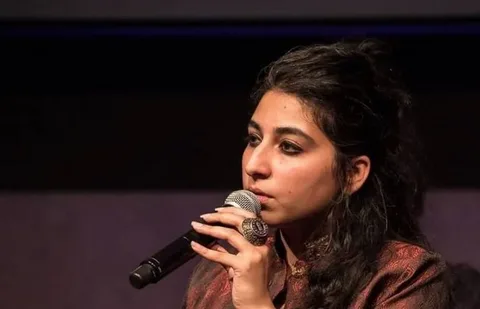
Background
Arooj Aftab Sweet Dreams Urdu — How This Version Came to Exist
The Arooj Aftab Sweet Dreams Urdu cover was created specifically for Bait — a new Prime Video comedy series created by and starring Academy Award and Emmy winner Riz Ahmed.
Bait is a six-part series that follows a struggling actor over the course of four wild days as his life spirals out of control when he gets the chance to hit it big through the audition of a lifetime. The series stars Riz Ahmed himself alongside Guz Khan, Sheeba Chaddha, Sajid Hasan, Ritu Arya, Weruche Opia, and Aasiya Shah.
The soundtrack EP that contains the Arooj Aftab Sweet Dreams Urdu track was produced by South Asian music innovator Anish Kumar — a DJ and producer described as hotly tipped — who brought Aftab in as a featured vocalist on what is undoubtedly the centrepiece recording of the entire release.
The full soundtrack EP features songs by Jorja Smith, Jay Sean featuring Véyah, MC Shabba D, and Anish Kumar alongside Arooj Aftab — a remarkable assembly of South Asian and British musical talent gathered under the banner of one of the most anticipated British-Asian comedy projects of the year.
The Arooj Aftab Sweet Dreams Urdu contribution follows Aftab’s continued involvement in cross-genre and cross-cultural musical projects. In 2026, Aftab contributed a track to the compilation album Help 2 in support of War Child to raise funds for humanitarian and medical aid efforts in war-torn territories.The Bait soundtrack adds another dimension to a year in which she has been everywhere and doing everything.
Details
Arooj Aftab Sweet Dreams Urdu — Why This Cover Works
The original Sweet Dreams Are Made of This by the Eurythmics was released in 1983 and remains one of the most recognisable synthesiser-driven pop songs ever recorded. Annie Lennox’s icy, declarative delivery — haunting, detached, ironic — is as much a part of the track’s identity as Dave Stewart’s signature riff.
What makes the Arooj Aftab Sweet Dreams Urdu version so striking is that it takes exactly none of that approach. Aftab does not replicate the original. She dissolves it — and reconstructs it entirely through her own musical language.
Aftab’s voice is described as an alchemy of displacement, reinvention, exile, chaos, feminism and the maddening fabric of love and loss and tragedy in the world. The calm in her vocal delivery is not comfort or consent but a persistent and expectant intensity that sears the text to countless lifetimes in as many lands.
Delivered in Urdu — the language she has spent her entire career demonstrating can hold everything from classical ghazal to jazz improvisation to ambient electronica — the Arooj Aftab Sweet Dreams Urdu version transforms a 1983 pop anthem into something that feels ancient and entirely new at the same time. The lyrics Lennox wrote about travel, disillusionment, and the search for purpose translate with unexpected elegance into Urdu’s poetic registers — a language built for longing.
Aftab possesses a warm alto that lends itself well to slow-burning ballads. She is inspired by jazz legends like Ella Fitzgerald and Billie Holiday, and her voice carries the rich depth and radiant clarity that has made her one of the most distinctive vocal presences in contemporary global music.
Anish Kumar’s production provides the sonic scaffolding — a landscape that honours the electronic DNA of the original while creating space for Aftab’s voice to move through it in a way that feels utterly unforced.
The Bait Soundtrack — Full Context
The Arooj Aftab Sweet Dreams Urdu track sits within a broader soundtrack vision that reflects Riz Ahmed’s ambition to centre South Asian creative talent in a mainstream British-Asian project.
The soundtrack boasts a stellar cast of talent including hotly tipped DJ and producer Anish Kumar, Grammy-winning composer, singer and producer Arooj Aftab, jungle and DnB legend MC Shabba D, iconic electronic music duo Original Unknown, BRIT and MOBO winning producer Amir Amor, and vocal powerhouse Véyah.
A full soundtrack album featuring more music from the series will follow the initial six-track EP — meaning the Arooj Aftab Sweet Dreams Urdu recording is the first taste of a considerably larger musical project.
Who Is Arooj Aftab
For those encountering Arooj Aftab for the first time through the Arooj Aftab Sweet Dreams Urdu version, the biography behind the voice makes the cover make complete sense.
Arooj Aftab is a Pakistani singer, composer, and producer who won the Best Global Music Performance award for her song Mohabbat at the 64th Annual Grammy Awards, becoming the first-ever Pakistani artist to win a Grammy Award. She was also nominated for Best New Artist at the same ceremony.
Aftab spent her adolescent years in Lahore, Pakistan. Her viral cover of Leonard Cohen’s Hallelujah at age eighteen aided in her passage to study jazz at Berklee College of Music in Boston, while Brooklyn, New York would be her next and most fertile workshop for the creation of her world-building music.
Releasing her debut album Bird Under Water in 2014, Aftab fused atmospheric acoustic jazz instrumentation with the centuries-old tradition of qawwali music she had listened to as a teenager. Her 2018 follow-up Siren Islands experimented with modular synthesisers to create an ambient soundscape punctuated by Urdu lyricism.
The arooj aftab mohabbat moment — winning a Grammy for a haunting, minimalist Urdu song about love — was the point at which the world beyond South Asian music circles began to pay attention. Since then, she has released Love in Exile with Vijay Iyer and Shahzad Ismaily, followed by Night Reign — described as a concept album for nocturnal reverie — which has further cemented her status as one of the most distinctive voices operating anywhere in contemporary global music.
The Arooj Aftab Sweet Dreams Urdu cover is a reminder of what happens when an artist of this calibre is given an unexpected source material and the creative freedom to do whatever she wants with it.
Arooj Aftab Relationship and Personal Life
Arooj Aftab relationship and personal life details are almost entirely absent from public record — and deliberately so.
Arooj Aftab is known for keeping her personal life relatively private. While she frequently shares insights into her creative process and musical inspirations, she rarely discusses her relationships or personal affairs in public interviews. Her focus remains on her artistry, allowing her music to speak for itself.
Questions about the arooj aftab husband search are similarly unanswered by available public record. No verified information about an arooj aftab husband or current partner exists in confirmed public sources. Aftab has never publicly identified a spouse or long-term partner and has consistently redirected interview attention back to her work.
What is publicly known about her personal life is this — she has spoken warmly about her family in Lahore, dedicated her album Vulture Prince to the memory of her younger brother Maher who died before its release, and described Brooklyn as the city that made her the artist she is today.
The arooj aftab relationship to her music is, by her own account, the most consuming relationship of her life. Her voice carries the specific texture of a person who has loved, lost, grieved, and transformed all of it into something that other people can feel.
Quotes
“Walking around on the street, out at night, ideas are coming to us all the time. That’s what it is to be an artist. Your brain is always open and you have to be that way.” — Arooj Aftab, on her creative process in Brooklyn
“My voice is an alchemy of displacement, reinvention, exile, chaos, feminism and the maddening fabric of love and loss and tragedy in the world.” — Arooj Aftab, on what her singing voice carries
“The night is my biggest source of inspiration.” — Arooj Aftab, on the creative wellspring behind Night Reign
“For once I’m not fighting. I’ve already won.” — Arooj Aftab, on arriving at a place of creative confidence
“Transformative may not be an urgent enough word to describe the multi-hyphenate creative Arooj Aftab.” — Shana L. Redmond, music scholar and critic
Impact
For the Bait soundtrack, the Arooj Aftab Sweet Dreams Urdu version provides an immediate signal of creative ambition. A show that opens its musical identity with a Grammy-winning Pakistani-American vocalist reinterpreting one of the 1980s’ most iconic pop songs in Urdu is announcing something specific about the kind of cultural statement it intends to make.
For Arooj Aftab’s career, the Arooj Aftab Sweet Dreams Urdu cover reaches an audience that her studio albums — however critically celebrated — have not always found. A soundtrack attached to a Riz Ahmed Prime Video series reaches millions of listeners who would never have searched for arooj aftab mohabbat on their own. For many of them, this three and a half minute Urdu cover will be the beginning of a much longer musical relationship.
For Urdu music’s global reach, the Arooj Aftab Sweet Dreams Urdu version is another brick in a wall being built one extraordinary recording at a time. Each time a voice like Aftab’s takes a globally recognised piece of music and delivers it in Urdu — not as novelty but as the natural and most powerful available mode of expression — the language reaches someone new.
FAQs
How did Arooj Aftab get started in music?
Aftab started creating her own melodies at the age of nine. Growing up in Lahore after her family returned from Saudi Arabia, she taught herself to play guitar because her parents were worried that formal lessons would affect her studies.Her viral cover of Leonard Cohen’s Hallelujah at age eighteen aided in her passage to study at Berklee College of Music in Boston, where she earned a degree in music production and engineering.She moved to New York in 2010 and began building the career that would eventually produce the arooj aftab mohabbat Grammy win and, most recently, the Arooj Aftab Sweet Dreams Urdu version for Bait.
What instruments does Arooj Aftab play?
Aftab taught herself to play guitar as a child in Lahore.Her compositions involve many musicians and instruments including piano, harp, strings, brass, guitar, synthesizer, and percussion.As a producer and composer as well as a vocalist, Aftab works extensively with synthesisers and electronic production tools — skills she developed at Berklee and refined across six studio albums. The Arooj Aftab Sweet Dreams Urdu version showcases her ability to inhabit a production built around synthesiser-driven electronica with complete naturalness, a testament to her production fluency as much as her vocal gift.
Where does Arooj Aftab live now?
Since her graduation from Berklee College of Music in 2010, Aftab has lived in New York, being part of the city’s jazz and new music scene. On any given night in Brooklyn, you might find her contemplatively walking the streets — a habit she credits as a central part of her creative process, saying that walking around at night is where the ideas come.Brooklyn remains the home base from which she tours globally, records, produces, and creates the work that includes the Arooj Aftab Sweet Dreams Urdu version currently capturing attention worldwide.
Conclusion
The Arooj Aftab Sweet Dreams Urdu cover is three and a half minutes long. It takes a song most people think they know completely and makes it feel like something they have never heard before.
That is the specific gift Arooj Aftab has been exercising for over a decade — taking forms that seem fixed and finding the living, breathing thing inside them that Urdu, and her voice, can unlock.
She eludes categorical capture through an expansive repertoire of study, moving with cunning intention through and alongside jazz, South Asian classical music, pop, and blues. With and from these living, mercurial forms Aftab labours in design of something she adoringly refers to as global soul.
The arooj aftab mohabbat Grammy proved the world was ready to listen. The arooj aftab relationship with Urdu poetry and Western musical forms has never been more fluent or more daring. And the Arooj Aftab Sweet Dreams Urdu version — made for a British-Asian comedy series on Prime Video — is the latest proof that the best music arrives from exactly where you least expect it.