Historic Trilateral Talks Address Ukraine, Nuclear Security and Global Stability Amid Continuing International Tensions
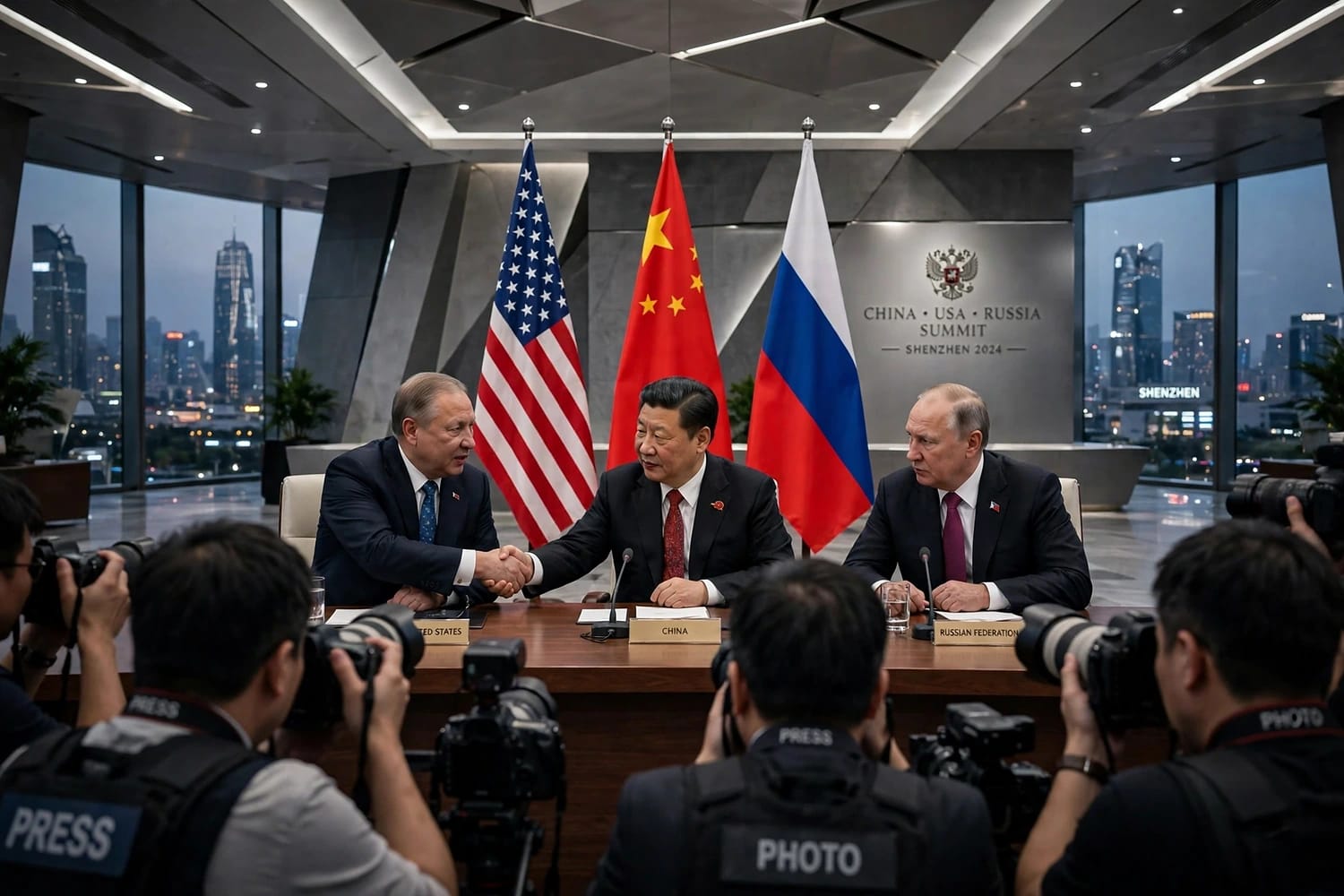
SHENZHEN, CHINA: US President Donald Trump, Chinese President Xi Jinping and Russian President Vladimir Putin held an unprecedented trilateral meeting in Shenzhen on November 19, bringing together the leaders of three major global powers for discussions on international security, nuclear risks, trade and the war in Ukraine.
The meeting, held on the sidelines of the Asia-Pacific Economic Cooperation (APEC) summit, lasted approximately 80 to 90 minutes and attracted international attention. Although the leaders described the gathering as historic, their discussions did not produce major breakthroughs on several pressing international disputes.
Trump described Xi and Putin as his friends and said the three countries had an important responsibility to maintain global stability and prevent major-power conflicts. He also presented the meeting as a significant diplomatic development.
Each leader entered the meeting with different diplomatic and strategic priorities.
Putin’s participation provided an opportunity to engage directly with the US president and Chinese leadership amid continuing international tensions over Russia’s war in Ukraine.
Xi sought to demonstrate China’s growing diplomatic influence and its role in facilitating dialogue among major powers.
For Trump, the meeting offered an opportunity to demonstrate his administration’s willingness to engage directly with Moscow and Beijing on issues affecting international security.
The three leaders emphasized the importance of dialogue, cooperation and their shared responsibility for maintaining international peace.
Despite the positive public statements, several fundamental disagreements remained unresolved.
Russia’s war in Ukraine continued to dominate discussions, while Washington and Beijing remained divided over trade, advanced technology, semiconductor exports and artificial intelligence.
Nuclear arms control also presented a major challenge. The United States and Russia possess substantially larger nuclear arsenals than China, while Beijing has remained reluctant to participate in traditional arms-control negotiations on the same terms.
The leaders nevertheless supported continued dialogue on reducing nuclear risks and preventing the spread of nuclear weapons.
The summit produced a four-point joint declaration covering United Nations reform, energy cooperation, nuclear security and concerns regarding the jurisdiction of the International Criminal Court.
The declaration also emphasized the principle that a nuclear war cannot be won and must never be fought.
However, the agreement did not resolve the central disputes surrounding Ukraine, nuclear arms reductions or US-China technological competition.
The meeting highlighted the growing importance of direct engagement between major-power leaders at a time when international institutions face difficulties in addressing complex geopolitical conflicts.
The Shenzhen summit demonstrated how personal relationships between world leaders can create opportunities for diplomatic engagement, particularly when traditional negotiations encounter obstacles.
However, friendly exchanges and historic photographs do not necessarily translate into lasting political agreements.
With the Ukraine conflict continuing, nuclear arms negotiations facing significant obstacles and US-China competition intensifying, the three leaders still have major differences to overcome.
The summit opened another channel of communication among Washington, Beijing and Moscow, but whether personal diplomacy can produce lasting solutions remains uncertain.
For now, the historic gathering has created an important diplomatic moment without resolving the major international challenges that brought the three leaders together.