Lawrence of Arabia
The Authentic, Fact-Checked Story of T. E. Lawrence
Important Clarification
Thomas Edward Lawrence (1888–1935), known worldwide as “Lawrence of Arabia”, did not destroy or divide India. India was partitioned in 1947, twelve years after his death. His wartime work took place in the Middle East, during the Arab Revolt against the Ottoman Empire in the First World War.
He was not the sole destroyer of the Ottoman Empire either. Its collapse had many causes: Britain, France, Russia, the Arab forces, and the empire’s own internal weaknesses. Lawrence was one important British officer in one theatre of that war.
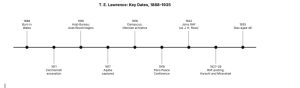
Figure 1: Key events in the life of T. E. Lawrence, 1888–1935.
Early Life and Education
Lawrence was born on 16 August 1888 in Tremadog, Wales. He studied history at Jesus College, Oxford, and graduated with first-class honours in 1910. His thesis was on Crusader castles, and he travelled through Syria on foot to study them.
From 1911 to 1914 he worked as an archaeological assistant at Carchemish, on the Syrian–Turkish border. There he learned Arabic and gained first-hand experience of local society. In early 1914 he also helped to survey the Wilderness of Zin in southern Palestine.
Intelligence Work in Cairo
When the First World War began, Lawrence was commissioned and sent to Cairo, where he worked in military intelligence, mainly on maps. In 1916 he became associated with the Arab Bureau, a British body that gathered and analysed intelligence about the Middle East. Describing him only as a “spy” is misleading, because his work also involved mapping, analysis, liaison and advising.
The Arab Revolt
The Arab Revolt began in June 1916 under Sharif Hussein of Mecca, and his sons Faisal, Abdullah, Ali and Zeid played major roles in it. The tribes and officers who fought were not created by Lawrence. In October 1916 he travelled to the Hejaz, met Faisal, and became a British liaison officer with the Arab forces.
Lawrence advised on guerrilla strategy and helped to coordinate British money, weapons and supplies. He adopted Arab dress, which helped him to work closely with Faisal’s forces.
The Hejaz Railway
The Hejaz Railway was the Ottomans’ main supply line in Arabia. Arab irregulars, with British advisers including Lawrence, repeatedly cut the track and attacked trains. These raids forced the Ottomans to keep large garrisons in the region instead of using them elsewhere.
The Capture of Aqaba, 1917
On 6 July 1917 Arab forces captured the Red Sea port of Aqaba by attacking it from the landward side. The operation was led by Auda Abu Tayi of the Howeitat tribe and Sharif Nasir. Lawrence took part as a British liaison officer, and the success was a collective Arab achievement.
Afterwards Lawrence crossed the Sinai to Cairo to report the news. Aqaba then became a base through which British supplies reached the Arab forces.
Damascus, 1918
Arab forces advanced north alongside General Allenby’s army, and Damascus fell on 1 October 1918. Lawrence was present, but he was an adviser and liaison officer, not the commander. Historians still debate who entered the city first, and Lawrence’s own account has been questioned on this point.
The Ottoman Empire signed the Armistice of Mudros on 30 October 1918.
Promises and Betrayal
Arab leaders hoped for independence. Between 1915 and 1916 the British High Commissioner in Egypt, Sir Henry McMahon, exchanged letters with Sharif Hussein that encouraged those hopes, although their exact meaning is still disputed.
At the same time Britain and France agreed the secret Sykes–Picot Agreement in 1916, dividing much of the region into spheres of influence. In November 1917 the Balfour Declaration supported a “national home for the Jewish people” in Palestine. Lawrence was not responsible for these policies, and he knew of the secret arrangements during the war. He attended the 1919 Paris Peace Conference as an adviser to Faisal and supported Arab claims, but he could not change the final settlement.
In October 1918 he declined a knighthood (KCB) from King George V. He is widely understood to have done so out of unease over Britain’s treatment of the Arabs, although personal reasons, including his dislike of fame, probably played a part.
Fame and Writing
Lawrence became famous after the American journalist Lowell Thomas toured with a lecture and film about the war in the Middle East. Lawrence’s own memoir, Seven Pillars of Wisdom, was privately printed in 1926 and published publicly in 1935. It is a gripping book, but historians treat it with care because it contains exaggeration and self-dramatisation.
In 1921 he advised Winston Churchill at the Cairo Conference, which helped to set up Faisal as King of Iraq and Abdullah as Emir of Transjordan.
The RAF Years and India
In 1922 Lawrence joined the Royal Air Force under the name John Hume Ross. His identity was discovered and he left in 1923. He then joined the Royal Tank Corps as T. E. Shaw, and he rejoined the RAF in 1925. In 1927 he changed his name legally to Shaw. His rank was aircraftman, not private.
From January 1927 he was posted to Karachi, and later to Miranshah on the North-West Frontier. In early 1929 he was sent back to England after newspapers speculated about his presence near the Afghan border. This is the genuine connection between Lawrence and British India. It was a minor posting after the war and had nothing to do with the partition of India.
The Kashmiri Wife and “Makki Shah” Stories
There is no reliable historical evidence that Lawrence married a Kashmiri woman or posed as a holy man called Makki Shah. These stories are best described as unverified folklore. Official records confirm his RAF service in Karachi and Miranshah, but they do not prove that the legends are false in the sense of a formal investigation. The honest conclusion is that nothing credible supports them.
Death
On 13 May 1935 Lawrence crashed his Brough Superior motorcycle near his cottage, Clouds Hill, in Dorset. He died on 19 May 1935, at the age of 46.
Fact-Check Summary
The table below corrects the main errors in the earlier version of the story.
| Claim in the earlier text | Verdict | Accurate version |
| Lawrence destroyed and divided India | False | Lawrence died in 1935. India was partitioned in 1947. He had no role in it. |
| He was simply a spy | Misleading | He was an archaeologist, intelligence officer, liaison officer, military adviser and writer. |
| He mastered Arabic and tribal customs | Exaggerated | He had a working knowledge of Arabic and Arab society, but he was not a native-level expert. |
| He organised the Arab tribes into a guerrilla force | Exaggerated | The Arab Revolt was led by Sharif Hussein and his sons. Lawrence advised and coordinated British support. |
| He was the master of demolition | Exaggerated | He took part in railway raids, alongside Arab fighters and British specialists such as Major Herbert Garland. |
| Lawrence led the capture of Aqaba | Misleading | Auda Abu Tayi and Sharif Nasir led the operation. Lawrence was a British liaison officer within it. |
| He entered Damascus ahead of the British army | Disputed | Arab forces and Allied troops reached Damascus on 1 October 1918. Who entered first is still debated. |
| He learned of the betrayal in 1919 | Wrong timing | Sykes–Picot dates from 1916. Lawrence knew of the secret arrangements during the war. |
| He enlisted in the RAF as a private | Inaccurate | He joined as an aircraftman, first under the name John Hume Ross, later as T. E. Shaw. |
| He had no connection with India | False | He served with the RAF in Karachi and Miranshah between 1927 and 1929. |
| He married a Kashmiri woman and posed as Makki Shah | Unverified folklore | No reliable historical evidence supports either story. |
Conclusion
Lawrence was a gifted, complicated and controversial figure. He played an important but limited role in the Arab Revolt, and the legend built around him, especially in the 1962 film, overstates his part and overshadows Arab leaders such as Faisal, Auda Abu Tayi and Sharif Nasir. The most reliable picture is of a British adviser who worked closely with Arab forces and later felt bitter about his government’s postwar policies.
Suggested Further Reading
- E. Lawrence, Seven Pillars of Wisdom (read critically).
- Jeremy Wilson, Lawrence of Arabia: The Authorised Biography of T. E. Lawrence (1989).
- Scott Anderson, Lawrence in Arabia: War, Deceit, Imperial Folly and the Making of the Modern Middle East (2013).