The Tomb of Nabi Imran (A.S) in Salalah, Oman
A short guide to the site, its traditions and the claims about its length
By Kainat Rajpute
Introduction
In the centre of Salalah, the main city of Oman’s Dhofar region, stands a small mosque with a green-and-gold minaret. Beside it is a long, narrow hall built around one of the most unusual graves in the world.
Local tradition says the grave belongs to Hazrat Imran (A.S), known in Islamic belief as the father of Hazrat Maryam (peace be upon her) and the grandfather of Prophet Isa (peace be upon him). His family is honoured in the Quran, and the third chapter, Surah Aal-e-Imran, is named after it.
This document explains what the site is, what is claimed about its famous length, and what can and cannot be confirmed.
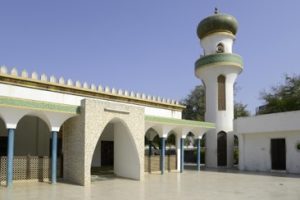
The mosque courtyard and minaret beside the tomb hall.
Who Was Imran?
In Islamic tradition, Imran (A.S) was the father of Maryam and, through her, the grandfather of Isa. The Quran honours his family in Surah Aal-e-Imran, the third chapter, which takes its name from them. The same chapter describes how the wife of Imran (A.S) dedicated the child she was carrying to God’s service.
What the Quran does not do is say where Imran (A.S) was buried. It does not mention Salalah, and it does not point to this grave. Any link between the two comes from later local tradition.
Family Background of Hazrat Imran (A.S)
The Quran says very little about Hazrat Imran (A.S) as an individual. What it makes clear is the standing of his family: verse 3:33 names the family of Imran among those Allah chose above all the worlds. His family is known mainly through three people: his wife, his daughter and his grandson.
Wife. The Quran refers to her as the wife of Imran. It describes how she vowed the child she was carrying to God’s service, and how she named her newborn daughter Maryam (3:35–36). Later Islamic tradition commonly names her Hannah, known as Anne in the Christian tradition. The name comes from tradition rather than from the Quran.
Daughter. Hazrat Maryam (peace be upon her) is called the daughter of Imran in the Quran (66:12). She is the only woman named in the Quran, and one of its chapters carries her name. According to the Quran, Prophet Zakariya (A.S) was entrusted with her care (3:37).
Grandson. Maryam was the mother of Prophet Isa (A.S), who was born by Allah’s command without a father. This is why Hazrat Imran (A.S) is described as the grandfather of Isa.
Further details, such as the names of Hannah’s own parents and wider relatives, appear only in later traditions, and scholars differ on them. This document therefore sticks to what the Quran states. Allah knows best.
Location and Key Facts
| City | Salalah |
| Governorate | Dhofar |
| Country | Sultanate of Oman |
| Site | Tomb of Nabi Imran (A.S) (Umran) |
| Approximate coordinates | 17.02° N, 54.11° E |
| Reported length of the grave | About 12 metres (40 feet) |
The Site
The complex stands behind a wide tiled courtyard. The mosque has white arches resting on slim blue columns, wooden lattice screens, and bands of green and gold mosaic along the roofline. A white minaret with a green tiled dome rises above it and can be seen from the street.
The grave lies inside a long, narrow hall. Reports say it once stood in the open air and that the building was added later to protect it. A railing runs along both sides, and the whole length is draped in cloth: green and red panels in some sections, black fabric embroidered in gold with calligraphy and palm-tree motifs in others. At one end, visitors leave fresh flowers.
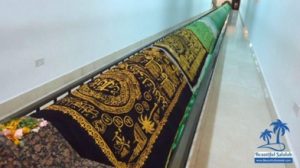
The cloth-covered grave inside the hall.
Outside, a quiet garden with a tall evergreen and a frangipani tree sits next to a covered walkway where people rest in the shade.
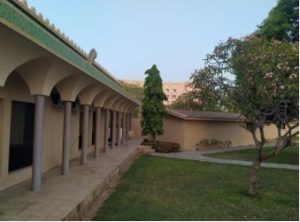
The covered walkway and garden beside the tomb hall.
The Question of Length
The length is the reason most people have heard of this place. Popular posts and videos often say the grave is 30 metres long. Most careful accounts give about 12 metres, or roughly 40 feet, and AFP has examined photographs circulating online alongside the 30-metre claim. Anyone quoting a figure should use 12 metres and call it a reported length, not an exact one.
Several explanations are offered. Some people say Imran (A.S) was an exceptionally tall man. Others say family members were buried alongside him, end to end. Neither has been verified. It also helps to remember that the size of a monument does not tell us the height of the person beneath it, since a marker can be built larger than the grave it covers.
Tradition and Evidence
It is worth being clear about what kind of claim this is. The identification of the grave as that of Imran (A.S) rests on local tradition handed down in Dhofar. No archaeological or historical evidence is widely cited to confirm it, and the Quran does not name this location. That does not make the visit meaningless to those who come to pray, but it does mean the site is best described as the traditional tomb of Nabi Imran (A.S) rather than as established fact. Allah knows best.
Visiting the Tomb
Entry is reported to be free, and the site is in the city centre, close to the Salalah clock tower. Visitors are asked to dress modestly, remove their shoes before entering the hall and keep their voices low. Early morning or late afternoon is more comfortable than midday, when Salalah can be hot. Because people come here to pray, photograph with care and avoid including worshippers in the frame without asking.
Conclusion
The tomb of Nabi Imran (A.S) is a peaceful place with a remarkable feature. Visit it with respect for the tradition behind it, and describe it honestly: a traditional tomb, about 12 metres long by most accounts, whose identity is a matter of local belief.