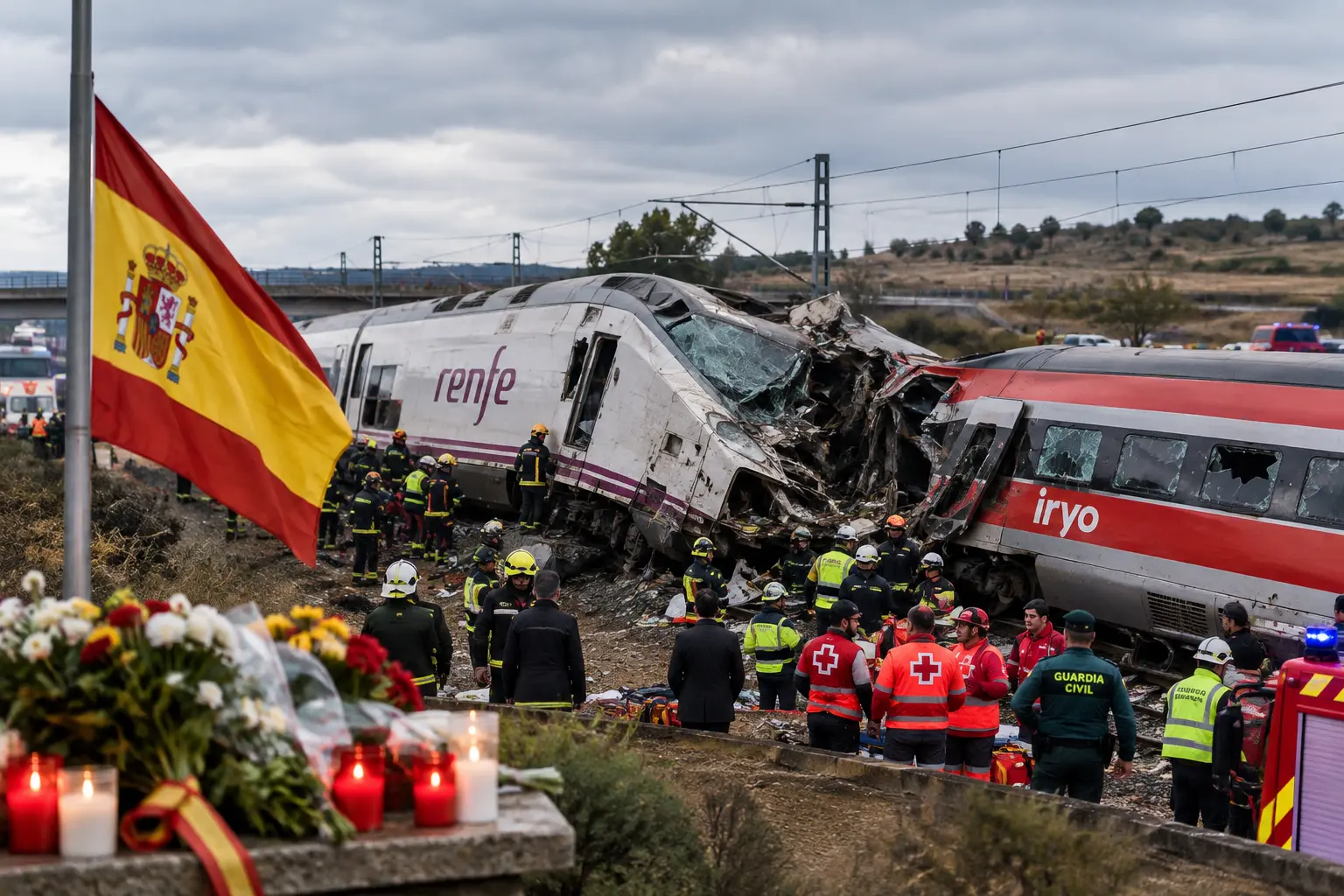
Spain Begins Three Days of Mourning After Deadly Train Crash
Spain has declared three days of national mourning following a devastating train collision south of Madrid that, according to the supplied report, killed at least 68 people and left dozens more injured.
The crash occurred on Wednesday on the busy Madrid-to-Seville railway line, approximately 140 kilometres south of the Spanish capital. The tragedy has prompted a major emergency response and renewed concerns about railway safety.
Two High-Speed Trains Collide South of Madrid
According to the report, a Renfe train travelling at high speed collided with the rear of a stationary Iryo train on the tracks. The impact derailed several carriages, sending some down an embankment and leaving passengers trapped inside damaged compartments.
Nearly 550 people were reportedly travelling on the two trains. Survivors described scenes of confusion and panic as passengers were thrown from their seats, windows shattered and people struggled to escape the wreckage.
Emergency services worked through the night under floodlights, cutting through twisted metal to reach trapped passengers and recover victims. Authorities also faced the difficult task of formally identifying those who died.
Questions Raised Over Railway Operations
The circumstances leading to the collision remain a central focus of the investigation.
The supplied report states that a computer failure automatically halted trains on the affected section of track. It further claims that railway controllers in Madrid instructed the Renfe train to continue at normal speed despite another train remaining stationary ahead.
Spain’s transport minister reportedly described the decision as “inexplicable.” Investigators will need to establish the sequence of events, determine whether safety procedures were followed and identify any technical or human factors that contributed to the disaster.
The allegations concerning the computer failure and instructions given to the train should be treated as preliminary until confirmed by official findings.
Prime Minister Expresses Condolences
Prime Minister Pedro Sánchez visited the area near the crash site and expressed condolences to the victims and their families.
“Lives have been shattered. Families have been torn apart. The pain is immense,” he said, according to the supplied report.
Sánchez announced three days of national mourning. Flags across Spain were lowered to half-mast, while the European Union also lowered its flags in Brussels as a gesture of solidarity with the Spanish people.
The mourning period reflects the scale of the tragedy and the grief experienced by families awaiting news of loved ones.
A Blow to Spain’s Rail Network
The crash has raised concerns about the safety of Spain’s high-speed railway system, which has long been regarded as a major component of the country’s modern transport infrastructure.
The report describes the incident as the second major deadly crash on the same high-speed line this year. That claim, along with the circumstances of the earlier incident, requires independent verification before publication.
As emergency operations continue and investigators work to establish what happened, attention is turning to whether technical safeguards, operational procedures or communication failures played a role.
For families who lost loved ones, the immediate priority remains mourning, identification and answers. For the wider public, the tragedy is a painful reminder of the importance of reliable safety systems and effective oversight across the railway network.
Spain now faces a period of national grief as the investigation seeks to establish how a routine journey ended in disaster.